What's new

Qu. blackbeard algae & CO2 injection

Neonlights

Fish Fanatic
Joined
Dec 6, 2020
Messages
118
Reaction score
47
Points
28
Location
United Kingdom
I currently run my nano tank on two periods of lighting/co2 in a day. I’ve got about 60 bubbles per minute (1 per second) but the indicator liquid is blue (showing not enough). It’s usually green at this rate.

I’ve had a terrible infestation of blackbeard algae for the past 18 months and have tried doing a few days without artificial light, without co2, cut back on feeding/stopped feeding for a couple days, nothing helps.

Would I better doing a solid 6hr co2/lights (staggered) rather than 1x2hr and 1x4hr split?
 
I'm not sure that lighting impact bba; I think it is usually associated with imbalance. 2 of my blackwater aquariums developed massive amount of bba but after a year or so it suddenly died (making a huge mess) but hasn't returned upon death.

I would say that when i ran co2 i was more prone to bba (esp since i did not focus on fertlizing schedule as some of the more dedicated users); also i find soft water more prone to bba then hard water but i'm not sure why.

Until blackwater (i have approx 16 or 17 tanks that are pure ro water); it always took co2 to cause large amounts of bba. In any event i would read up on correct fertilizer dosing with co2 (including micro elements) and see if a more rigorous schedule helps. I did find two fishes that lavish eating bba but neither are going to be suitable for a very small aquarium. One was Siamese algae eaters (sometime mixed up with flying foxes that won't touch the stuff - worse there are three species of closely related fishes sold under the common name Siamese algae eater of which only one lavish bba); the other is panda gara which likes a nice group of 6 or so - so they can spend the day fighting with each other.
 
I'm not sure that lighting impact bba; I think it is usually associated with imbalance. 2 of my blackwater aquariums developed massive amount of bba but after a year or so it suddenly died (making a huge mess) but hasn't returned upon death.

I would say that when i ran co2 i was more prone to bba (esp since i did not focus on fertlizing schedule as some of the more dedicated users); also i find soft water more prone to bba then hard water but i'm not sure why.

Until blackwater (i have approx 16 or 17 tanks that are pure ro water); it always took co2 to cause large amounts of bba. In any event i would read up on correct fertilizer dosing with co2 (including micro elements) and see if a more rigorous schedule helps. I did find two fishes that lavish eating bba but neither are going to be suitable for a very small aquarium. One was Siamese algae eaters (sometime mixed up with flying foxes that won't touch the stuff - worse there are three species of closely related fishes sold under the common name Siamese algae eater of which only one lavish bba); the other is panda gara which likes a nice group of 6 or so - so they can spend the day fighting with each other.
Thanks for sharing your experience. With each water change I fertilize with API’s Leaf Zone and I add Seachem’s Stability. It would be ironic if the CO2 I’m adding to encourage plant growth is just fueling the bba.

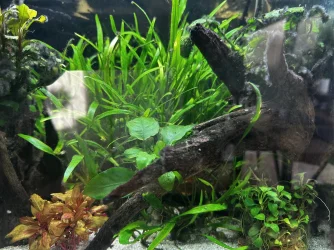
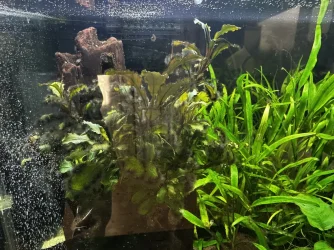
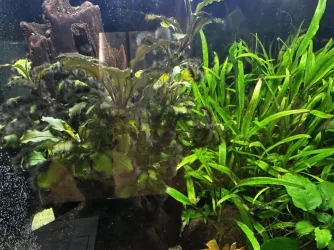
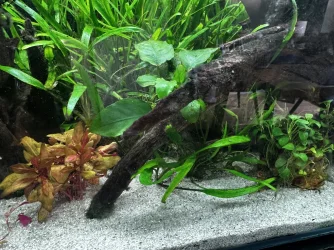
The plants I have aren’t particularly fast growing. I don’t know the species names but I’ll post a photo of the aquarium later.
 
If the plants in question don't need co2 i'd stop using it but again it depends on the species. Of course it will take a year for the aquarium to fall back into balance.
 
I have seen suggestions on here that a single photo period is best, in nature the sun doesn't take a nap part way through the day.
If you have slow growing plants why CO2?
Here is an example of a low light, low tech tank without CO2. I never even fertilised it regularly.
20210216_192746502_ios-jpg.129245
 
Some of the plants are fast growing (I had more but they died off) so it’s probably a split of 70/30 fast to slow growing. Also, I forgot that I’d turned off the early morning light/CO2 cycle a while back. It’s now built around my viewing times of winter (6pm - 10pm light, CO2 starting/ending 1hr earlier). I use to have 8hrs light but reduced it last year hoping to tackle the algae. I’m thinking now I should extende it to 6hrs).
 
Here are shots (excuse the reflections). You’ll see on the left side one plant that has grown pretty quickly but is coated in bba.
 

Attachments

  • IMG_5082.webp
    IMG_5082.webp
    325.8 KB · Views: 84
  • IMG_5083.webp
    IMG_5083.webp
    373.5 KB · Views: 104
  • IMG_5084.webp
    IMG_5084.webp
    300.5 KB · Views: 98
  • IMG_5085.webp
    IMG_5085.webp
    437.1 KB · Views: 105
Do you have hard or soft water? Also the only plant you have that might benefit from co2 is the red clump on the left. The anubias won't really take advantage the the green stuff all are easy to grow plants might grow faster with co2 but it isn't needed and it is easier for things to swim back and forth out of balance with co2 injection - basically as plants use nutrients they will grow fast and when nutrients become less available they will die back. I'm not sure anyone fully understand why bba grows but it seems to be associate with strong imbalance in the chemistry and stressed plants. The co2 has a habbit of stressing plants because of uneven nutrients - it isn't just a question of you have putting in the same amount of fertilizer daily or weekly - it is more of a 24/7 thing.

I used co2 on several aquariums for a few years (3ish) but decided in the end it wasn't worth the head-ache over-all though it did wonders to my ha-ra rotala. I've seen dedicated plant aquariums that do really well with co2 but when things fall apart these hobbist just throw everything away and start over. Having said that they have fantastic looking aquariums it just the behind the scene detials that are missing to get there ;)
 
Also the only plant you have that might benefit from co2 is the red clump on the left. The anubias won't really take advantage the the green stuff all are easy to grow plants might grow faster with co2 but it isn't needed
I agree, I don't see anything in there that needs CO2. The red clump looks like alternanthera rosaefolia, which happens to be what is in the centre of my pic. The fact that mine is not bright red is down to the really dim lighting in this tank (same applies to the ludwigia)
 
Do you have hard or soft water? Also the only plant you have that might benefit from co2 is the red clump on the left. The anubias won't really take advantage the the green stuff all are easy to grow plants might grow faster with co2 but it isn't needed and it is easier for things to swim back and forth out of balance with co2 injection - basically as plants use nutrients they will grow fast and when nutrients become less available they will die back. I'm not sure anyone fully understand why bba grows but it seems to be associate with strong imbalance in the chemistry and stressed plants. The co2 has a habbit of stressing plants because of uneven nutrients - it isn't just a question of you have putting in the same amount of fertilizer daily or weekly - it is more of a 24/7 thing.

I used co2 on several aquariums for a few years (3ish) but decided in the end it wasn't worth the head-ache over-all though it did wonders to my ha-ra rotala. I've seen dedicated plant aquariums that do really well with co2 but when things fall apart these hobbist just throw everything away and start over. Having said that they have fantastic looking aquariums it just the behind the scene detials that are missing to get there ;)

Pretty hard water, GH fluctuates between 11 - 16.

If I want to transition from CO2 to no CO2, do you have any advice?
 
Pretty hard water, GH fluctuates between 11 - 16.

If I want to transition from CO2 to no CO2, do you have any advice?

I'm mostly used to soft water and can't comment on harder water (though if the water has high gh but very low kh that helps softwater plants); transitioning to no co2 - i turned mine off and it really through things out of whack for about a year as the plants adjusted - i believe if you very slowly reduce it it might be smoother - the 2nd aquarium i shut off the co2 when i moved so i effectively started over with that aquarium; and while i kept the plants they were scattered across aquariums so i didn't pay too much attention to individual plants. But the 120 really was a mess when i just shut off co2 for a long time - the problem is the plants grew like this:

120_march_27_2021.webp

(this is 4ftx2ftx2ft aquarium); they could not support their mass without the co2 which caused a huge die back (nothing actually died but it did create a huge algae mess as the algae took advantage of the dying plant matter).
 
For root feeders I use Seachem flourish root tabs - this makes it targeted so is not avaiable in the water column. For the water I use TNC Lite at half the recommended dosage once a week. Typically I do this with a new setup and stop ferts after a few months (but I choose easy plants). For now remove as much of the BBA as you can.
FWIW once you have the balance right BBA can actually live in the tank without getting out of hand. I have some on wood and left it because it looks good, but it never spreads. Unfortunatley there is no magic formula though - it took me many months to get the balance right for my tanks / water parameters.
 
The problem is it’s impossible to remove the bba from plants without tearing leaves and as it’s usually formed either side of the leaf it’s easier to just trim back all the affected leaves.

I’m thinking I could decrease the bba over a couple weeks to nothing, prune the plants worst affected by bba and invest in some new plants to take their place so provide more competition for the nutrients to keep the bba at bay.
 
My 60L became a haven for BBA months back, though my situation was much different from yours. The tank is considered overstocked and doesnt use CO2, yet it was rampant. My remedy? Duckweed & water changes. I still have BBA in the tank, but nothing compared to what it was. It is only present on hardscape and a couple of older leaves on my anubias. Even though some say duckweed shouldn't touch aquariums, I found the larger variety is easy to work with (spirodela polyrrhiza)
 
My 60L became a haven for BBA months back, though my situation was much different from yours. The tank is considered overstocked and doesnt use CO2, yet it was rampant. My remedy? Duckweed & water changes. I still have BBA in the tank, but nothing compared to what it was. It is only present on hardscape and a couple of older leaves on my anubias. Even though some say duckweed shouldn't touch aquariums, I found the larger variety is easy to work with (spirodela polyrrhiza)
Thanks - duckweed, is that the stuff that floats on the surface? If it is, I tried it twice and both times it sunk and disintegrated in days. I turned down the filter outflow, kept surface agitation to a minimum but it just melted.

I also had moss in the tank on the wood and it grew like crazy and looked great but the base of it kept turning brown and dying/floating off of the wood and making a right mess in the tank. Saying that, I never had bba at that time. I did have the candy floss like algae (green hair algae?) though, which was really bad, but then it suddenly cleared up and never returned.
 
Last edited:

Most reactions

Back
Top