What's new

long term use of resin as decoration items for your tank???

Magnum Man21 136

Fish Maniac
Tank of the Month 🏆
Fish of the Month 🌟
Joined
Jun 21, 2023
Messages
7,539
Reaction score
6,764
Points
113
Location
Southern MN
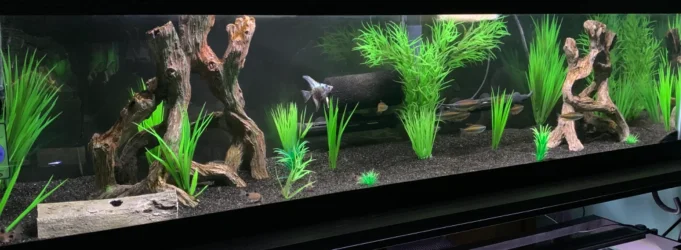
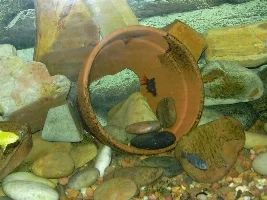
I started using resin items in aquariums several years ago, my experience has been positive… I was always concerned with leaching from the plastics or coloring agents, but with normal water changes, at least in a couple years of use I’ve never witnessed any issues ( I always wash the items before adding them to a tank, to remove any mold release agents or other materials from the items ) when restarting my tanks , about 4 years ago, I added 2 very large pieces of real drift wood to my tanks, and they seem to have shrunk over the years, either leaching into the water, or from the fish actually eating them over time, in grazing, my resin hollow logs look the same over the years, and are now larger in comparison to the natural wood, the resin gets bio film, that the fish still graze on, and if anything over the years look more natural… I have several resin hollow logs, several resin stump shaped pots for plants, and 2 huge resin pagodas, that are in my Asian themed tank… thoughts on using resin items, and if you had any problems with any you’ve used???

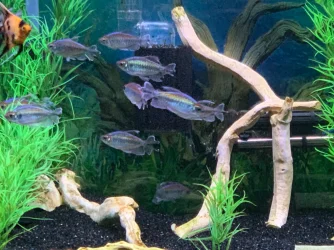
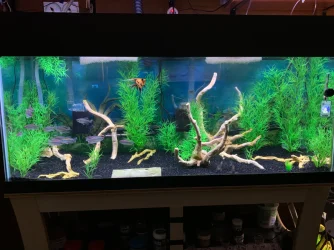
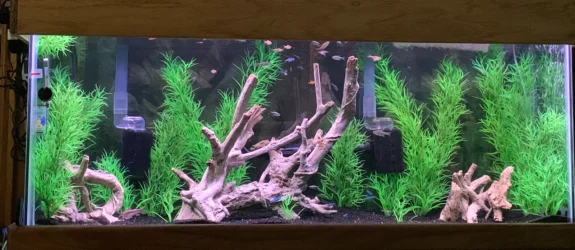
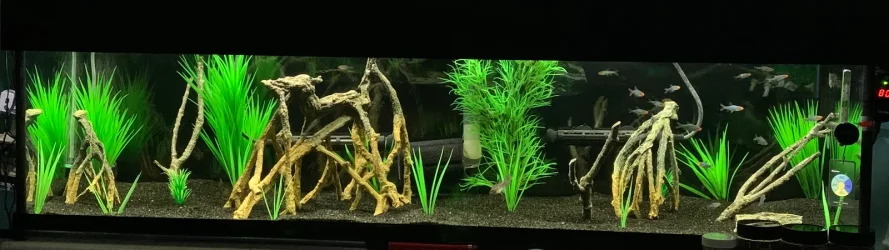
my tanks aren’t cleaned for pictures, but a few examples of items I’ve chosen in trying to keep as natural a look as possible…

2 pagodas, and a resin stump pot, ( my favorite of pot forms ) make a great grow place for algae in my hillstream tank…


IMG_9593.webp


one of my hollow logs, in my tetra tank, next to a natural drift wood that was larger than the resin log, when I added it years ago…

IMG_9594.webp


another large resin pot…

IMG_9368.webp


and a smaller pot… with a tissue culture plant in it…
IMG_9376.webp
 
Last edited:
I, too, have used resin for years without incident or signs of degredation. I periodically clean mine off at WC time and WCs themselves probably would help if such a leaching ever did take place.
IMG_0527.webp
IMG_0521.webp
IMG_0518.webpIMG_0269.webpIMG_9618.webp
 
I pretty much do not use artificial decor. I do have one ceramic log in one tank which anchors an anubias, I have no resin at all. But this is not because I feel artificial is not safe but because I prefer natural.

When I set up my first tank my attitude was different. I used all silk and plastic plants. Within a year I was starting to do live plants and it was mot long before there were no fake plants in my tanks. I did save a few of them as I do use them in a hospital tank when I need one. I believe that sick fish are stressed and proving some cover for them helps to reduce their stress level, In addition I used real rocks as I can easily sterilize them if the patient doesn't make it. The same applies to artificial plants.

I also do not normally cycle an H tank. I want the entire contents of such a tank be bleached at the end of the Hospital stay.

My choice not to use artificial ornaments is personal. I consider live plants to be one of the best filters I can have in tanks. But, when I had over half my tanks for breeding and growing out plecos. I had no live plants, but I did use all real wood and rocks and terracotta or slate caves.

The ceramic log I mentioned above is hollow and has openings to allow water into it.Many years ago I needed to bleach it for algae m=removal. It turned out I did not see the BN pleco hiding inside even though I looked. That was over 22 years ago and I am still haunted by this incident. I sent that poor fish to a very painful death. :sad:
 
Your point regarding plant filtration has merit and I agree. So….being the goon that I am, I put algae scrubbers in all my display tanks to basically accomplish the same thing as having regular plants.
 
I do not understand how pot scrubbers are able to do any of the things which live plants can. Can you please educate me on this?

Live plants make oxygen. Live plants consume nitrates. Live plants use ammonium much faster than the microorganisms use ammonia. Some fish dine on live plants. Some live plants oxygenate the anaerobic areas of the substrate which results in zones of denitrification zones above and below the newly created zones of nitrification which can happen due to the presence of the oxygen being released by the plants. All of these things make a tank more healthy.

I do not understand the biology of how pot scrubbers can be doing any of these things. So I am confused here. As far as I know, the only thing pot scrubbers do is to offer a solid surface to which the microorganisms can attach. But almost any solid surface does this.
 
Not sure what a “pot scrubber” is or what you might mean by it, but live algae does the same as what you referred to as live plants although algae is not in the same phylum as plants. Regarding the removal of things, algae carries out the same functions…..O2 production with NH3, NH4, NO2, NO3, and phosphate removal from the tank water.

Algae scrubbers, of which there are many types, simply grow algae in an enclosed area which one must periodically clean out. I have used 3 of the 6 or so types. The algae utilizes and grows using both NH3 and NH4 (free ammonia and ammonium) to do so along with NO2 (nitrite), phosphates, and NO3 (nitrate) in the tank water. When the growing algae uses these things, they are effectively removed from your water by first, taking the new tissue form of algae and second, when you physically remove the algae from the scrubber growing area.
IMG_2232.webp
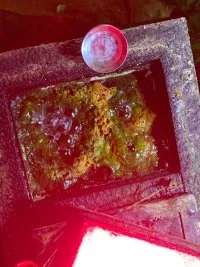
This is a pic with the LED light top removed from a “Surf” floating scrubber showing the area with agal growth. Removing the algae will start the growing part all over again.
IMG_2233.webp
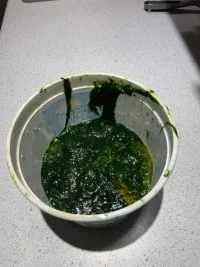
Here, the algae is collected into a cottage cheese container for discarding. Some people feed some of this back to the algae-loving fish as a treat.

I have used this form of water conditioning for many years. I started out doing this in my discus tank days.

One place that makes very good scrubbers is Santa-monica.cc.
These units are not cheap, but cheap is not my goal……quality is. They come super well packed and if you have questions, there is a phone number (1-801-502-3009) which is almost rare these days. They are located in Utah and provide ultra detailed directions for use.
 
I had never heard of algae scrubbers. So I asked Google about them.

AI Overview


Pot scrubbers and algae scrubbers are two entirely different aquarium tools. Pot scrubbers are utilized for biological filtration (housing beneficial bacteria), while algae scrubbers are specialized nutrient export systems designed to remove nitrates and phosphates. [1, 2, 3, 4, 5]
The specific applications and setups for each clarify their distinct roles:

1. Pot Scrubbers (Biological Filtration)
  • What they are: Inexpensive, doughnut-shaped balls of thick, coarse plastic fibers (the same material used in kitchen scouring pads, though made with safe plastics). [1, 2]
  • How they work: They offer immense surface area in a small, lightweight footprint. Placed inside a sump or canister filter, they act as a biological home for beneficial nitrifying bacteria to break down ammonia and nitrites. [1, 2, 3]
  • Pros: Extremely cheap and do not degrade in freshwater or saltwater. [1, 2]
  • Cons: They can trap physical debris and detritus if not used alongside a mechanical pre-filter. [1, 2]

2. Algae Scrubbers (Nutrient Export)
  • What they are: Specialized pieces of filtration equipment (often referred to as Algae Turf Scrubbers or ATS) consisting of a plastic screen over which tank water flows, illuminated by intense grow lights. [1, 2]
  • How they work: By cultivating fast-growing turf or hair algae in an isolated area, they absorb excess nitrates and phosphates directly from the water column. This outcompetes nuisance algae growing in your display tank and improves overall water quality. [1, 2]
  • Pros: Highly aggressive and effective at removing excess nutrients, reducing the need for frequent water changes. [1, 2]
  • Cons: Upfront costs can be high, and they require a dedicated water pump, specific lighting schedules, and bi-weekly to monthly harvesting. [1, 2]
I know the info re pot scrubbers is accurate. Assuming the information about algae scrubbers is correct I notices all the info came from reef sites, So, I went the next step with the AI and asked if algae scruubbers were best use in FW or SW and got this back,

Algae scrubbers are best and most commonly used for saltwater (SW) systems. While they are completely compatible with freshwater (FW) aquariums, they are less popular there because freshwater hobbyists have easier, more efficient natural alternatives.

I am lazy so easier and more efficient appeals to me. The other information which is easy to find is algae does best in lower nutrients than plants will. That is algae will outcompete plants in lower nutrient and CO2 levels than plants.

Also there is this:

Choi O, Das A, Yu CP, Hu Z. Nitrifying bacterial growth inhibition in the presence of algae and cyanobacteria. Biotechnol Bioeng. 2010 Dec 15;107(6):1004-11. doi: 10.1002/bit.22860. PMID: 20632370.

Abstract​


Nitrifying bacteria, cyanobacteria, and algae are important microorganisms in open pond wastewater treatment systems. Nitrification involving the sequential oxidation of ammonia to nitrite and nitrate, mainly due to autotrophic nitrifying bacteria, is essential to biological nitrogen removal in wastewater and global nitrogen cycling. A continuous flow autotrophic bioreactor was initially designed for nitrifying bacterial growth only. In the presence of cyanobacteria and algae, we monitored both the microbial activity by measuring specific oxygen production rate (SOPR) for microalgae and cyanobacteria and specific oxygen uptake rate (SOUR) for nitrifying bacteria. The growth of cyanobacteria and algae inhibited the maximum nitrification rate by a factor of 4 although the ammonium nitrogen fed to the reactor was almost completely removed. Terminal restriction fragment length polymorphism (T-RFLP) analysis indicated that the community structures of nitrifying bacteria remained unchanged, containing the dominant Nitrosospira, Nitrospira, and Nitrobacter species. PCR amplification coupled with cloning and sequencing analysis resulted in identifying Chlorella emersonii and an uncultured cyanobacterium as the dominant species in the autotrophic bioreactor. Notwithstanding their fast growth rate and their toxicity to nitrifiers, microalgae and cyanobacteria were more easily lost in effluent than nitrifying bacteria because of their poor settling characteristics. The microorganisms were able to grow together in the bioreactor with constant individual biomass fractions because of the uncoupled solids retention times for algae/cyanobacteria and nitrifiers. The results indicate that compared to conventional wastewater treatment systems, longer solids retention times (e.g., by a factor of 4) should be considered in phototrophic bioreactors for complete nitrification and nitrogen removal.

Full paper here: https://analyticalsciencejournals.onlinelibrary.wiley.com/doi/10.1002/bit.22860

So I learned something here. I now what what an algae scrubber is and does. However, I will stay with live plants. One reason is that plants reproduce a lot better than the algae. I have a number of tanks filled with live plants yet I have not bought almost any new live plants in over 16 years. I planted new tanks by propagating plants I already had. And then there is the fact that, once a tank gets filled with plants, I prune and sell them. If I am understanding things here, I can grow lots of plants in "lower" light levels but an algae scrubber need high lighting.
 
I notices all the info came from reef sites,
TTA have you never run a saltwater tank? I assumed with your knowledge you'd have been down that road.
Anyway algae scrubbers are practically a requirement for reef tanks since most inverts and corals are sensitive to nitrate levels. On a freshwater tank they allow you to 'be lazy,' if you want to look at it that way, and the light required won't affect your plants. The scrubbers @bgarthe referenced are enclosed, or they can be installed in or plumbed to a sump.
 
That is correct. I currently have one scrubber in a mini sump and the other 5 are corner “drop ins”. Both types run on power for the 3-4 LEDs in each and an air pump. This also allows me to run the lights in any way (duration and intensity) I desire, maintain with no fert. additives, and keeps from introducing live plant hitch hikers to the tank. I was, years ago, a big live plant user.
 
I am sorry for the long post, but I hope it expalins how and why I do things as I do. As always, it I how I do things. It is by no means the only way to do them but I have found it works very well for me. All of us must decide what works best for them as long as our goals are the same- to keep our fish healthy and living longer lives than they might in the wild.

I have never done a SW tank and never will, I hate salt water itself, not the fish etc. but salty water itself. I have not been in the ocean in almost 6o years. I like the shore but I never go to the beach ot into the water. I really dislike the feeling when the water evaporates and the salt remains. I hate the sand getting into everything. But I like the night life on the shore and, having reached the age of being a "dirty old man" I enjoy watching the gals in bikinis. When I was younger I did to ocean and even did some scuba dibing in the Bahamas and in Acapulco Bay. I also gave up hatching BBS as the bubbling jug in which I did it put out a salt water mist which messed up everything around it.

I am also lazy. By this I mean I hate having to do things inefficiently. I am a big believer in two things:

1. Occam's razor is a problem-solving principle stating that when presented with competing explanations for the same phenomenon, you should select the one that requires the fewest assumptions. It is a rule of thumb to "shave away" unnecessary complexities rather than an absolute, unshakeable law.

The Core Idea
Attributed to the 14th-century English philosopher and Franciscan friar William of Ockham (often spelled Ockham), the principle is summarized in Latin as pluralitas non est ponenda sine necessitate, or "plurality should not be posited without necessity".

Put simply: the explanation with the fewest moving parts and untested theories is usually the best starting point.


2. The KISS theory--> Keep it simple, stupid!

As folks here know I am a big fan of Poret foam because of its physical properties. The plecos I have worked with for years when young do not do well with nitrates. However, in my tanks with Poret Matten Filters or multiple Poret cubefilters, I do not worry about nitrates because my media also does denitrification.

The bacteria for doing this are called facultative. They are able to function both aerobically and anaerobically. When the water which reached them has passed though areas of nitrifying bacteria as well as other hetertrophic oxygen using bacteria, what emerges is water with no oxyen but which contains nitrate. Whem that happens thee facultative bacreria cu=hange what they do and they use the nitrate, The result is N gas.

What makes this possible is the structure of the sort of foam engineers to be more righ and more porous and controlled as to the porosity. Consider a sheet of Poret type foam 2 or 3 inches thick and which completely fills a section of a tank from front to back and from the bottom glass the just above the surface of the water. There are an incredible number of pathways water can take to get though the foam.

As the microorganisms create the EPS which coats the pores and inside which the microorganisms live, it is possible that in some number of the potential pathways the nitrifiers will use all the oxygen and will produce nitrate. As the nitrate filled water moves further along it encounters the facultative bacteria which then use that nitrate. And the result is one has the complete nitrogen cycle in their media.

However, it takes more time for the the facultative bacteria to establish and then the time for it all to fall into place. What makes this possible is the massive size of the foam in terms of its internal structure combined with the semi-riigid natur of the foam which ha;d maintain the structure.

Because the amount of media is so massive, it becomes a lot harder for the foam to become clogged and harder to be degraded. I do not squeeze out Portet, I swish it. I will tap a cube filter gently against the sides and bttom of the bucket and swish it. This works well. Here is how Dr. Tanner suggest one clean Poret sheets:

The easiest way to rinse your Poret ® foam sheets is outside in the yard or driveway using a garden hose. Simply bang the sheet flat on the ground several times (Note: I recommend not wearing your best outfit doing this) to shake out the filter sludge, then rinse with the hose. Repeat until the water coming out is relatively clean. Don’t overdo it. Sufficient microorganisms will survive this procedure to quickly re-establish the biology of the filter. It does not matter if you use cold or chlorine-treated water! The often repeated notion that this process would kill all the filter organisms is nonsense, because the residual chlorine concentration in drinking water is too low to kill them all. The microorganisms are quite well-protected in the slime of the biofilm.

When I was first starting to use Poret and a few Matten I asked Dr. Tanner how I would know I needed to clean it. His answer was simple- when the water level behind the sheet was lower than what was on the tank side, it was time to clean it. Unfortunately, with the cubefilters this clue is not possible. When all my foam filters were ATI, I rinsed them weekly. When I changed them to Poret, this became monthly.

I also filled my 3rd canister with all Poret. Again I asked Dr. tanner when to clean it. He said when the return flow to the tank had clearly slowed. I have recently leaned that filter for only the second time in over 10 years. However, I also have to admit that the 75 gal. tank it is on also has an AquaClear 300 gph (70) as well as being heavily planted. It has a single, regular output 4 foot LED type fluorescet style bulb.

One last observation her. Over time what one sees behind a Mattenfilter is best desribed as sedimant- very fine brown stuff. It is not the bacteria but the remains of the mechanical waste that has made the journey through the foam. What it took me some time to learn was that most of what is called mechanical waste is organic. In nature it is degraded by a series over ever smaller organisms which cone parts of it. But the big difference between what happens in nature v.s. intanks is the presence of larger organisms which are consuming and and shrinking the particles. Here is how Dr. Tanner explains things.


Eukaryota: the pore space in soils is full of organisms, some are sizeable such as earthworms and various insects, others are very small such as mites. Fungi are somewhere in the middle, since individual hyphae are tiny (in the micron range), while the whole colony can cover several square miles. Many of these organisms are summarized as detritivores, detritus feeders, or saprophages. They start the decomposition of organics by eating leaves, dead animals, excrements, etc. Their waste in turn is eaten by ever smaller organisms until we reach the true saprotrophs, which digest waste and organic matter by extracellular digestion (fungi but also bacteria and archaea). Saprotrophs release enzymes that break down matter and then absorb its components such as amino- and fatty acids, sugars, etc.


What does that mean for aquarium biofiltration?


Water filtration is teamwork by the members of the substrate microbial community from all domains of life. This is an important conclusion, both for freshwater and marine habitats. The different players form a food web, where most organisms cannot exist alone but are interdependent. The microbial community varies greatly depending on the availability of foods, pore sizes, and substrates.


And all of the above helps with my being "lazy." My filtration takes a lot less time to maintain because if this. It may xost me more up front but in the long run it lasts longer worked better and saves me a lot of time. I do not remember the last time I used a nitrate test kit. I almost never use a nitrite kit either unless I see fish gasping at the surface which is very very rare.

 
I have not been in the ocean in almost 6o years.
I actually get this. In my Navy days we were doing some cold water diving and had a school of bluefin tuna swim through the area. They were in some kind of hurry and you could feel the currents produced as they passed overhead. Most people think of tuna as something tasty to mix with mayo and put on a sandwich, but they are HUGE fish that could easily hurt or kill you if they happened to run into you at speed.
The point being, there's no end to the things in the oceans that could eat us.
 
Pulling it back into the road. I always wondered about the long term leaching of compounds from the resin. I am not a chemist but I have worked with various epoxys and resins over the years and personally I wouldn't put them in contact with water I intended to drink. I tend to not use them in my fish tanks, but they are likely no more polluting of the fish's water than all the plastic and resin in the filter cases, tubes, and hoses.
 
I would think a normal water change schedule would take care of most leaching percentages even in reality, adding lime stone, if neutral water was used for 1/3 to 1/2 weekly water changes I’m sure the calcium would have a hard time getting to had water levels, I said the same thing using lead plant weights, I’m sure the plastics leach at even a lower level… it just reinforces the need for water changes…
 

Most reactions

Back
Top