What's new

Let's speculate with educated (or not) guesses about a problem...

GaryE

Moderator
Staff member
Global Moderator ⚒️
2x Fish of the Month 🌟
Joined
Oct 14, 2011
Messages
11,213
Reaction score
20,338
Points
113
Location
Eastern Canada
Around 2000, I got eggs of Chromaphyosemion biteniatum from Ijebu Ode, Nigeria. It's a famous old colour form. I lost that local variety in 2019, to uneven sex ratios. Soon after, I got the same species, but in the slightly different Lagos form. I still have males, but no more females.
Part of the problem was that if I tried to collect eggs by hand (with killies of this group you can pick them up with wet fingers and incubate them away from predators), touching the eggs would always make them fungus within a few hours. If I left them in planted tanks with the parents, or moved the mops untouched, I got a steady supply of fish, until the sex ratio issue ended the line. Numbers were always small as older siblings (not the parents from what I can see) eat their younger relatives. But a species that lives 3 years, running for 20 plus years isn't bad.

I kept both populations rigidly separate to maintain their pleasing differences.

I figured that I somehow had toxic fingers - maybe an oil on them, or something similar. The egg killing fingers problem happened as I tried to collect eggs periodically over many years. And it was only that killie species, and from both different localities.

Fast forward to my recent trip to Benin, a few weeks ago now. We caught four different localities of biteniatum, and I've kept two here, from different drainages. One pair has grown to breeding size, and 3 days ago, they gave me 7 eggs. I hope this is the start of something good, as I have several younger pairs coming along well in other tanks. When I saw the first egg in its acrylic mop, I decided to pick it by hand. I transferred it to the same incubation water the Nigerian ones had fungused in (the inability to touch eggs had happened over 3 houses with different water). I wanted to see if the eggs would react badly, as I would love to be able to mail eggs of these new locations/possible new colour types to friends.

All 7 eggs now show embryo development, and all didn't fungus. None reacted to my fingers, after close to 20 years of their species reacting badly. Any ideas what that's from????

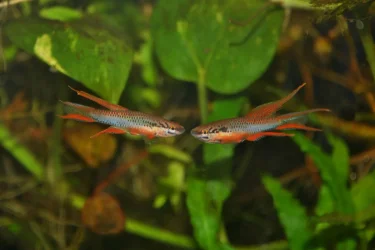
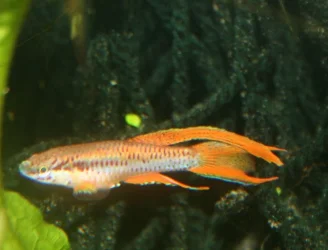
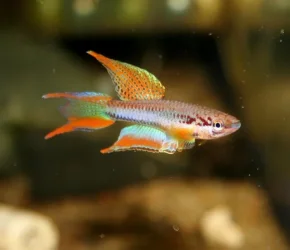
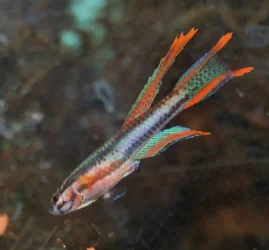
I have no pictures of my barely mature Benin ones, as they aren't developed enough to see much with them. But here are some of the older (wild) types from Lagos and Ijebu Ode, to give an idea of why I bother.
 

Attachments

  • ijebu1a (640x597).webp
    ijebu1a (640x597).webp
    29.8 KB · Views: 106
  • ijebuode faceoff1.webp
    ijebuode faceoff1.webp
    75.7 KB · Views: 109
  • lagos red2 (640x488).webp
    lagos red2 (640x488).webp
    28.4 KB · Views: 67
  • ijebu1 (640x552).webp
    ijebu1 (640x552).webp
    24.9 KB · Views: 67
If fungus happens again, dip finger tips in isopropyl alcohol then dip in distilled water. Then pick up eggs before your finger tips touch anything else. The surgical approach.
 
You say what form it is - well that is the majestic form - as lovely as they come - a true artist. But you only had 7 eggs - is that enough to create a self perpetuating population? As for the eggs and fungus - no clue - i never touch eggs myself i always use tools to move them - usually involve tearing a leaf off a plant.

Actually more seriously are you sure the touch cause the fungus and they didn't fungus simply because they went bad ?
 
I thought of you when Glaser posted this the other day. Yours are better.

And I take issue with the 'community tank' endorsement. But their job is to sell fish...

ijebu ode.png
 
Last edited:
Seven is the first day of eggs from 9 adults. Luckily, I ended up with 3 males and six females from one location (BDEL 26-8), and 1 male and 3 females from the other (BDEL 26-3). We lost all the larger adult fish from location 3 in the brutal heat as we returned to the hotel with its rickety AC. The young ones survived well, but only one male had his fin extensions, and he's the first to fertilize eggs.
I expect to be able to build up a large F-1 group, which should give me eggs to mail out next year, if luck holds.

I'll go with that surgical technique in the future.

I had two populations for 15 to 20 years. If I touched the eggs, every one fungused. If I didn't, I had fry, just not in predictable numbers. So I think my fingers were killing them. It happened over a long period, and repeatedly. My then Chromaphyosemion poliaki could be collected, and I still have lots of C. poliaki, also with eggs I can handle.

The main difference between the two forms was that Ijebu Ode had much more turquoise on the fins, especially the anal fin. Lagos Red had longer fins, but very little colour other than red.

For the Benin fish, BDEL 26-3 showed scarlet spots on the flank. I hope that the male I have grows into that, as now, he's young. It may have been an individual's colour, but in the sunlight, it looked very good. BDEL 26-8, the one I have 3 tanks of, is looking a lot like Ijebu. I can already see blue turquoise. The male fins are looking large with real extensions. There were no large adults left alive in their drying up, shallow, hot habitat.

And with killies, local variation is very possible. They don't vary wildly as individuals, but do regionally.

It's fun to see them develop and not know exactly what I'll see. Killies are fun to breed, but if you can get wilds bred in nature and can grow them out, the mystery is even better. They'll be pretty, but in what ways?
 
Oh well i have no clue - we can speculate it is the oil, pressure or change in temperature from touching it but it would take some eggs and tests to make an educated guess. In truth i find it hard to believe it would be the oil and given the number of times it has happened i doubt it is something you had on your hands unless you use lotion or similar. I will say i very rarely touch my fishes despite joking about petting my chocolates since i worry something innate to my pours will be bad for them - i think i read somewhere the oil we generate is quite toxic to fish and will hurt their slime coating but it could have been my imagination.

I know this isn't related but since i'm watching my aquarium (it is next to my desk) i'm really happy my chocoates aren't eating my herd of serpae.
 
It may be as simple as fingers are penetraing some.outer membrane on the eggs.
If it were me I would go with @anewbie sterile approach, or latex gloves, or use a tool like a slurpee straw.
@GaryE those are stunning fish. Truly beautiful.
 
The question is why that species funguses, and not others. Then, why the ones I had in the past, but not these new arrivals. Curious.

With Chromaphyosemions, eggs are laid daily, in bursts of a couple of weeks with short periods between. Each egg is individually deposited and is slightly adhesive. You can use acrylic mops to collect the eggs. Adults don't seem to eat fry, but they do eat eggs if they can find them.

It's very different from most other egg layers - quite hands on, literally.

You get a hard, sticky egg that you can pick with wet fingers. The only way around picking them (other than a low yield natural set up) is to cut the strand the egg is on, and put it an incubation container. With Epiplatys, Aphyosemion, Chromaphyosemion and most Fundulopanchax, incubation can take 10 days to 3 weeks. The eggs are transparent, and I've filmed red blood cells moving through the heart.

Gloves don't give me the dexterity (I tried) and straws, eye droppers, etc don't easily dislodge them. It's similar with blue eyes, medaka, rainbows, and a few other daily spawning egg layers.

One week old fry can eat newly hatched ones.

If you look at the second shot, you see the eyes staring out of the eggs not long before hatching.
 

Attachments

  • egg.webp
    egg.webp
    228.6 KB · Views: 76
  • eggeyes1.webp
    eggeyes1.webp
    50.4 KB · Views: 53
The question is why that species funguses, and not others. Then, why the ones I had in the past, but not these new arrivals. Curious.
In truth not enough information is provided. It could be a change in your hand chemistry as you aged or the eggs as global warming has impacted some adjustment by species to this or that (where this and that are 100's of speculative parameters). Naturally the real way to do this is reproduce the fungusing and then find someone who can do a proper chemical analysis or find someone with a heck of a lot more experience then most of the forum readers here with that specific species who might have run into the same issue and determined the cause. I would presume some killi club or association might be means to find someone (on line club not physical meeting).

I rarely touch eggs over the years and the ones i have had never had an issue but they have been robust monsters like c. sterbai or angelfishes or other cichild. None of the eggs i've accidently --- oh wait I do know that some eggs are very sensitive to ph for proper development. While some eggs require extremely soft water for the sperm to live long enough to penetrate other eggs a change in ph will kill the developing fry so if your hand changed the ph significantly that might cause an issue.
 
It would be great if we had a Scientific Institute to Help Solve Weird Hobbyist Questions. When I establish my utopia, it's on the list.

I guess something in my biochemistry interacted with something in theirs. Was I toxic? Dang. That may have changed (thanks to the influence of TFF, or possibly medications I now take, changes with age, etc?). Maybe there is no difference in the eggs of these wild caught ones compared to their aquarium cousins, but maybe my biochemistry has changed. I'll never know.

I have discussed this with longtme killie keepers, some of whom have had similar issues.

I promise that once my fish begin to colour up in a way that allows photos to say something, I'll share pictures.
 
I want to know how the heck you manage to pick them up with your fingers in the first place. I have never been able to do that without crushing them or have them squirt off into the water column.
My shot-in-the-dark guess would be micro abrasions from the "pinch," and plain old luck. Or we could blame global warming, that's handy.
There's so many odd ball, one-off type things that happen, no matter the endeavor, you could drive yourself crazy trying to get to the bottom of it. At least in your case you know what not to do.
 
It would be great if we had a Scientific Institute to Help Solve Weird Hobbyist Questions. When I establish my utopia, it's on the list.

I guess something in my biochemistry interacted with something in theirs. Was I toxic? Dang. That may have changed (thanks to the influence of TFF, or possibly medications I now take, changes with age, etc?). Maybe there is no difference in the eggs of these wild caught ones compared to their aquarium cousins, but maybe my biochemistry has changed. I'll never know.

I have discussed this with longtme killie keepers, some of whom have had similar issues.

I promise that once my fish begin to colour up in a way that allows photos to say something, I'll share pictures.
Everyone has a skin biome. Diabetics’ skin biome is influenced by blood sugar levels. Variability in your blood glucose levels may be a factor.
 
Killie eggs? When they are first deposited, they pop. Give them about an hour, and they can be rolled between your fingers (not that I do that!). With all other species of Aphyosemion or Chromaphyosemion, they don't fungus from my fingers. In 30 years, I can't count how many eggs I've picked. It's a mindless relaxing game to play.

I never touch eggs of other fish, with the exception of Pseudomugil blue eyes. I mop spawned Melanotaenia and related fish for years, but didn't touch the very tiny eggs.

Species sensitive micro-abrasions seem likely, though the mystery persists. Now here's a medical thought inspired by @gwand's post. I had suspected for 25 years that my blood sugar was unstable, based on a family history of atypical diabetes. I "passed" all tests until recently, and have been medicated with excellent levels for 3 years now. So that could be the skin biome. I wondered about that but thought I might look foolish if I said it. So we get everyone in the world to keep this species, and if the eggs consistently fungus, we have an early indicator of diabetes. Just mail me the Nobel Prize, which I'll graciously share with @gwand!
 
I have nothing to contribute to cause and effect about breeding. I just want to say a big thank you. For some 50+ yrs I have been looking for this fish I saw as a pic when I was a wee lad. I now know it's name. Woohoo. Sadly I don't keep fish any more.
 

Most reactions

Back
Top