Hello Sp00ky --
No-one really really knows the ancestry of the fancy mollies available to aquarists. Most molly species actually live in freshwaters, not brackish or marine ones, but the domesticated species seem to include genes from the salt-loving species, and they do, as penguinpimp1990 said, do best in brackish water. Provided you have hard (at least 20 degrees GH) water with a high pH (7.5 to 8) you don't, strictly speaking, need salt. But there's no question that mollies do better in water with at least a little salt: they live longer, they don't get fungus, and they don't get fin-rot.
Mollies will thrive in brackish conditions; technically the optimal range is around specific gravity 1.005 to 1.010, or around 8 to 15 grammes of marine salt mix per litre of water. If you're working in US gallons and ounces, you'll need to do the math yourself! But it's quite a lot of salt. Freshwater aquarists always get a surprise when they see how much salt is needed to turn a bucket of water into seawater.
Luckily, marine salt mix is cheap, so don't be frightened off by the cost! By the way, you measure specific gravity, SG, with a hydrometer. Some of these are pricey, but the basic ones (which I use) cost three or four dollars.
However, SG 1.005 is rather higher than most freshwater fish will tolerate. The idea that somehow the salt "burns" fish is not right; as Annastasia pointed out, it's more to do with the kidneys. The more salt you add to the water, the more quickly the water is 'sucked' out of the fish. In effect, freshwater fish in salty water dehydrate (just as we do, if we drink salty water). The fact that catfish lack scales has nothing to do with this; there are in fact many species of marine catfish (go saltwater fishing in Florida and you'll catch lots!).
Brackish water fish (and of course marine fish) have mechanisms to compensate for this. Brackish water fish in particular are able to tweak their physiology to exactly match the ambient salinity, and this is part of the reason why brackish water fish are so astonishingly hardy. Mollies can be adapted to marine conditions in about two hours. They are routinely used to mature marine reef tanks.
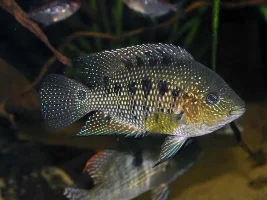
If you are going to add salt to the tank, you need to figure out if your freshwater fish are salt-tolerant ones. Broadly speaking, hardy livebearers, killifish, glassfish, halfbeaks, and cichlids tend to be salt tolerant. Obviously there are exceptions with species adapted to soft water (like angels and rams) or very specific water chemistry values (like mbuna and Lake Taganyika cichlids). But things like kribs, acaras, Central American cichlids, Asian killis, guppies, swordtails, etc., generally all do fine when a little salt is added to the water. I'd recommend an SG of no more than 1.003 though. The reason why these fish are salt tolerant is that their ancestors came from the sea, and so they still have some of the "marine hardware" in their bodies.
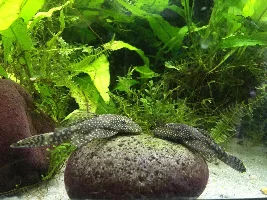
By contrast, tetras, catfish, loaches, 'sharks', barbs, etc., are salt intolerant. Again, there are exceptions, but broadly this is a reliable rule of thumb.
There are also lots of cool fish that
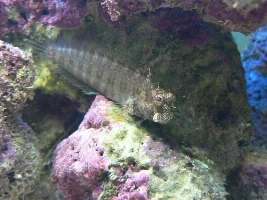
prefer[/b] slightly brackish water: gobies, orange chromides, puffers, and so on. Check out the Brackish section of this Forum for more.
Hope this helps,
Neale
PS. I wrote a little computer program called Brack Calc that helps you convert between "weights" of salt per litre and salinity and specific gravity. It's for Mac and Windows, and is Freeware.