Help ! Emergency Goby Rehoming

There you go Pip

The following is taken from PFK
Freshwater bumblebee goby, Brachygobius xanthomelas

"It's entirely likely that all bumblebee gobies are freshwater fish in the wild. Goby expert Naomi Delventhal has written on this issues extensively, including in my brackish water aquarium book. Frank Schaefer at Aqualog has said much the same thing. So the idea that Brachygobius xanthomelas is unusual in being a "true freshwater" species is likely misleading.

I've kept standard bumblebee gobies in freshwater tanks without problems, and my own specimens currently live in a tank with 50% rainwater, 50% tap water, and are doing just fine. They've been there for years now.

So what's the deal? Why are Brachygobius spp. widely pushed as brackish water fish? In part, they may well do better in brackish water conditions in captivity. As I've mentioned with reference to mollies in this month's PFK (December 2008) marine salt mix buffers pH and detoxifies nitrite and nitrate. These benefits may be the critical issues rather than salinity. Certainly, a wide variety of fish do much better in brackish water in aquaria than they do freshwater conditions, despite the fact they are mostly or even entirely freshwater fish in the wild! Figure-8 puffers, green spotted puffers, Ceylon puffers, knight gobies, orange chromides and of course mollies fall into this category.

In the case of bumblebees, another key issue may be feeding. The vast majority of specimens die within months of purchase because they starve. These fish do not compete well with other fish at feeding time. It is entirely possible that over the years aquarists have assumed their gobies died because of water chemistry issues, without realising that starvation was actually the cause.

In any event, bumblebee gobies are good fish for either freshwater or brackish water tanks, provided you observe their requirements for peaceful tankmates and the right types of food. Bloodworms are a favourite, but live daphnia and brine shrimp also go down well. Shrimp eggs can be scraped off whole North Atlantic prawns through winter and especially spring, and these are greedily devoured! In winter they're in the "head" and in spring underneath the legs. Buy a bunch, eat the prawns yourself, and freeze the eggs for your gobies and indeed any other fussy fish in your tank.

Cheers, Neale"
Posted by: Neale Monks - 3 months, 4 weeks ago
Date: Wednesday December 10th, 2008, 5:06 pm
 
Edit- Darn you Davo, although mine is directed at truckasauras123...

i'll give them a home and keep a close eye on them if i see that they are going down hill at all then i will pass them on to another good home
i would get a small 30 litre (18*10*10) set up with a salinity of 1.003 SG the salt will buffer the hardness giving them what they prefer, please post photos for an ID (as there are a few species).

The book includes words and pictures on at least half a dozen bumblebee goby species. There are actually rather more than that known in the genus Brachygobius, as well as Hypogymnogobius xanthozona. This latter, often called Brachygobius xanthozona by aquarists, is probably (almost certainly) never imported or traded. The commonly traded species (in the UK anyway) are Brachygobius sabanus and Brachygobius doriae.

Since the author is a collector as well as an aquarist, and this is an AquaLog book, I'm fairly happy to assume the names and pictures are correct. AquaLog books tend to have rock-solid systematics, whatever their other flaws.

Some species (e.g., B. doriae) are known to come from very soft, acid waters, and the author says that he has only ever found them in freshwater, not brackish. Though he also says that breeding is easiest (in aquaria, presumably) in brackish water. Mine are Brachygobius doriae I think, and are in slightly acidic, moderately hard water. I've seen one male in breeding colours, but as yet, no sign of fry.

I'm not suggesting that we all keep bumblebees in soft, acid water by the way, but it may be that at least some of our preconceptions are erroneous and worth thinking about. SirMinion's point about the figure-8 is bang on the nail here... while these fish 'should' be freshwater fish, they seem to do best in brackish aquaria. Do bumblebees fall into the same category? Are they freshwater fish that do best in brackish?

There's something like a dozen or so species in the BBG genus, Brachygobius. Telling them apart is, for the most part, impossible for the aquarist because of "species groups" containing several very similar-looking species. Scientists identify them by looking at dead specimens under a microscope, and need to count things like the arrangement of scales on the body. There's absolutely no way on Earth you can do this with a live specimen in a fish tank!

Anyway, the bumblebee gobies usually seen in aquarium shops belong to a complex of closely related species including Brachygobius doriae, B. xanthomelas, and B. sabanus. This Brachygobius doriae-group, as this species group is known, includes species that get to about 1.5 inches in length, which contrasts with the "dwarf" bumblebee goby group.

The dwarf BBG species group, including Brachygobius nunus and Brachygobius mekongensis, are less than half the size of the Brachygobius doriae species group. All this sounds simple enough, but the name Brachygobius nunus has quite commonly been applied to members of the Brachygobius doriae species group. Although the dwarf species aren't commonly traded, they do turn up periodically, but are never identified as such.

Another name that gets misused is Brachygobius xanthozona. This species is in fact extremely rare in the wild and is never, ever traded as an aquarium fish. All photographs of BBGs in aquarium books identified as Brachygobius xanthozona do so in error.

Does any of this matter? All BBGs will do extremely well in low-end brackish water (around SG 1.003-1.005). But many species are also found in freshwater, and all can be kept in freshwater aquaria without problems. Some species are also found in blackwater streams, with an acidic pH and virtually no hardness, where they are found alongside things like rasboras.

In short, BBGs are adaptable. In aquaria, keeping them in brackish water is possibly the ideal simply because the salt helps detoxify nitrite and nitrate. According to Schaefer (in Aqualog) the key advantage is you can fill a brackish water aquarium with live brine shrimp and let the BBGs feed on them all day long. The real problem with BBGs is food. Most specimens die because they starve to death, not because of water chemistry issues. These gobies are very difficult to feed, and when kept in freshwater communities simply don't get enough to eat.

Both from, well, I'm sure you can guess.
 
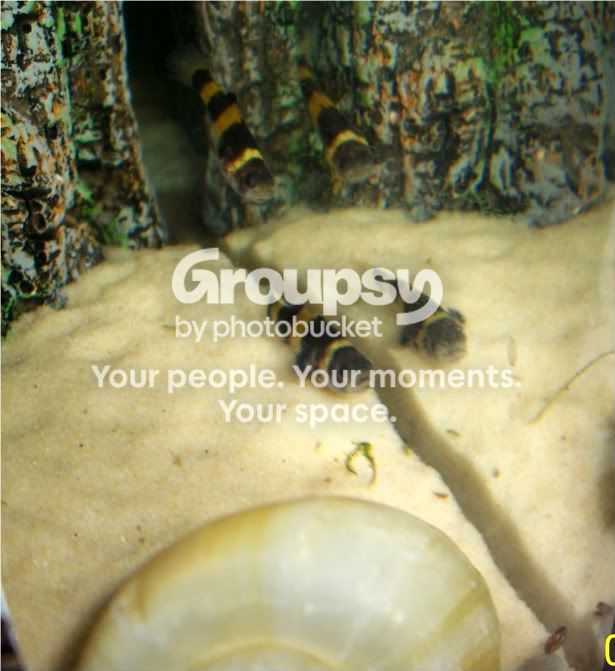
they are fighting over an empty apple snail shell as we speak so i've just thrown in another one at the other end of the tank -

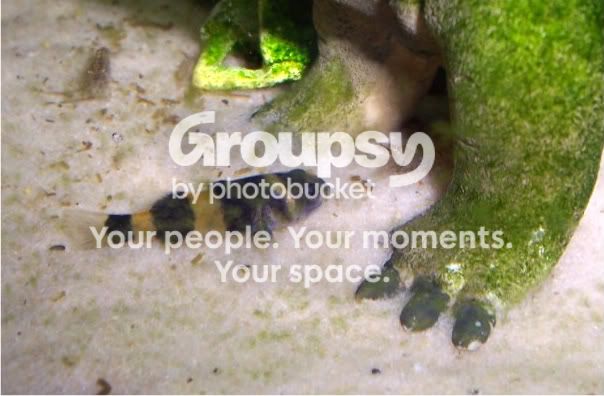
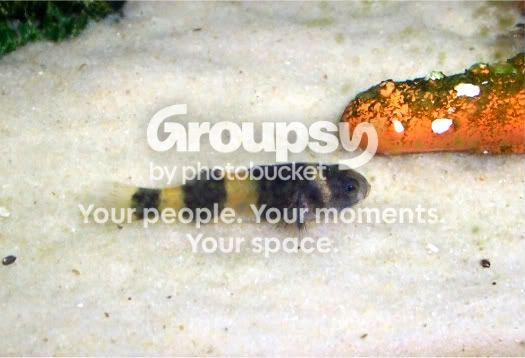
PICS as requested
1056.jpg

1059-1.jpg

1061-1.jpg
 
I hope they are doing well, do they take normal foods.

that last pic had me confused for a second because i thought i saw 4 gobies in there lol :)
 
they are still doing ok today
they have had melted frozen brine shrimp and daphnia
i got a spoon and kept spinning it round in the water so it kept swimming past them and then were munching it like mad
they ate some melted frozen bloodworm aswell :)
 
I'm so glad you were able to keep them and they're doing well, Sarah, clever of you to 'stir' their breakfast to make it move.
It would have been awful if healthy, (cute!) little fish like that had been killed, and now you've got even more cool fish!
 
I'm so glad you were able to keep them and they're doing well, Sarah, clever of you to 'stir' their breakfast to make it move.
It would have been awful if healthy, (cute!) little fish like that had been killed, and now you've got even more cool fish!

How can you see something so helpless being killed for no reason :)
If they have any problems then i will rehome them to a good home but they are eating which is a good sign

take care hun

Sarah x
 

Most reactions

Back
Top