Group order to The Wet Spot

It still amazes me how fish species can look so alike externally but at the cellular level have unique DNA sequences.
And the opposite how things that look totally different externally might be nearly identical at the dna level ;)
 
It still amazes me how fish species can look so alike externally but at the cellular level have unique DNA sequences.
And there are cryptic species. In Carnegiella (hatchets) a cryptic species is widely known to exist in Rio Negro populations of C. marthae. They share the same waters, are indistinguishable, but are reproductively isolated. Stan Weitzman wondered if the same was true for N. beckfordi populations in the Guiana Shield. He noted there was more genetic drift between certain physically identical Guyanese populations than there was between one Guyanese population and the various Amazonian populations a thousand miles away.
 
Vis-a-vis our discussion, just read this on Glaser's daily update--a listing for Chilodus punctatus, the spotted headstander, another Amazonian characin. Sounds familiar.

"Furthermore, C. punctatus, as it is currently defined, looks slightly different depending on its origin— which should come as no surprise to anyone. It is likely that the name "Chilodus punctatus" does not actually refer to a single species with near-universal distribution across tropical South America-it has been reported from Brazil, Bolivia, Ecuador, Guyana, Colombia, Peru, and Suriname-but rather to an entire species complex..."

 
Vis-a-vis our discussion, just read this on Glaser's daily update--a listing for Chilodus punctatus, the spotted headstander, another Amazonian characin. Sounds familiar.

"Furthermore, C. punctatus, as it is currently defined, looks slightly different depending on its origin— which should come as no surprise to anyone. It is likely that the name "Chilodus punctatus" does not actually refer to a single species with near-universal distribution across tropical South America-it has been reported from Brazil, Bolivia, Ecuador, Guyana, Colombia, Peru, and Suriname-but rather to an entire species complex..."
It goes back to the old question when is an lemon an actual lemon. I miss the day when all corys were corys life was simpler and i actually new what i was looking at - now i frequently find that the cory i'm looking at isn't a cory at all but might be an ostrich :(
 
Ah, but the cory you were looking at wasn't just a cory back then. We were just happily wallowing in our ignorance.

In the killie world, this is key stuff. It's all anecdotes, but there was a strain of Aphyosemion australe gold kept in the hobby since the 1930s. When people started collecting new locations of australe in the late 80s, breeders got excited at the new bloodlines. They were concerned the old line was inbred, even though it was recommended as a starter killie because it was so easy to breed. They immediately crossed in new lines, and got - in many cases, mules after a generation.
I had a lot of experience breeding very difficult Aphyosemions, but it took me 5 tries to get common gold australe that would breed. Or rather, ones where the fry would live more than 2 weeks. Others had the same issues, and it appeared that in the maze of new australe introductions there must have been cryptic species, and hobbyist carelessness about keeping lines separate killed them off. They looked like australe...

I got some Enteromius (ex Barbus) jae barbs yesterday, and I don't know what I got. The fish come from lots of disconnected habitats and differ slightly. Are they a complex of species? Most likely - all similar, all unstudied in detail.

The other plot twist for our puny human eyes is some species that can have local populations that look very different, but are the same species. I was with a friend yesterday trying to identify newly imported NIgerian killies, and when you work off photos, yellow, blue and red fish can be the same species if they are in different drainages. None of this was "done" for our eyes as a tool to understand it.

If you want a nice clean world with straight lines and easily understood divisions, hop on a spaceship with Elon Musk and see if it's out there. It isn't here. We're chin deep in astonishing diversity. I love it. This is a great planet to evolve on.
 
Ah, but the cory you were looking at wasn't just a cory back then. We were just happily wallowing in our ignorance.
Sometime being naive is the best of things; i just want my cory back ;)

I got some Enteromius (ex Barbus) jae barbs yesterday, and I don't know what I got. The fish come from lots of disconnected habitats and differ slightly. Are they a complex of species? Most likely - all similar, all unstudied in detail.
Yea i tried to get some yesterday but the order failed; my understanding is they require minerals along with many (but not all) Microsynodontis species which is esp confusing if it is just sp and no one knows the exact catch location.

If you want a nice clean world with straight lines and easily understood divisions, hop on a spaceship with Elon Musk and see if it's out there. It isn't here. We're chin deep in astonishing diversity. I love it. This is a great planet to evolve on.
No freaking way i want to be in the proximity with a toxic crazy sob.
 
I never caught Enteromius jae, but the guy beside me did. They were in a slow moving rainwater stream - soft mud bottomed, tea coloured with no measurable hardness. It was about a foot deep. Twenty feet downstream, it widened into a brook with a riffle, mini rapids.
It was caught with a Mormyrid in large numbers, Parananochroms gabonicus cichlids, Aphyosemion cameronense killies and Neolebias trewevasae.

The ones I got yesterday can't have been from that spot, but probably somewhere like it. I had another group for years, breeding in replacement numbers only in a soft dark tank. Eventually, I ended up with only one sex and lost them. I'll try harder with these ones.

It's a fish for a single species tank. It hugs the bottom and is very cryptic with tankmates. No tankmates, and you see them.
 
The situation in killies is enviable in that locations are more commonly provided and specific: i.e. Aphyosemion cognatum (Kinshasa) or Fundulopanchax filamentosus (Ikeja) . But for a genus like Nannostomus, locations if given at all are rarely more specific than nationality--i.e. N. marginatus (Peru)-- and even that information is often unreliable.
 
Often, if fishermen find something that can be sold, they'll put a false location on it to keep the competition out of their spot. Plus they often combine fish from several localities at their holding facilities (they all go into the same oil drum together).

I think as a hobby, we were making progress on respecting diversity when breeding fish was a big thing, but since that fell out of fashion, things like location became only of interest to a few wild type purists. I just saw a discussion involving newer AKA people (once a bastion of informed breeding) about slapping location codes onto fish that looked like the ones in the pictures. When even the killie crowd forget their lessons and get slack, a big change for the worse is underway.
 
I just saw a discussion involving newer AKA people (once a bastion of informed breeding) about slapping location codes onto fish that looked like the ones in the pictures. When even the killie crowd forget their lessons and get slack, a big change for the worse is underway.
That IS foreboding.
 
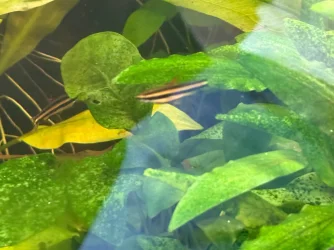
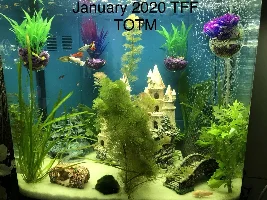
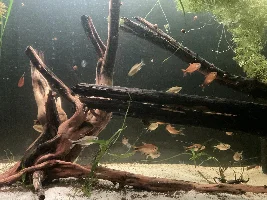
The group order to the Wet Spot brought me 18 Nannostomus marginatus supposedly from Peru. They do have a pretty yellow stripe so I assume the country of origin is correct.
IMG_3871.webp
IMG_3868.webp

IMG_3866.webp
 

Attachments

  • IMG_3870.webp
    IMG_3870.webp
    126.2 KB · Views: 18

Most reactions

Back
Top