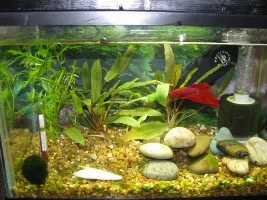
color has been slowly washing out on the cherries... many generations, 100's of shrimp later... techniques for keeping the bright colors

Magnum Man

Fish Connoisseur
Tank of the Month 🏆
Fish of the Month 🌟
Joined
Jun 21, 2023
Messages
6,798
Reaction score
5,752
Location
Southern MN
So, I started out with a couple different breeding groups, from different suppliers, in an attempt to start with as large a gene pool as possible, and have produced literally 100's of shrimp in this tank, in the last couple years... they are still red, but not as vibrant as the 1st breeding colonies...

so a couple questions about retaining color... of any of the colored neo shrimp...
are shrimps color effected by the foods they eat??? I've not been impressed with fish coloring up by any specific foods, I notice more coloration from a varied diet...

as far as the red color, the bloody mary shrimp are supposed to be colored differently ( less transparent ) would adding that gene trait to the cherries help keep a more solid red color, generations later???

so as far as foods, my shrimp eat algae cookies, and the extra fish foods, there are small live bearers in most tanks... in the rotation, includes dusted bug bites, and other high quality foods, and the tanks get treated occasionally with Bacter AE ( probably once or twice a month ) the tanks are all heavily planted...

I'm using a blend of RO water, and my rock hard well water in my shrimp tanks, and have not been supplementing calcium, and haven't been witnessing any shedding issues... I have been dropping other calcium foods into the tanks occasionally, but never got any activity around those...

so does the temperature effect the colors??? I keep the tanks in the low 70's F.

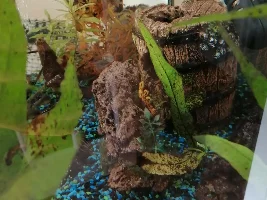
I posted a thread last night, as I got a trial of another type of calcium feeder, and the shrimp swarmed it in 5 minutes.... this picture from that thread, shows the shrimp are still red, but pretty translucent ( sorry about the dirty glass, I don't usually clean the glass in the shrimp tanks )...

noted in the 1st picture, I keep a small slab of limestone in each shrimp tank...


IMG_8552.jpeg

IMG_8553.png
 
Last edited:
As far as I am concerned there are three things which determine the quality of offspring produced fish or shrimp breeding and what the quality of the offspring might be.
1. Water parameters- Getting them close ti right for any given species is important.
2. Diet- this really matters on many levels one of which is color.
3. Who spawns with whom.

Number 3 above is likely one of your major issues in terms of color of the kids. No matter how well colored and how good the genes of any individual shrimp engaged in spawning, it does not mean all of the offspring will be as well colored. How red, how healthy etc. the kids are will vary. Some will not be up to the standards of the parents.

This starts to matter more and more as the population grows through reproduction. If all one has to start are really nice specimens and then you let them go their own way, some of the less red shrimp will end up spawning as well as the really red ones. What this means is the more shrimp in the tank the greater the odds are that not the best colored ones will also reproduce.

Ideally, to get the best offspring requires that they are produced by the best colored adults. Therefore, if your goal is to produce as many of the best colored offspring as possible, you need to remove the lesser ones from the mix. That is not so easy in your situation. But you are not a shrimp factory.

I am thinking that in your case the inability to keep the best colored shrimp by themselves to eliminate the lesser ones from doing the reproducing is one reason your are seeing a loss of color. However, diet also matters a lot. This is why we see color enhancing foods being sold. Something like this from kensfish.com might help. Astaxanthin Powder

Have a read here: The effects of feed on shrimp pigmentation you will read this:
In nature and in extensive or semi-intensive farms, shrimp absorb microorganisms, such as microalgae, that are rich in carotenoids. Carotenoids are pigments that give prawns their characteristic pink-orange color. Even though the Carotenoid family is quite large, only a few of its compounds have an impact of pigmentation. Among them, astaxanthin is the most effective pigment in impacting the color of shrimp. The majority of shellfish can also produce astaxanthin from other pigments such as β-Carotene.

I have a small tank with the red Neo. davidi and I notice some are really red and some are not. But I do not sell these. I also have another tank with the Blue Dream variety of the davidi and they seem to hold their color better than do the reds. I have sold a few 100 of the blues over the years. I feed both tanks the same foods. The reds are alone in their tank but in the blue's tank I also have amanos and a few white clouds and one albino BN plus assassin snails. So this tank also gets food for the fish. The tank for the reds gets only shrimp foods.

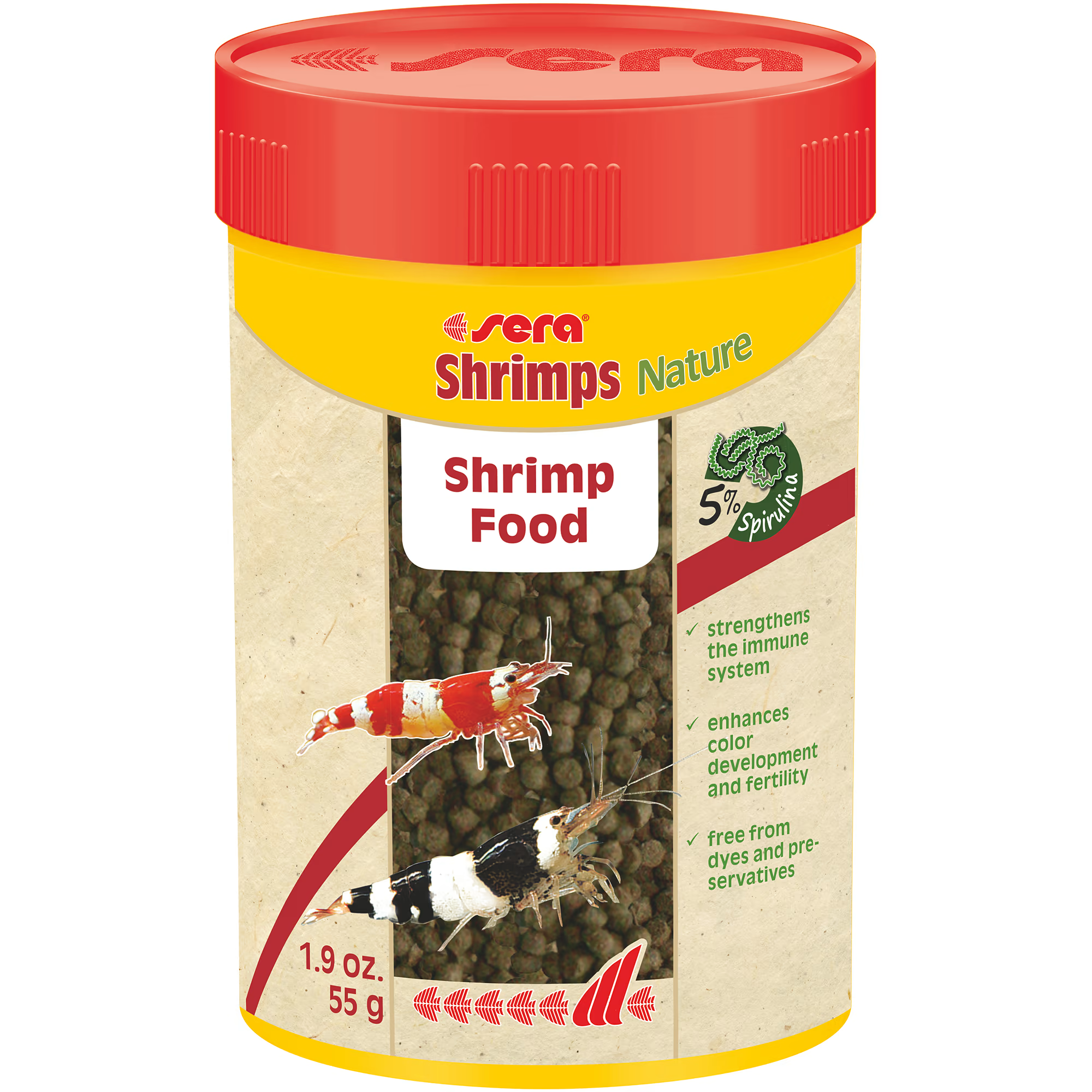
At my fish club meeting last August I came home with a small bottle of the Sera Shrimps Nature Shrimp Food:
3109124-center-1

Feeding guide:
Feed sparingly once daily.
Advice: Do not remove remainders of the granules, which keep their shape for a long time, too quickly since shrimps graze off their food slowly.

Ingredients:
fish meal, wheat flour, wheat germ, brewers yeast, spirulina (5%), Ca-caseinate, sea algae, gammarus, stinging nettle, willow bark, alder cones, fish oil (containing 49% omega fatty acids), mannan oligosaccharides, herbs, alfalfa, parsley, paprika, green-lipped mussel, spinach, carrots, Haematococcus algae, garlic.

Guaranteed analysis:
Min. Crude Protein 38.3%, Min. Crude Fat 6.4%, Max. Crude Fiber 7.7%, Max. Moisture 6.0%, Max. Crude Ash 11.8%, Min./Max. Calcium 2.0% / 3.0%, Min. Phosphorus 0.9%.

Additives:
Vitamins and provitamins: Vit. A 16,800 IU/lb., Vit. D3 820 IU/lb., Vit. E (D, L-α-tocopheryl acetate) 54 IU/lb., Vit. B1 16 mg/lb., Vit. B2 41 mg/lb., Stabilized Vit. C (L-ascorbyl monophosphate) 25 mg/lb.
 
A couple more points continuing on from TwoTankAmin's post, in particular point 3 (genetics). In the wild I have found glass shrimp that varied in colour. Normal glass shrimp are clear and that is how they are found in most areas. In some creeks that were heavily tannin stained (black water), there were glass shrimp that were a pale yellow/ gold colour. They were semi-transparent but had a yellow colour to them. I have found marine glass shrimp that had a green sheen to them. These ones were found in weed beds where the plants were green and the same green as the shrimp. Some ghost/ glass shrimp have black spots or lines and others have red markings. Some have red & black dots and lines.

Over a number of generations, the shrimp will develop colours similar to their surroundings. Green shrimp in green weed beds, yellow shrimp in yellow/ brown coloured water. Your substrate appears to be brown and white and the shrimp will produce young with a range of colours. Some will be closer to the colour of your substrate and they will blend in better and be less likely to get eaten. Others might be much brighter coloured but get seen more easily and get eaten. Even if there's no predators in the tank, the shrimp will revert back to their original colours over time.

I had ramshorn snails in one tank for 10 years. The original batch of eggs that came in on plants produced dark brown snails. Over the years they became inbred and I saw snails with stripes and spots and some because light brown and others were red (red body & red shells). The inbreeding also weakened them and they didn't grow as big and didn't produce as many eggs. Eventually I add a couple of new snails that were black and it significantly improved the health of the overall population and I still had lots of variety in the colours of the offspring. The substrate in my tank was white gravel. I don't know if the colour of the environment affects snails like it does shrimp, but it might. However, after 10 years and potentially 50 odd generations of snails inbreeding, none went white or even came close to it. So I don't think snails adapt their colour to their environment like shrimp do.

In your case, I would add new bloodlines to improve the colour and remove any pale or poor coloured shrimp.

---------------------

As for adding calcium, shrimp and aquatic crustaceans normally draw the calcium out of their shell and store it in their body when they shed their skin (exoskeleton). Once they have shed the old skin, they pump the calcium and water into the new soft shell and it stays in there. Unless you have really soft water and the shrimp don't get fed a varied diet, you shouldn't have to add calcium to their diet. It's not going to hurt them but it shouldn't be necessary if they get a varied diet.
 
I'm curious how some of the sellers that breed and sell shrimp, there are several sellers that breed their own, can maintain brightly colored shrimp to sell... maybe they use a system, of only breeding the original breeders, and separating all the babies to a grow out tank, to sell those???

I Originally had 10 - 12 from 2 different sellers, opposite sides of the country, in an attempt to get as large a gene pool as possible, and I have gifted starter groups to 4-5 people... one guy had a 70 gallon he just pulled down, and sold his fish to a shop that tegularly bought fish he was breeding... he pulled his tank down, less than a year after getting the started group from me, and he had around 100 cherries, so these have definitely been prolific...

in my original post I mentioned the bloody mary shrimp... I believe they are also neo shrimp, so should likely cross with the cherries...

I read this about bloody mary shrimp...

"Bloody Mary Shrimp are beautiful creatures! These tiny critters are often compared to standard Red Cherry Shrimp, but are slightly different in that their flesh, not just their shells, are red. This variety can also be identified by a shorter rostrum when compared to Cherry Shrimp. With proper care, freshwater shrimp have an average life span of 1-2 years. Most species will readily breed in healthy, freshwater conditions. It is recommended to keep shrimp separate from other species to prevent cross-breeding that typically results in brown, muddled offspring."

I know that happens with the "skittles" packs, but I'm curious if the bloody mary red flesh trait, could help the cherries with color fastness???
 
Last edited:
I have no idea if they can hybridise. If the bloody Mary shrimp actually hold colour and they can cross breed with the normal cherry shrimp, maybe they will provide better colour stability. The first thing to test is can they hybridise and if yes, do they produce fertile offspring.
 
a little more on them...

"Bloody Mary Shrimp are fascinating shrimp with bright red color, they are another strain selectively bred from Chocolate shrimp. Unlike Fire red cherry shrimp, which have red opaque coloration, Bloody Marys are translucent with bright red tissues."
 
I notived my Neo. davidi reds wer reproducing a lot and many were not real red. I was doing some looking around for Sera Foods and I came across this from kensfish

Shrimp Lolly Stick Astaxanthin 10 Pack
shopping

Bring out the most vibrant reds in your shrimp with the Shrimp Lolly – Astaxanthin Edition. This nutrient-packed snack is specially formulated to enhance red pigmentation, improve fertility, and support the immune system.

Key Benefits​

  • High in astaxanthin – Intensifies red coloration and enhances overall pigmentation
  • Vitamin-like effects – Supports shrimp fertility and immune strength
  • Easy to use – Simply place the stick in your shrimp tank
  • Perfect for red shrimp – Ideal for Crystal Red, Wine Red & Red Pinto shrimp
  • 100% natural – Made from plant-based ingredients and natural pigments
Each lolly is coated with a concentrated astaxanthin-rich blend, designed to boost color vibrancy while offering health benefits. Mounted on a sturdy skewer, the stick can be easily placed into your aquarium for long-lasting feeding and close-up shrimp watching.

The are pricey- $12.99 plus shipping unless your total order is $49, then shipping is free.

https://kensfish.com/products/shrimp-lolly-stick-astaxanthin-10-pack?_pos=52&_sid=13d836ab5&_ss=r

edited to add:

I just did a small order from kensfish.com and it included a pack of the above sticks. I can let you know how they work out.
 
Last edited:
I wouldn't combine Bloody Marys with cherries. BMs come from a different strain (brown/chocolate) , so mixing them would likely lead to the same result as mixing any other colour, i.e. wild type offspring down the line. I've also heard that they're not very stable and require systematic culling to maintain their colour :/
As far as I know food can enhance natural pigmentation, but it'll never be able to replace it or achieve the same effect as good genetics. If you want to colour them up, what I'd do is remove as much of the washed-out shrimp as you can (rehome or cull) and replace them with higher-grade shrimp like Painted Fire Reds or very high grade sakuras. That way you should be able to get babies that have a bit more colour than your current ones (not as high as the replacement shrimp though). I've never personally done this, but *in theory* it should work.
 
Do shrimp breeders work like fancy fish breeders, and remove individuals with the traits they want into smaller tanks, and keep controls on who breeds with whom, and what lines get crossed? Is it one of those deals where it takes a number of small aquaria to maintain the desired colours?
I ask from ignorance because shrimp have never appealed to me. I visited somepne who was selling quite expensive shrimp varieties a few years ago, and she had all her lines in 5 gallon tanks, grouped by colour forms. I don't know if she was mainstream in her approach, or was doing things differently from the usual, but her shrimp were very distinctive. She was a bit of a Grim Reaper type with her culling.
She seemed to spend a lot of time on her shrimp, and had quite a focus on them. It appeared to be paying off from her prices and turnover.
 
on my current set up, I have 4 colors, in 4 different 10 gallon tanks... I've had the reds , about twice as long, and started with a more serious breeding group, with stock purchased from 2 different sellers , in an attempt to get as wide a gene pool as possible, being the longest here, and the most prolific, I see the most color loss with the reds, I've not noticed any color loss yet, with my yellow, orange, or blue shrimp, but I'm also not turning those over enough to even fill the tanks they are in yet...

my 10 gallon tanks are not user friendly enough to spend much time culling, they are not sitting on the actual floor, but the bottom ones are sitting on "2 by lumber", so only an inch and a half off the floor... so if I were going to take culling seriously, I'd be laying on the floor, and I really have too many plants in the tanks to easily cull...

I would suspect if this were a business, it would be more like fish, and each tank would have a breeding group, and those would be occasionally moved to a fresh tank, while there was significant size difference, and the tank the breeders were in, would become a grow out tank... doing it this way, would keep just the original breeders, doing the breeding, and limit the need for culling, and the tanks would then be positioned at a more serviceable height and place...

my goal was never to sell any, but maintain the tanks full of the various colors, with the overs being moved to other, bigger tanks, either as feeders, or if they survive ( like my Hillstream tank ) which has a small colony that the adults seem to be thriving, and I expect the baby shrimp become feeders... I have gifted a bag of the cherrys to a friend, who got out of having tanks, and when he pulled down the big tank, that he had put the shrimp into, sold about 100 of them back to a fish store... so, I suspect many of my original breeding group was caught and removed over the couple years I've had them, leaving the youngsters to run amuck
 
Do shrimp breeders work like fancy fish breeders, and remove individuals with the traits they want into smaller tanks, and keep controls on who breeds with whom, and what lines get crossed? Is it one of those deals where it takes a number of small aquaria to maintain the desired colours?
You should see some of the operations these breeders have. They have a keen eye when it comes to the smallest details of shrimp. I've seen shrimp be removed from breeding colonies because the size of the markings were too big/small. It's a big market in Asia especially. Kelvin Wong from Singapore has some very high-quality shrimp. Some are listed as $200 per shrimp. He has won many awards for his shrimp and is sometimes known as the godfather of high-quality shrimp.

1762630631643.png
 
I'm a simple guy, I like the orange eye blue or the orange eye purple the best...
 
I have fed my cherries two sticks over a period of about 5 days. I am seeing more red than before and some of them are really pretty bright red. When I feed them the sticks are covered with shrimp. Whatever they leave on the stick after a day falls of onto the bottom and the ones who did not get a shot at the stick clean up the substrate,

This tank is absolutely loaded with shrimp. It looks like I may have to bring a bag to my club for the monthly auction.
 

Most reactions

Back
Top