Check My New Tank Setup.. Cycle & Stocking Question?

chophousemusic

New Member
Joined
Jan 28, 2009
Messages
39
Reaction score
0
Points
0
Hey I am a new member to this forum. Want to introduce myself. Whats up everyone.

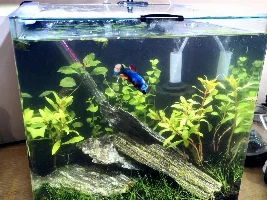
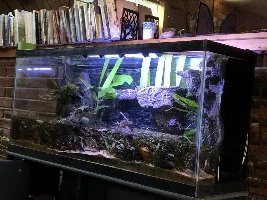
So I got a 75 gallon tank, fluval 405 filter, heater, whisperer 100, air stone, gravel, river rock type boulders stacked like a cave with holes in them for the fish to swim through and hide, and a bunch of fake plants in there.

My buddy at the fish store never told me about fishless cycling so I bought a bunch of fish already and started my cycle.

I have 2 zebra danios, 2 buenos aires tetras, 1 blk phantom tetra, 2 silver dollars, and 2 krib cichlids. ( I know i need to get the blk phantom a friend but i didnt want to add any more fish untill cycle is over ) I wanted to establish a community tank and then add some semi agressive fish. But my friend went and bought the 2 silver dollars and 2 chichlids like 2 days after I got the other fish, thinking I needed more than 5 fish to cycle my 75 gal. tank.

First Question: Do you think these cichlids are now going to change the direction of what type of fish i can add??????? I wanted to do something along the lines of Elec Blue Jack Dempsey, Firemouth cichlid, and a few others with maybe a school of tetras, danios, or barbs ???

Second Question:...given my setup...its only been a week or so...my ph is at 7.0, ammonia is now at .50, nitrite and nitrate at 0. Should i be doing 15% water changes every few days like ive read on the internet or go with the guy at the fish store who says not to change the water untill the cycle is over ?? ??

Any advice would help, just want my tank to cycle, as quick as possible, without losing the fish obviously.
 
Yes, welcome to the forum,

Yeah, you're going to get a lot of comments and advice about the stocking you've done. I'll leave that to the others.

I'll just go to the more urgent thing: You've got a large bunch of fish in an uncycled tank and have had no access to fishless cycling information or knowledge probably about the nitrogen cycle and good test kits.

Fish give off ammonia as well as CO2 from their gills and this ammonia along with fish waste, excess food and plant debris (all of which are broken down into ammonia by heterotrophic bacteria in the water) will begin to build up in the tank water. In nature, there are thousands or millions of gallons of fresh water to dilute this ammonia. Even in a large aquarium there will not be this dilution and the ammonia level will be toxic (in fact, already is in yours if the .5ppm is correct.) If you put chemicals in to remove this toxic ammonia, your biofilter will never cycle because the bacteria won't get food, so what to do?

Well you are in what we call "a fish-in cycling situation" (and "situation" it is because it is not good and we can not guarantee that the fish will live!) Here's what you do (assuming you can't re-home the fish and do a proper fishless cycle): Your new goal is to get the ammonia and nitrite(NO2) levels in the tank down as close to zero as possible and to not let them rise above a measured 0.25ppm. You do this via large water changes. You change 70% or 50% or so and you can change as soon as an hour later if the goal has not been accomplished. When cycling new filters with a fish-in cycle, water change technique is important. You need to use conditioner and to roughly temperature match (your hand is good enough.) For a large aquarium like yours you'll want to investigate a "Python" type product to help with the large water changes. Now the large tank volume will definately be a help and it may be that after you get started with 50% or so daily changes, you'll find that you don't need quite that much frequency or percentage to accomplish the goal. But you have to be a detective and figure out how to meet the goal.

To be able to do this you will need a good liquid-reagent based test kit. Most of us here us the API Freshwater Master Test Kit and think its the best. Test paper strips are worse than worthless, they are misleading. You will need to test morning and evening. Initially you only need test for ammonia and pH (you don't want pH to go down to 6.2 or above 8.5) but after a week or so you should also test for nitrites(NO2)... well, you've been going for a while so you should go ahead and test for that right away too.

Ammonia, even in small amounts, causes gill damage that will shorten the life of the fish or kill it. This varies by species, but on average the transition amount is 0.25ppm to .5ppm or so, so we say that when you rise above 0.25ppm you are potentially getting into the area of shortening their lives or setting them up for stress and potential death. After some of the ammonia oxidizing bacteria are formed, they will begin to process the ammonia into nitrite(NO2), which is also a toxin and will harm fish in amounts above 0.25ppm. NO2 will displace O2 on the fish blood hemoglobin and from there will destroy the hemoglobin molecule, leaving a dead brown mush instead of a nice red blood molecule. This action will suffocate fish and the first symptom will be nerve damage and eventual death. Anyway, all this is just to say that you doing water changes and testing is now the lifeline for your fish. It will take a month or two for the filter to cycle.

Good luck!
~~waterdrop~~
 
Thanks for the advice....Yeah thats the exact testing kit I have. I kinda knew I had to do the water changes. Just needed to hear it I guess, because ive been told so many different things. I just did a 50% water change and will test the results tonight.

So basically, .25 is the limit i should try and keep the ammonia levels at during the cycle process? This level is ok and the bacteria will convert into nitrites ...and then into nitrates ?

Then I got into thinking....from what i've read... water changes will slow down the cycle process... but if the bacteria level is stilll building up and u keep the ammonia levels low from water changes...shouldnt there be more bacteria to convert the ammonia to nitrites and nitrates...which should then make the cycle process faster... ? ? :hyper:
 
In a Fish-In cycle you don't worry about the bacteria, its all about protecting your fish. The bacteria will get plenty of ammonia. If you think about it, a fully-functioning mature filter system holds the ammonia and nitrite(NO2) at zero when measured and yet the bacteria is obviously healthy! That is because there is a constant small stream of ammonia just below the "measured zero" level that the kits show. In other words, Zero is only zero in the sense of the fish!

The advice that "water changes will slow down the cycle" you've heard is for -fishless- cycles, not fish-in cycles. A fish-in cycle is already a non-ideal situation and keeping the fish alive via water changes is the only choice. One good thing though is the smaller, more steady rate of ammonia feed from the fish, it helps the fish-in cycle to generally finish in about the same average time-frame as a fishless cycle (between 3 weeks and 2 months, with plenty of individual variability.)

~~waterdrop~~
 

Most reactions

Back
Top