Bristlenose pleco with marks/injuries. Please help!

okairy1

New Member
Joined
Nov 15, 2026
Messages
3
Reaction score
0
Points
1
Location
united kingdom
Hi, I’m new to plecos. I have an albino bristlenose, still very young. Does not live with any aggressive tank mates.

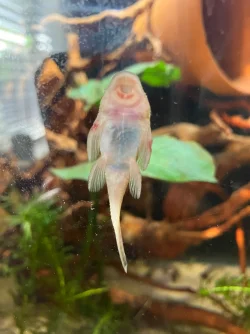
I’ve noticed these red marks/injuries on its fins and some redness around the mouth. At first I thought it had burnt itself on the heater (now has a guard on it but unfortunately didn’t at the time) but I just want to be sure its not something else, like a bacterial infection? Any ideas?

Ammonia 0, nitrite 0, nitrates well below 40ppm. Any other info you need I’ll be happy to supply. I’ve also added an indian almond leaf to the aquarium for its antibacterial qualities.
Thank you
 

Attachments

  • IMG_8101.webp
    IMG_8101.webp
    132.2 KB · Views: 6
Those look like bite wounds. Can you give us a list of what else lives in the tank?
 
Really? Oh I hope not. It lives with 6 mollies, 6 glass catfish, a honey gourami, and two dwarf African frogs. I’ve never seen any of the others take any notice of the pleco.

Could it injure itself on a tank decoration in this way? I have some bogwood in there. I didn’t think it looked particularly sharp but it’s not smooth all over.
 
I would argue in favor of the heaters burns. I have kept plecos for close to 25 years now. They often love to be attached to a heater. It is a good place to hide if it is on the back side or even the bottom. But here is why I am favoring heater burns. The red area around the mouth is not likely to be caused by other fish nipping. The fin red marks could be, but not those mouth. However resting.hiding ion a heater can cause both.

However, is is possible that either fin nipping or heater burns could result in an infection. If there is one, then the antibiotic would likely help in either case. The cause should become obvious because of the added heater guard. Once the red goes a way it should not return if the cause was heater burn since the guard removes that potential.

There is one more way for plecos to get injured mouths and that is from something in the substrate or other hard surfaces to which it will attach or to graze that has something sharp that causes and accidental injury. But that would not be very likely to affect the fins.
Thank you for the detailed reply! I’ll keep an eye out for any aggression from the other fish, but assume heater burn for the time being. Do you think the almond leaves will be enough or should I add a treatment of some kind? In case of infection.
 
Unless a fish is doing so poorly that I suspect it will die if nothing is done but I have no idea what the cause is, I will take my best shot at medicating. However, in the absence of symptoms and no obvious behavioral clues, I refrain from medicating until I know what the problem might be.

I have bought imported wild fish that have just been landed and I do not treat them proactively. I want to know what the problems might be first. But. I Q wild caught imports for 3 months. This mean 4 continuous months with no issues. If I have to treat a Q tank, if I am successful, then the calendar resets to day one again. There are some things that can remain hidden in fish for some time before they manifest any symptoms. It can be a couple of months before they become obvious.

Fish which are not recently wild caught and which come from a reputable source only get a 30 day Q but with the same rule re needing to treat and resetting the Q period if successful.

We have a number of member on this site with more knowledge and experience than I have and they will proactively treat imports. They know what to expect and can be more certain than IO am about what to treat for in different species from different parts of the world.

I have gotten most of my fish shipped to me and which have originated from nearby to across the globe What I have learned is that one healthy live fish in a bag have to be worth at least what 3 cheaper DOAs may have cost.

Our fish all come from one of three sources, the wild, fish farms or hobby home based breeders/ other fish keepers tanks. One of the more important information we acquire as fish keepers is from where to get healthy fish. The only two cases of Ich I have ever had in my tanks both came in with new fish. The white spots were not showing at the time but thet did the next day. In one case I had not used a Q tank and it cost me the new fish and one of my own. The other case I had 19 fish from a store go into a Q tank and only one survived despite being treated.

I do have one rule here with no exceptions which is that any tank that contains $1,000s worth of fish never gets new additions that have not gone through a successful Q period. The same applies to the less expensive fish but which have been in my tank for years and are expected to be there for many more.

As always, the above is my way and not the only nor necessarily the best way. You need to decide for yourself how you want to handle new fish.
 

Most reactions

Back
Top