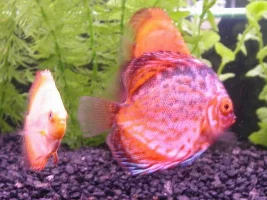
Well if you read either of the two articles Byron and I have referenced, they cover a decent amount of time. Although they have clearly been around longer, the first described identification of a discus dates back to the 1840. The final ESU was found in 2006.
One of the more interesting aspects of fish from the amazon basin is how rivers with different parameters often meet and combine their waters. Even within individual rivers parameters may be different for a number of sections. The methods for identifying species has also changed due to the science of genetics which allows for the historical tracing of a species.
When it comes to fish adapting to conditions which are not ideal, but not fatal, requires changes at the genetic level if almost any life form is going to "adapt" to them. A perfect example are the Cichlids of lake Malawi. Here is a quote from a 1999 paper investigating the species there:
Lake Malawi contains a flock of >500 species of cichlid fish that have evolved from a common ancestor within the last million years. The rapid diversification of this group has been attributed to morphological adaptation and to sexual selection, but the relative timing and importance of these mechanisms is not known,
from
http /www.ncbi.nlm.nih.gov/pmc/articles/PMC21824/
The paper goes on to consider that this spetiation was "rapid" and is ongoing. Currently, I believe there are over 1,000 identified species in Lake Malawi. But I am fascinated by how 1,000,000 years is fast.
However, circling back to the original topic, I have a host of questions. Lets assume one keeps any given fish outside the supposed extremes of its "accepted range" and that they still reproduce and manage to appear OK. Now,
1. How does one know if the fish are living to the same average lifespan as their original parents would do if kept within their "accepted range"?
2. How does one know if the average growth rate is the same, less or greater?
3. How does one know if the immune systems of each generation have been the same, better or worse?
4. How does one know how many generations it may take to "adapt", especially when we may have fish with short lifespans and are able to reproduce a few months after they are born vs fish which live a long time and take years to reach spawning size?
5. How far beyond the "accepted range" does a parameter have to be to be considered out of range?
6. How many or which parameters must be out of range to be considered importantly out of range? Example, one can create acid tea stained water conditions minus the coloring and this has no effect on the fish. Which parameters matter?
I have been keeping fish for over 14 years and have had many spawn on their own. I had 3 generations of LF Rosy barbs, several of montezuma swordtails and tank bristlenose. But for most fish I have not seen beyond F1 in my tanks. I do know some went beyond that in new homes. How many of us have taken any of the longer lived, longer to mature sexually fish to 3rd or 4th generation in our tanks? To make the anecdotal argument that fish can adapt wouldn't it have to include such species in our anecdotal experiences?