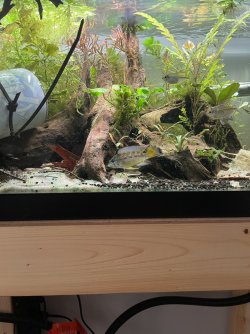
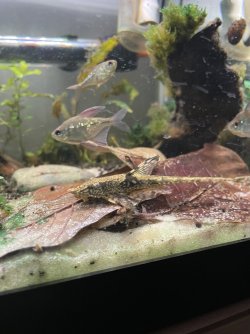
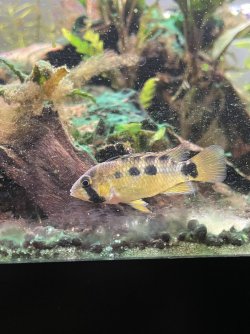
20 Gallon Long University tank

Tacocat

Fish Herder
Pet of the Month 🎖️
Joined
May 28, 2021
Messages
1,092
Reaction score
680
Location
Ontario
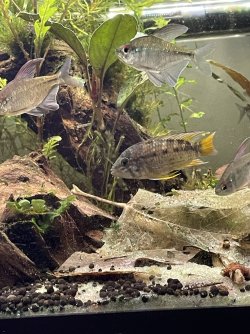
Hey guys! I'm starting this journal about 3 months into the journey as I've been busy with school and living in my own place, but finally I have a tank completely administrated by me! All the previous tanks I've managed were in my parents house with shared responsibility with my brother, meaning that an equilibrium had to be reached within my family when making decisions about the tanks. Now that I'm renting my own room for university, I can finally choose my own fish!
For equipment I was able to get a 20 long for cheap off of facebook marketplace, and over the summer my father and I resealed it and built a wooden stand for it. I was also able to get a relatively cheap Fluval 206 canister filter along with a light and heater, but the light was wayyy overpowered and I had to go with an amazon nicrew light that I would like to replace in the future. For substrate I used a mix of old fluval stratum, ADA amazonia 1, and pool filter sand.

Plants:
Various Bucephalandra varieties, an Anubias, Ludwigia palustris, Ludwigia brevipes, Cabomba aquatica, Rotala blood red, Hygrophila pinnatifada, Crypt wendtii, and various mosses.

Fish:
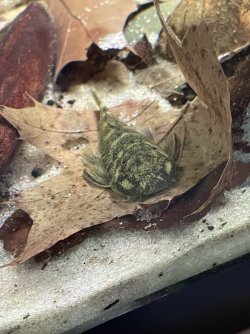
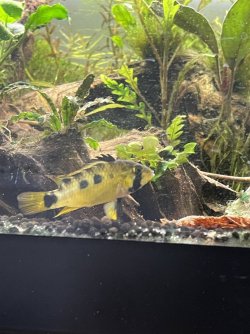
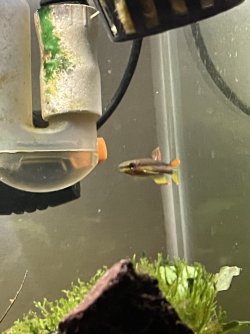
Apistogramma ortegai pair, Aphyosemion volcanum pair, currently 5 super blue kerri tetras, 6 diamond tetras, 1 Sturisomatichthys leightoni, 1 rubber lip pleco, 1 female red chinned panchax
Other:
Ramshorn snails, 2 amano shrimp, 1 nerite snail I haven't seen in a while

Regarding the single panchax, it is the lone survivor of a group of 6 that all died while I was away for a week. I am not certain as to why this happened, as the water parameters were completely fine and none of the other fish appear to have been affected. I believe that it might be due to the quality of the fish at the store, as this particular LFS has sold me ailing fish previously. In the meanwhile I will attempt to sell it or find it a larger group (this will be difficult as that was the only store that sold Epiplatys dageti within my area).

IMG_3462.jpg


I've been trying to get the Apistogramma pair to begin breeding, but I cannot seem to get my tapwater to a pH lower than 7.2. For now though, they appear content and unstressed, which is all I need in the meanwhile.

More pictures of the fish:
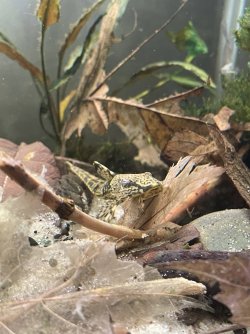
IMG_3423.jpgIMG_3460.jpgIMG_3468.jpgIMG_3466.jpgIMG_3464.jpgIMG_3463.jpgIMG_3221.jpgIMG_3225.jpg
 
Ignore the ph and obtain the kh and gh - the ortegai will require pretty darn soft water for the eggs to hatch (if that is your objective). The ph implies the kh is 6ish but there are other reasons the kh might be high. Also if the water gets harder while in your aquarium then something is leaching (rock?substrate?) which will be bad for the ortegai.

Last but least never say your water is fine - give the precise parameters and let others determine if it is fine for the species. I will also point out that the rubber nose pleco is a poor choice to mix with the ortegai and conflict can (and will likely occur) esp if the ortegai attempt to breed. You could of course remove the female ortegai and save them all some grief.
 
Ignore the ph and obtain the kh and gh - the ortegai will require pretty darn soft water for the eggs to hatch (if that is your objective). The ph implies the kh is 6ish but there are other reasons the kh might be high. Also if the water gets harder while in your aquarium then something is leaching (rock?substrate?) which will be bad for the ortegai.

Last but least never say your water is fine - give the precise parameters and let others determine if it is fine for the species. I will also point out that the rubber nose pleco is a poor choice to mix with the ortegai and conflict can (and will likely occur) esp if the ortegai attempt to breed. You could of course remove the female ortegai and save them all some grief.
I unfortunately don't have the GH and KH test kits on me as they are still with the other tank. I will make sure to retrieve them next time I get the chance. I also don't think that the hardness is being leeched into the tank, as the only rocks I added were presumably inert river rocks and certainly not enough to actively raise these parameters by much, especially not with all the buffers. You are quite close with that KH estimate, as my city lists the water hardness as 120 mg/L CaCO3 or 6.7 DGH(according to google). I had hoped that the aqua soil would contribute to lowering the kh, but perhaps not enough of it is in the tank to lower the kh to the desired levels. Thanks for pointing that out.
I have been considering attempting to utilize kitchen vinegar to lower the kh of tap water, but I will do the math on this first before doing anything.

Regarding the pleco, why might the rubber nose be more difficult with the cichlids than the Sturisomatichthys leightoni? I have observed some sparring a little while ago, so perhaps a rehoming might be in order, but what makes this species stand out?
 
They pleco will ignore territory markers - the way the ortegai works if the male defines his territory (which will be most of the aquarium but will be more relax if the female is not breeding. Once the female breed the female will ahve her own territory and the male a larger area but both will defend it to protect the eggs. Fishes that are high up are less likely to be a threat - the twig might trigger a response (ive been more hit and miss with similar fishes) and tend to be a bit more 'shy' and run away if approach in an aggressive manner the pleco is more likely to ignore the ortega which will result in stronger attacks. All of these things are hard to predict as it can come down to individual fishes and their level of aggression but in general the ortegai will attack the pleco until it moves they might do the same thing with the twig which is more likely to move immediately. Also the twig is less likely to be a threat to eggs/fry and this is something the ortegai might learn.

Btw while some species of apistogramma are more flexible on water hardness ortegai are less so and really do best in blackwater conditions. Borelli are one of the most flexible and also prefer cooler temperatures (72 is great for them) BUT domestic borelli are horribly inbred and are more prone to dying and wild caught borelli haven't been availalbe for a long time (brazil export ban; though a few individuals have gone down there and caugth a few samples).

I hate to list other domestic species because nearly all of them have been bred for colours while most ortegai are still in natural form.
 
Last edited:
I have come up with a solution! In order to lower water hardness, you must lower the CO3(2-) concentration somehow. Now the easiest way (chemically) to do this is by adding a strong acid like HCl, which releases H+ ions and converts carbonate into H2CO3, which then turns into H2O and CO2. However, I'd say that adding HCL to water you would put in an aquarium is probably unwise, and I fear the consequences of excess chloride ions. Thus, instead what I could do instead is boil roughly a gallon of water pre-water change while suspending steel coils in this. The high surface area allows more CaCO3 to precipitate out, thus lowering both KH and GH. Then, I can then add this singular gallon to 3 other gallons of tap water, resulting in a 1/4 dilution of both GH and KH. On top of this, I can add more tannins (post-boiling) to further lower KH to acceptable values. Once I do this consistently over a number of weeks, I believe that I will be able to successfully bring it down. Does this sound conceivable?
 
They pleco will ignore territory markers - the way the ortegai works if the male defines his territory (which will be most of the aquarium but will be more relax if the female is not breeding. Once the female breed the female will ahve her own territory and the male a larger area but both will defend it to protect the eggs. Fishes that are high up are less likely to be a threat - the twig might trigger a response (ive been more hit and miss with similar fishes) and tend to be a bit more 'shy' and run away if approach in an aggressive manner the pleco is more likely to ignore the ortega which will result in stronger attacks. All of these things are hard to predict as it can come down to individual fishes and their level of aggression but in general the ortegai will attack the pleco until it moves they might do the same thing with the twig which is more likely to move immediately. Also the twig is less likely to be a threat to eggs/fry and this is something the ortegai might learn.

Btw while some species of apistogramma are more flexible on water hardness ortegai are less so and really do best in blackwater conditions. Borelli are one of the most flexible and also prefer cooler temperatures (72 is great for them) BUT domestic borelli are horribly inbred and are more prone to dying and wild caught borelli haven't been availalbe for a long time (brazil export ban; though a few individuals have gone down there and caugth a few samples).

I hate to list other domestic species because nearly all of them have been bred for colours while most ortegai are still in natural form.
Okay thanks! I'll see what I can do with this fish then. Perhaps I shall add otocinclus in replacement, as I have read that they are typically amicable tank mates with Apistos.
 
I'm not sure that will make the water softer; you should test gh first and perhaps tds (which is kh+gh); hcl will definitely lower ph but lower ph doesn't mean the water is softer. You could for example pump in co2 until the ph is 4 but the water will still be just as hard.
 
In my two 20 gallon long tanks each has a pair of a. cacatuoides. One also has 10 n. beckfordi and the other has 10 Glowlight tetras. My tap water has a GH of about 215 ppm so I cut it to about 107 ppm with distilled water. Everyone is happy.
 
In my two 20 gallon long tanks each has a pair of a. cacatuoides. One also has 10 n. beckfordi and the other has 10 Glowlight tetras. My tap water has a GH of about 215 ppm so I cut it to about 107 ppm with distilled water. Everyone is happy.
First cockatoo are a completely different species; domestic cockatoo are known to be more flexible with regards to water chemistry. 107ppm is well within the spawning range (i've spawned them in 140 without any issues); however they would probably live longer in blackwater - though with domestic it is hard to tell. My wc tend to live 4+ years and if they live less than 3 then i know i'm doing a bad job. In any event while these two fishes are in teh same genus they really can't be compared beyond belonging to the same genus. It is like saying guppies do well in my water so neon tetra should also do well.
 
First cockatoo are a completely different species; domestic cockatoo are known to be more flexible with regards to water chemistry. 107ppm is well within the spawning range (i've spawned them in 140 without any issues); however they would probably live longer in blackwater - though with domestic it is hard to tell. My wc tend to live 4+ years and if they live less than 3 then i know i'm doing a bad job. In any event while these two fishes are in teh same genus they really can't be compared beyond belonging to the same genus. It is like saying guppies do well in my water so neon tetra should also do well.
You missed my point. I was saying he can alter his GH by diluting it with distilled water or RO/DI water. A lot easier than mucking with adjusting pH.
 
You missed my point. I was saying he can alter his GH by diluting it with distilled water or RO/DI water. A lot easier than mucking with adjusting pH.
Yes using distill or ro water to dilute the hardness will work but it can get expensive over time. Altering the ph i don't think will do anything useful with regards to the hardness of the water. I'm not sure how low he has to go but i suspect tds below 60. I had wc ortegai but i keep them in blackwater (tds 10); they did spawn often enough (i had 3 females with a male in a 65 and all three spawned at the same time).
 
Yes using distill or ro water to dilute the hardness will work but it can get expensive over time. Altering the ph i don't think will do anything useful with regards to the hardness of the water. I'm not sure how low he has to go but i suspect tds below 60. I had wc ortegai but i keep them in blackwater (tds 10); they did spawn often enough (i had 3 females with a male in a 65 and all three spawned at the same time).
I unfortunately do not have an RO system, so consistent usage of RO water is out of the question for now However, I do think that mucking with boiled water will have some effect, as removing the calcium and carbonates will certainly affect both GH and KH, which will allow my pH to go lower as well with the addition of botanicals.
 
I unfortunately do not have an RO system, so consistent usage of RO water is out of the question for now However, I do think that mucking with boiled water will have some effect, as removing the calcium and carbonates will certainly affect both GH and KH, which will allow my pH to go lower as well with the addition of botanicals.
Sounds like a home distiller ;)
 

Most reactions

Back
Top