Yes my answer is a little confusing. While ammonia is a nutrient, not many of us see it that way (and most of us know this is one of the main causes of algae), as we usually dose nitrates for the nitrogen, and if we do not dose enough, the plants will not grow, and therefore algae - or cynobacteria - can get a foothold.
and most of the causes (dirty filter, organic matter) cause ammonia spikes.
Low flow/ poor circulation is also another cause.
Some interesting information you have posted there too, although i dont 100% agree with this quote:
If you have an established infection, do not try to
get rid of it by turning the lights of. Most likely this will
get you into more trouble. Your going to kill of the "good"
algae and the plants, but the blue-green bacteria is going to
return when you turn the lights back on (usually more fiercly
than before). ...
If you dont do a blackout then how are you going to get rid of it? Easiest way is to get rid of it, then fix the cause. Plants are not killed in this short amount of time anyway, they be get knocked back a bit, but nthing ti worry about.
Quote: 'Yes my answer is a little confusing. While ammonia is a nutrient, not many of us see it that way (and most of us know this is one of the main causes of algae), as we usually dose nitrates for the nitrogen, and if we do not dose enough, the plants will not grow, and therefore algae - or cynobacteria - can get a foothold.
and most of the causes (dirty filter, organic matter) cause ammonia spikes. ...'
But it's only confusing for those who don't yet happen to have even a vague understanding of how BGA (or various forms of true algae) functions, and makes perfect sense otherwise.
The quoting of info wasn't only because it's interesting in itself, but because if there's no general understanding of the blue-green nuisance, it's a lot harder to sort out why and get rid of not only it but the potential reason( s ) for its sudden appearance/rapid growth - and there could, as you point out, be far worse results from the circumstances causing an overgrowth than from the algae itself, which may actually serve as a warning of other issues.
And even if the OP knows all this inside and out, new people/forum lurkers may come across the information quoted and have things suddenly fall into place.
People don't tend to mention the history and complexity of the organism, and it may not occur to the newer or more casual aquarium-keeper to look this up generally.
And if, like so many other commonly occurring conditions, it's been too often [not in this case, of course] essentially stigmatized as necessarily a result of sloppy, careless management of a dirty aquarium with neglected fish, new people may even be too embarrassed to ask about it, so it certainly doesn't hurt to counteract this with a variety of information from sources not generally quoted in example.
Aquariums are not and cannot be sterile, they're made to support life - we just typically want only very specific life in there...
And circumstances/causes can vary so greatly that some very different strategies have been successful for different people, and even for the same people in different tanks.
Another point is that since many aquarium plants much prefer ammonium to nitrates, with luck and enough plants, resident algae may be kept starved to a minimum and never become a major problem.
http /www.aquabotanic.com/plants_and_biol..._filtration.htm
But in the high-tech planted tank, of course, maintenance and, as a result, conditions, are entirely different from those of us who may add a few root tabs to inert gravel/sand and dose a bottled patent ferts mix, as in the former case, nutrients are carefully measured to produce plant growth far in advance of that otherwise achievable.
So both basic tank conditions and the perspective of those using different methods may affect results/strategies in multiple areas.
Quote: '... Some interesting information you have posted there too, although i dont 100% agree with this quote:
If you have an established infection, do not try to
get rid of it by turning the lights of. Most likely this will
get you into more trouble. Your going to kill of the "good"
algae and the plants, but the blue-green bacteria is going to
return when you turn the lights back on (usually more fiercly
than before). ...
If you dont do a blackout then how are you going to get rid of it? Easiest way is to get rid of it, then fix the cause. Plants are not killed in this short amount of time anyway, they be get knocked back a bit, but nthing ti worry about. ...'
Actually, neither do I 100% agree with that portion quoted, although the principle fits with results I've had.
Plants aren't usually killed, maybe not even set back too much if in good condition but - you're a plant expert with phenomenal planted tanks.
Your plants will be in top condition, because you know what suits your tank conditions as well as your personal taste, and you can tell at a glance what to dose when, ideal lighting, etc. because you've got the experience and knowledge many of the rest of us lack.
Your perspective - as well as plant conditions and their assisted ability in recovery - is bound to differ from those of us who aren't plant experts, although here, of course, I speak for myself, rather than the OP.
And all I can speak from is my own rather limited experience and what I've read/heard.
So, while I did feel a bit silly suggesting alternatives under the circumstances, it occurred to me that the very fine layer noted by the OP was quite similar to that of a problem I'd encountered in one tank and which was dealt with quite easily, (unlike that in another problem tank which was actually due to be shut down some time ago,) and that removal of this top layer and the addition of more plants might form an option which would not risk setting his existing plants back.
As stated, I developed that BGA problem from plant melt - so I, personally, would worry about setting plants back, which may or may not be a consideration to others, in a situation where a BGA problem already exists.
Because Cyano is evil about coating plants, and where it already lurks it doesn't seem to take much visible (if sneakily concealed) dead plant matter to trigger what can be an amazingly fast-moving boom...
Probably not in your carefully monitored and balanced tanks, though, which is, again, where the different perspective comes into play.
And the O P no doubt has a different one again.
Mine is also one where a half-dozen of my (entirely and extremely low-tech) tanks (so far) house bettas and have limitations on levels of current flow as well as low nitrates.
As I only use a bit of Flourish after waterchanges, and was unable to obtain any for a while, some of the non-earth-sustained plants in the non-Walstads crashed rather badly after a while - starting, of course, by dropping mushy leaves near the back wall behind/among concealing plants and triggering a fair-sized area of cyano, although this occurred in two larger, non-betta-containing tanks with relatively strong filtration, as well as the one problem tank.
I do tend to think of an increase in plant mass (and manual cleaning) as solving this problem (if restricted to specific, accessible areas where this can be easily done, as by sucking up a thin layer off the top of the substrate in a limited area for cleaning and return, with due awareness of the potential for ammonia spikes from the removal of too large a section of beneficial bacteria-bearing substrate) as it worked so well for me, even if I personally would still use a black-out for various other algae issues.
Although the point must also be made that plants are likely not actively sucking up ammonia at that time, just when dying algae is producing more under blackout conditions - along with that of the ability of various types of BGA to survive virtually anything normally encountered in nature only to reappear when conditions are better.
There are a number of elimination options which have been used, successfully by some if not others, due to the variations already noted among algae types and tank conditions.
Personally, when I'm dealing with a problem/subject, I generally like to read through a multitude of sources and get as much info as I can - as you may have noticed, I tend to buttonhole everyone within range when I come across something I think is of interest or worthy of consideration.
Unfortunate for them there's such a lot, lol, as not everyone shares the same notions of what constitutes 'cool info' or areas of concern.
But one never knows which bit of info may be of interest or use to whom, whether at the time or down the road.
And I like to try to establish basic principles by which means I can (hopefully) sort out things generally.
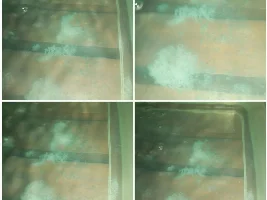
In the case of the OP, he apparently has the beginning of a problem, with a very fine layer of BGA on the surface of sand grains in some areas, which could be blacked out or removed, washed and returned and planted, or whatever - but what exactly is/are the issue( s ) in this case encouraging this problem to arise?
My problems with BGA have been plant-related, so, as stated, I tend to think of siphoning out any dead vegetable matter along with obvious BGA, and increasing plant mass, and have had other algae problems very obviously related to the wrong light for the tank rather than an issue of 'too much'.
Some plant lights do seem to actually slow plant growth and encourage algae.
So, regarding the OP's tank, is any problem in this area more likely the fact of the amount of light in this case, or of the wrong light for the tank, since he'd specified this problem already?
I was rather hoping you'd comment on that...
The OP added:
'... EDIT: Some more info. I actually have some brown algae in the tank (diatoms). The tank stats appear to be fine - though I have no test for phosphates (can phosphates cause brown algae?) This leads me to think it is a lighting issue. I that sometimes low light can cause brown algae.
Additionally my plants aren't growing very fast. They seemed to have really slowed down since I added the Aqua-Glo light. So right now I am considering adding more light. Thing is - do I replace my oldest light-bulb (the one that came with the tank) or do I add an additional third light bulb? ...'
I know nothing of lighting - but when that happened to me in one tank I exchanged the offending new plant light for another slightly less unsuitable light and watched things improve.
The manufacturer may say their light's good for plant growth - but if it doesn't appear to be good for the plants in the tank it's in, should results be taken into account, or at least tested by process of elimination?
That 2-hour siesta period taken between 4 hr. lighting periods should reduce algae growth, from what I've read.
The algae appeared several weeks after the addition of plant tabs - coincidentally or not, the problem area in my tank which was addressed by top-layer substrate removal and replanting was also in an area disturbed by resetting plants (which were also shedding fragments of mushy leaves) over 3-month plant tabs, and I rather more than suspect that some of whatever remaining nutrients were close enough to the surface to feed the BGA as well, although the problem cleared as stated.
(The plant tabs had been added for plants which probably needed higher light, and were initially replaced by ones which were essentially water column feeders...)
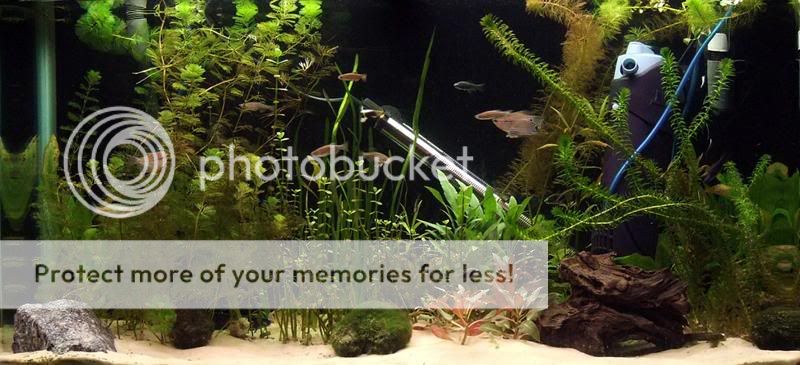
In the OP's case, according to the photos, there are no plants in the area affected.
Could fragments of nutrients be sifting up and around through the sand to nourish BGA?
There could be a lot of factors involved, and all I know for certain is what seems to have solved similar problems in various of my tanks.
So viewing things overall, and apart from the blackout, based on the excellently informative opening post given by the OP, what are the problems that should be tackled in the OP's tank, and how?
What's the OP's perspective on this?
Or was the whole thing effectively cleared up by the time I posted this monster, lol?






 To answer some of your/ OP's questions (if i can find them all lol)