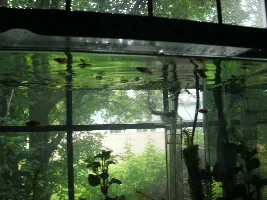
Tank Looking After Itself

Though I would advise weekly waterchange for people who are new to fish keeping, I do know of one fo the cuctomers inthe shop at which I work, who claims not to have carried out a waterchange in 28 years :blink: I perswaded him to bring in a sample of water for testing, as I was intregued asto what his levels looked like. All were normal, except GH, which was off the chart :crazy: KH was 4, ammonia nill, nitrite nill and nitrate was less than 12.5. pH of 7.5. He only topps up weekly direct from the tap, with no water conditioner :blink: All his fish are fine and he has only ever had to treat for disease once.
I was quite supprised by the results, but apparently it is possible to keep a tank that does not require maintanance. This one does not run a filter, is 20g and has arroung 15 inches of fish swimming in it....

This peron does have a clear knowlage of why his tank works though, where as most who ty this don't, so again, I would not advise following his lead. Things that we canno test for may well be dangerously high in his tank, but we have no way of telling without top spec lab equipment.

All the best
Rabbut
 
http://www.aquariumlife.net/print/article.asp?id=16
Explains what 'old tank syndrome' is.

Briefly, it means how a neglected aquarium can look fine, but the fish have just adjusted to living in extreme conditions and are suffering. When the owner buys a new fish, it can't cope with the poor conditions of the water and dies, so the person blames the shop, afterall they have fish living in it so why should other fish die?

Another thing to note, I cant find the website, but it gives a much better description of old tank syndrome, warns not to do water changes often on such a tank, you should do them gradually as the 'better water will kill the fish' as it will be a shock. If you do have a neglected tank, or know of one be careful about making it nice for the fish again.
 
There is a book called Ecology of the Planted Aquarium by Diana Walstad that describes the scientific aspect of what you want to do.

I've not got the book myself, but my understanding is she has a heavily planted tank with low stocking using normal garden soil as substrate and the plants take care of the majority of the waste. The tanks have no filters and water changes as rarely as 1 every 6 months.

Its also known as the "EL Natural" method.
 
There is a book called Ecology of the Planted Aquarium by Diana Walstad that describes the scientific aspect of what you want to do.

I've not got the book myself, but my understanding is she has a heavily planted tank with low stocking using normal garden soil as substrate and the plants take care of the majority of the waste. The tanks have no filters and water changes as rarely as 1 every 6 months.

Its also known as the "EL Natural" method.
I seem to recall that her stocking is not massively lower.

The book also describes the uses for an algae turf scrubber, which has allowed a number of people to go some time (years) without a water change and without the tank developing old tank syndrome (characterised by a supressed pH and low KH).

I agree that if you want to aim for a tank such as this, the above book is essential (if occasionally heavy going) reading.
 
am i correct in thinking that if you set the tank up correctly with the right fish etc then you shouldnt have to clean it out much?

depends what you mean by cleaning out. if you mean water changes, no you really must do them, unless you run a very specific tank setup. if you mean draining and cleaning the tank and contents, then yes it is possible, even desirable, to do this. but cleaning the filter is also something you will always have to do. incidentally cleaning the tank and contents means that your tank will never become "mature", something we all look for in our tanks, mature tanks tend to be more stable than their none mature counterparts
 
I think the point is, if you aren't willing to do water changes, whether you feel they're needed or not, perhaps you should buy a cactus instead. Or a Furby...
 
forgive me, but exactly where does the OP even mention water changes, never mind not wanting to do them?
 
I know when my 55 Gallon Tank was working at its peek with the some what pants I had I only had to do a water change maybe once a month and it was crystral clear. I also know that once I stopped cleaning my substrate I even got better readings because it seemed like the tank was cleaning itself. I know I had to do water fills maybe 2 times a month but the 2nd was also a clean fill for me.

Just my 2cents.
 
forgive me, but exactly where does the OP even mention water changes, never mind not wanting to do them?


'shouldn't have to clean it out as much'

Although posts after that mentioned other people who do not. You don't just have to talk to the OP.
 
There is a book called Ecology of the Planted Aquarium by Diana Walstad that describes the scientific aspect of what you want to do.

I've not got the book myself, but my understanding is she has a heavily planted tank with low stocking using normal garden soil as substrate and the plants take care of the majority of the waste. The tanks have no filters and water changes as rarely as 1 every 6 months.

Its also known as the "EL Natural" method.


This is the book, but she does not stock lightly. In fact, if she started a user here and listed here stocking, she's probably be flamed off the forum because she actually has very heavily stocked tanks. The one thing that she uses that is not talked about in her book is a powerhead or two to circulate the water -- to prevent stagnant zones because there s no filter return.

There is still a need for waterchanges, in my mind, however. There are a lot of chemicals in the air that don't affect us too bad because you just have to open a window to change out our air. But, there chemicals -- and I'm talking about carpet fumes, fumes from cleaning products, oils from cooking, if you smoke the cigarette smoke, all the daily things that give off small amount of fumes -- these all get into the tank eventually. And, chances are that the tank water isn't exposed to enough of them to become saturated, so they aren't going to get back out of the tank. Low level exposure to toxins can be exactly the same as acute exposure to high levels of toxins, that is can be just as deadly. If you do regular water changes, they will dilute and remove significant concentrations of these daily toxins, just we open the window to get fresh air.

However, as Diana Walstad shows in her book, for almost everything organic, nature has come up with a system of dealing with it. The nitrogen (in the form of ammonia primarily) is consumed by the plants. The dissolved organic compounds like tannins are used to bind up heavy metals and then the roots of the growing plants preferentially take up these bound up metals for micronutrient use. Because the ammonia isn't processed into acidic forms (nitrite, nitrate), the buffering capability of the water isn't consumed anywhere nearly as fast.

Shrimper, just make sure next time before you talk about a book, please have had read it before you post. Because what you posted here about the "low stocking" is 100% wrong, and is addressed many times in the book.

 
I know when my 55 Gallon Tank was working at its peek with the some what pants I had I only had to do a water change maybe once a month and it was crystral clear. I also know that once I stopped cleaning my substrate I even got better readings because it seemed like the tank was cleaning itself. I know I had to do water fills maybe 2 times a month but the 2nd was also a clean fill for me.

Just my 2cents.

I change 10% of my water a week and vacuum my substrate whilst doing so, however I dont by my Amazon swords as I have noticed that they grow better and show better colour when left with their "natural" fertilizer.
 

Most reactions

Back
Top