Sand?

is sand expensive?

Depends on what sort of stuff you get- there are quite a few types of sand for aquariums. The stuff i have is fine white silica sand, which is quite expensive as far as sand goes, but on the other hand you can also just use thoroughly washed childrens playsand which is very cheap to do (often cheaper than gravel).
 
thanks have you got a pic? i might go and buy some :D it seems alot more better for the fish but also i think it looks better :D
 
thanks have you got a pic? i might go and buy some :D it seems alot more better for the fish but also i think it looks better :D

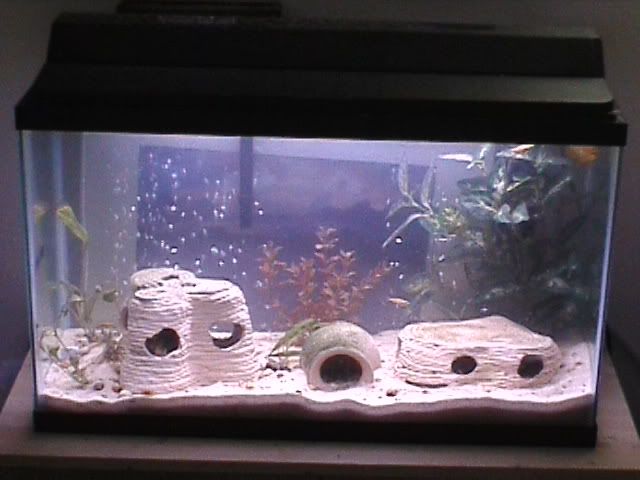
I got some pics of my fish/tanks that i took a couple of months ago, the sand looks whiter in life;

Whole tank shot;

fish4.jpg


Common pleco;

fish1.jpg


If you would like to see any more pics of the sand, feel free to say, but these should give a general idea of what it is like- it is very good for making the fish and decor/planting stand out more and make the tank feel larger and brighter, however, waste is obviously a lot more obvious look when it falls on it because it is so white.
 
humm what about if you put sand in over your gravel would that work because then some fish that like ravel would ahve the gravel and the others would have sand?
 
humm what about if you put sand in over your gravel would that work because then some fish that like ravel would ahve the gravel and the others would have sand?

The problem with gravel and sand is that the gravel often ends up just settling to the bottom of the sand layer where it can't be seen or interacted with by the fish, and often makes the sand a lot more compact too.
 
I moved to sand and never went back, I think it looks more aesthetically pleasing, and my plants have taken to it much better than they do to my gravel set up. I do have a kind of meandering line of gravel down the middle which gives a kind of river bed feel to the tank which I like.

My LFS owner was strongly against selling me sand for my tank as he said that it would be a nightmare to clean and would only look nice for a few months but being stubborn as I am I went with it anyway, I've had no probs and its been 6 months.

Kuhlis and Corys help to turn it over I have found.
 
thanks for that guys i like the pics thir really helpful can i see a few more i like the pleco ave you got much in ur tank
 
thanks for that guys i like the pics thir really helpful can i see a few more i like the pleco ave you got much in ur tank

The majority of fish are written down in my profile, the common pleco is around 10inches long and still growing, there is one other common plec in the tank as well as a sailfin pleco and a para plec.
Common and sailfin plecos poop a huge amount (as well as the clown pleco which also lives in the tank), so the sand needs to be regually cleaned to stay looking white, but having the sand does make it easier with dealing with the poop- if it were gravel, it would just fall in between it and be much more difficult to clean out.
Looking down at the water pic- feeding time;

fish22.jpg


RTBS;

Fish10.jpg


Coris and khuli loaches particually enjoy having the sand around, i remember when i first made the change from gravel to sand they were amazed at the stuff, they were practically burying their heads in it lol.


No, I have loads of it, I think there are 25KG bags at my LFS for like �5-6.

Tokis, the anerobic conditions lower nitrate and from everything I know do not create nitrite. They give off sulphur biproducts but those are harmless when they come into contact with oxygen rich water, like the water in our tanks.

Sorry typo error, i meant to say the anerobic conditions created hydrogen sulphide, which can kill fish- see Nmonks pinned article on sand and avoiding anerobic conditions;

http://www.fishforums.net/index.php?showtopic=131373

This is what happens in freshwater aquariums anyway, i think its a different matter in marine or soil substrate ones.
 
the common pleco is around 10inches long and still growing
huh please say thats not true i brought 2 plecos because the people in the shop tole me they would only reach 6" at the most. any ways i will prob have a bigger tank by the time they get that big. also i notised you had some cuecumber in your tank i was thinkon putting some foods liek that in my tank for my fish how long is it recomended that you keep the veg in your tank?
 
the common pleco is around 10inches long and still growing
huh please say thats not true i brought 2 plecos because the people in the shop tole me they would only reach 6" at the most. any ways i will prob have a bigger tank by the time they get that big. also i notised you had some cuecumber in your tank i was thinkon putting some foods liek that in my tank for my fish how long is it recomended that you keep the veg in your tank?


Yeah common pleco's do grow pretty big- there are actually two different types of common pleco which look very similar, one only grows to 9-12inches tops, while the other (and more commonly sold one) can grow up to 18inches long. My 2 common plecs are one of each of these two types, the 10inch long one i suspect is the larger growing type.
For the larger type of common pleco you are looking at a 125gal tank (5ft long and at least 2ft wide), while for the smaller growing type you need at least a 4ft long and 2ft wide tank.

Sailfin pleco's can look quite similar to common pleco's and usually grow to 2ft long although they vary a huge amount in max size- it mostly depends on the plecos gene's, diet and the conditions it is kept in during the first year or two of its life (when it grows the most).

Cucumber makes a great food for both common, sailfin and many other types of pleco's- i usually leave mine in for 24hrs+ as my plecs usually devour the whole slice during this time.
However, if it is mostly uneaten or just the outer flesh/skin left (as most pleco don't pay much interest in the skin) during this time, its best to take it out and either replace it with a fresh slice or just feed the plecos something else :) .

You can tell when a cucumber slice really needs taking out as when it rots (which is what you want to avoid in your tank), the flesh goes very squishy and eventually falls apart. Cucumber flesh usually goes hard when put into an aquarium, so if you are not sure when the cucumber is past its best, just feel its flesh to see if its squishy or not :good: .

edit: oh i just forgot to add, that cucumber floats in water so you will need something to weigh it down- i personally use little metal weights that often come with new aquarium plants, however, you can just as easily use something like a metal spoon and push the handle through the cucumber flesh to weight it down too :thumbs: .
 
Tokis hydrogen sulphide is netrualized as soon as it comes into contact with water, well the oxygen in the water (no quite instant but VERY fast).
 
Tokis hydrogen sulphide is netrualized as soon as it comes into contact with water, well the oxygen in the water (no quite instant but VERY fast).

I'm not sure on how quickly it is neutralised in water, however, if it is left to build up in the tank substrate and then is disturbed while cleaning, the effects can be very quick and very devasting on the fish population- i learnt this the hard way when i did not stir up my substrate for about a month when i was very busy (during this time loads of pockets of this gas built up) and then disturbed the gas pockets during a tank cleaning session.

Most of the fish were unaffected, but the more fragile fish like oto's were much more affected and i lost a couple within about under an hour. Ammonia and nitrites were 0 during this time, nitrates around the usual 16- it was the hydrogen sulphide which killed the oto's.
 
Quotes from Bignose (hope you don't mind?)

hydrogen sulfide gas that can be created in anaerobic conditions is very quickly neutralized by oxygen when in aqueous solution (dissolved in water)

The main concern people have about sand would be anaerobic bacteria build-up. Anaerobic meaning without air, though more accurately, without oxygen. If you didn't know, the ammonia and nitrite reducing bacteria require oxygen to work (to convert ammonia to nitrite and to convert nitrite to nitrate).

Anywho, under anaerobic conditions, bacteria start to get their energy from other sources, like reducing sulfur instead of oxygen. And a by-product of that is hydrogen sulfide, yes, one of the deadliest compounds in nature.

But, there is relief. In water, as soon as hydrogen sulfide comes into contact with any oxygen, it will become harmless. So, even if there is a pocket, and even if you accidentally stir it up, it will become harmless as soon as it hits your well-oxygenated water. And you know your water is well-oxygenated since your fish are living in it, and they need oxygen. This is the stinky smell you got, sulfurs, but you most likely smelled sulfur oxides, not hydrogen sulfide. Like I said, hydrogen sulfide decomposes very quickly in the presence of oxygen while in aqueous solution.

So, there really isn't anything down there to worry about, so my recommendation is to not stir it at all. Just vacuum the top of the sand to get the uneaten food off the top. If uneaten food on the top is a constant problem, you probably should be feeding less, maybe a lot less. If it really bothers you, maybe decrease the thickness of your sand layer.

p.s. Another source of energy anaerobic bacteria may use is actually to convert nitrates to nitrogen gas. This is what living rock and living sand does for some marine tank setups.

Many biological processes generate electrons, and these have to be used somewhere (the organism does not allow charge to build up). The transfer of charge can also be used a source of energy not unlike how we (humans) light lightbulbs for example. Most typically, oxygen can be used as an electron acceptor, since it is normally available, and tends to be the most favorable acceptor (measured by redox potential). The oxygen redox is +816 mV, (+ means it is favorable). Nitrate redox is +421 mV.

This nitrate redox is what the live sand and live rock are performing:

NO3(-) + 2 H(+) + 2 e(-) --> NO2(-) + H2O

This is only the first step, nitrate to nitrite. The overall reaction is:

NO3(-) --> NO2(-) --> NO --> N2O --> N2

Nitrates to nitrogen gas.

When oxygen and nitrates are gone, many bacteria begin to substitute Iron (Fe) or Manganese (Mn) to accept the electrons generated. While there is typically much more Iron than Manganese, Mn is th better electron acceptor:

MnO2 + 4 H(+) + 2 e(-) --> Mn(2+) + 2 H2O

When MnO2 is exhausted, ferric iron can be used to accept electrons:

Fe(OH)3 + 3 H(+) + e(-) --> Fe(2+) + 3 H2O.

Both of these have lessor redox, though. Mn: +396 mV, Fe: -182 mV.

Sulfate can also be used as an electron acceptor:

SO4(2-) + 10 H(+) + 8 e(-) --> H2S + 4 H2O

which has a redox potential of -215 mV But, when nothing else is available to accept the electrons, the organism has to go somewhere with them.

So, if the substrate is anaerobic and has been delpleted of its manganese and iron, it may turn to sulfer (which is in all the foods and is typically very abundant). And note that a by-product of the reaction is hydrogen sulfide (H2S) gas that is very toxic to all living things. The really good news is that H2S is very unstable near oxygen. As soon as H2S runs into some oxygenated water it becomes sulfuric acid, which while dangerous, it nowhere near as bad as hydrogen sulfide gas:

H2S + 2 O2 --> HSO4(-) + H(+)

As a point, H2S was found to be negligible in a study of a swamp with oxygenated water, even when the sediment levels in the swamp were very high. I think that the classic danger that is warned about is H2S gas, but my understanding is that H2S is neutralized very very quickly. So you would have to have quite a lot of stagnant H2S for it to come out of the subtrate and kill something.
 
changing from gravel to sand

Simply rinse your sand by placing a one inch layer in the bottom of a bucket or spare five gallon. Fill the bucket stirring the sand as much as possible. When the bucket is full of water dump it all out leaving only the heaviest sand particles in the bucket. Repeat this process until the water clears completely after stirring within ten-fifteen seconds. This prevents massive cloudiness in your tank when you add the sand.

Next you should gravel vaccum your tank thouroughly over a couple days. Once you've done this bring your sand into the room your tank is in. Now you should scoop out the gravel with a thouroughly cleaned and even more thouroughly rinsed (soap is bad for fishies) cup. Dump the gravel into a container for disposal/storage. after you have cleaned out all the gravel you can begin adding sand.


(any other soil substrate should be added before the next step)

If you rinsed your sand properly there should be almost no cloudiness to your tank after this step. You may want to turn your filter off for this step. I didn't but it is recommended. Take the cup you used to remove the gravel and scoop out a cupfull of the sand. Lower the cup into your tank right side up. Once you have reached the glass gently pour the sand into a big pile in a corner. Repeat this process a few times and then smooth out the sand. You'll want a 1/2 to 1" layer if you have no plants a bit more if you do have plants. and that's about it. If you do get some cloudiness don't worry about it your fish should be just fine. Oh and one more thing be careful if you have a megnetic driven impeller in your filter. If sand gets into that you'll have some noisiness and a possibility of a busted filter.


If your worried about anaerobic bacteria then go to your pet store and get some MTS/ malaysian trumpet snails. They regularly turn over the sand so you don't have to. Cories khuli's and cichlids tend to do this aswell but you may run into compatibility issues. MTS can go in most tanks and are free.

here's a pic of my girlfriends tank right after the switch to sand ignore the plants they weren't doing so hot at the time...

DVC01267.jpg
 

Most reactions

Back
Top