What's new

Safe Number Of Water Changes?

I think what i am saying has been slightly misunderstood here. I agree with the points you are making and do not dispute them.

Does Mr Axelrod explain how a fish can experience osmotic shock when new water with identical (or near identical) pH and hardness levels is introduced?

I bet he doesn't ;)

No he doesn't, and i never claimed that he does. As i said in my previous post, I am referring to when, for instance, water changes have been neglected and maybe PH has varied significantly. (not when new water with identical or near identical PH and hardness levels is introduced).

I quote Mr Axelrod to clarify exactly my point for the aviodance of doubt;

"Aquarists often allow long intervals between partial water changes. During that time the water of the aquarium can undergo extreme changes in chemistry, most notably a massive buildup of nitrates and a reduction in PH as the acids of metabloism accumulate. These changes, however, take place gradually, and as the weeks pass, the aquarium inhabitants slowly acclimate to them. A large water change at this point presents an extreme chemical shock to the fish, as the PH jumps up and the nitrates drop. Any change in water chemistry needs to be gradual, even if the change is for the better."

Again, both myself and Mr Axelrod are referring to replacing tank water with water of a very different chemical make up.

Hope this clarifies my point.
 
Sorry to get involved i just need some clarification, i have heard many mixed opinions on 'osmotic stress' and/or 'osmotic shock' in freshwater fish. I believe (perhaps naively) that i've got the very basic jist of it, but could any of those with an honestly decent scientific knowledge clarify or perhaps elaborate, particularly on its connection with PH?
My summation is in post#7 in this topic--> link. Can't find the original post, but someone mentioned it only applying to saltwater fish, even i know this is wrong, but i do think the topic is not widely understood. I'm sure it should be mentioned in conjunction with many of the emergency questions brought up on here, particularly those relating to physical damage.
But again, i may be incorrect.
Thanks in advance for any replies concerning this.
 
Well one person sites the "fact" that osmotic stress is a null point and that changes in hardness are more of a problem. I can't agree with that. A ph of 7.0 is neutral, a ph of 6.0 is 10 times more acidic, a Ph of 5.0 is 100 times more acidic, and a Ph of 4.0 is 1,000 times more acidic. Changing from one Ph to another can be a very great shock. A change in Ph of 2 on the Ph scale is 100 times different than the original and is a great shock for any fish. However change in hardness doesn't affect a fish except when breeding. I don't know where he gets his info from and I would very much love to see it.
 
Yep, its a logarthmic scale.
I'm not exactly sure how PH affects the osmoregulatory function in fish though. My other main query is how much of a negative effect does the mineral differences between what a fish would experience in the wild (and i assume has evolved to be more tolerant toward) and those encountered in an unsuitable aquarium (ie; leading to osmotic stress, rather than shock with which the cause, on its simplest level, is more understandable ie; a rapid change in conditions) have when sodium chloride is ignored, if it can be in regards to this?
A simple question, phrased very complicatedly, head hurts now...
 
OK, well then, here's a little primer on pH, osmotic stres, etc.

Firstly, let me talk about pH. Yes, pH is a logarithmic scale. The p is mathematic shorthand for the negative of the base 10 logarithm (wirtten -log_10) and the H is shorthand for the concentration of H+ ions. So, how does this work? Well, a concentration that has 10^-7 ("ten to the minus seventh power" or 0.000 000 1) moles of H+ ion per liter has a pH of 7.0. The log base 10 of 10^-7 is equal to -7, then the negative of -7 is 7, hence the answer. 1 mole of a substance is 6.022x10^23 molecules of a substance. It is defined like this because in chemistry it is far easier to work in numbers of molecules of a substance for balancing chemical reactions rather than the masses of the reactants.

One really important thing to note here, however, is how small of a number 10^-7 or 0.000 000 1 really is. Now, 10 times that, 10^-6 is 0.000 001. And, while it is a ten-fold difference, both numbers are still really quite small. This is why changes in pH are not as dramatic as they are made out to be. Yes, it is a 10 fold increase to change 1 pH unit, or a 100 fold increase to go 2 pH units, but until you get to pH's of about 2 or 3, we are talking about very small quantities of substances here. And a 10 fold change of a small quantity is almost always still a small quantity. This is why changes of 1 or even 2 units in pH aren't really all that bad for fish, *if the hardness changes aren't too big either* I'll explain this below.

Next, let me talk about osmotic stress. First off, osmotic stress and pH are pretty much unrelated. Osmotic stress is based on the concept of osmotic pressure. The total pressure in a liquid is both a function of the density of the fluid and what has been dissolved in that fluid. The osmotic pressure is the part that is related to what has been dissolved in it. It is useful in determining in what way pure water and/or the minerals dissolved in the water are going to go. As relating to fish, the fish have certain minerals/nutrients they keep in their bodies and of course, the water they live in has certain minerals dissolved in it. Osmotic pressure/stress is NOT a function of the charge of what is dissolved in the fluid, however, so pH being a concentration of a charge, does not have an effect.

Regarding osmotic stress, I want to write first here about how not to use it. Often, people will add salt when their fish are sick, thinking -- because they've seen it written on the Internet and the box of aquarium salt itself says it -- that this will reduce the osmotic stress of the water. Well, firstly, the fish have lived and adapted to the osmotic stress, the difference in osmotic pressures between their bodies and the surrounding water, their whole lives. They do not need to be relieved of it any more than we need to be relieved of the pressure, or the stress, of Earth's atmosphere pressing on us when we are sick. Secondly, the fish actually use that osmotic pressure to perform their regulatory functions.

Here is the promised discussion why the fish use the osmotic pressure and changes in hardness are much more important than changes in pH. We all know fish excrete ammonia as waste. Well, that is not quite 100% true, since fish actually excrete ammonium, NH4+, not ammonia, NH3. Their waste is in the ionic form. Also, fish excrete a large amount of that ammonium via their gills, over 80%. There is some excreted with their urine, but the majority is done via the gills.

It is important to know that they excrete the ionic form, because when they want to remove ammonia from their bodies two things occur. 1) Since there is very little or no ammonium in the surround water, the ammonia will diffuse preferentially out of the fish's body. Diffusion occurs down a concentration gradient. That is, it will leave the high concentration, in the fish's body, to go to the low concentration, the surrounding water. This is advantageous to the fish, since the ammonium wants to leave the body naturally, it doesn't have to expend any energy for this to occur. Nature does the work for it. 2) Since it excretes the ionic form of ammonium, NH4+, at the gills the fish has to maintain a charge balance. That is, since it loses a positive ion, it must pick up a positive ion to remain in balance. And the usual positive ion the fish picks up to keep the charge balance? Na+, ionic sodium. Sodium being among the most commonly dissolved minerals in the water. Fish can also use Ca2+ and other positive ions, like potassium, K+. And what is the main measurement we use to know how much positive ions are in the water? The hardness which measures the total amount of minerals in the water.

Note here, that there is two principles at work, diffusion down a gradient and a charge balance; these two principles can work together or can work against each other.

So, how do large changes in hardness affect the fish? Let's do some examples. Consider a fish that goes from high hardness water to low hardness water. The problem here is that low hardness water won't have as many positive ions available for ion exchange at the gills. That means the rate at which ammonium can leave the fish's body is severely hampered, especially compared to the water it was previously in. The fish's body had gotten used to being able to perform a certain rate of ion exchange with its surrounding water, and when it gets placed in water that has much lessor ion exchange capability it take the fish's body a while to re-adjust. And, meanwhile, the ammonium in the fish's body that cannot be exchanged as fast is building up -- poisoning the fish's body, actually. This is why large changes in hardness is tough on fish's body. In this case, the principle of the charge balance harms the fish.

Now, consider the opposite example. The fish goes from low hardness water to high hardness. In this case, the ammonium won't build up because there are ions available for exchange. But, in this case the principle of diffusion down a gradient is what will harm this fish. Because, the fish coming from low mineral content water will have lower mineral content in its system. So, when it is placed into high mineral content water, the minerals in the water are going to want to enter the fish's body. So some extent, that higher concentration of minerals are going to try to flood into the fish's body. Again, there is a period of readjustment that has to occur before the fish's bodies acclimate. This is why large changes in hardness is tough on fish's body.

In both cases, the fish can carry out its normal bodily functions, but they wll have to expend energy to perform their tasks. Like, in the first example, the fish can expend energy to expel the positive ion even though there are no other ions to exchange it with. The energy is expended in order to neutralize the NH4+ to turn it into NH3. In the second example, energy is expended to prevent the ions from flooding into the fish's system. In general, a fish will survive the second example better than the first. But both can be pretty stressful and should be avoided if possible.

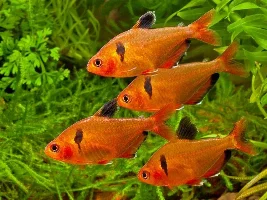
Finally, experimental evidence shows that fish can change their internal pH's very quickly in response to pH changes in the environment. Data indicate that most fish's excrete a net acid flux of 10 to 100 micromol per kilogram per hour under control of steady acid-base conditions. Some back of the envelope calculations indicate that assuming the low number there, 10 micromol per kg per hour, that a small aquarium fish (I did it for a tiger barb) can change its pH over 4 units per hour. A larger fish is going to take a little longer, but the point remains the same, that a fish can change its pH very quickly. Again, this really is best evidenced by nature where the pH in lakes can change 2 units through the course of a day, and again the runoff during hard and fast rains.

This information is taken from the articles: Evans, Piermarini, and Choe, "The Multifunctional Fish Gill" Dominant Site of Gas Exchange, Osmoregulation, Acid-Base Regulation, and Excretion of Nitrogenous Waste", Physological Reviews Vol 85, 2005 and Claiborne, Edwards, and Morrison-Shetlar "Acid-Base Regulation in Fishes: Cellular and Molecular Mechanism", Journal of Experimental Zoology Vol 293, 2002.

So, there you guys go. Please feel free to ask any questions, I am happy to answer them. But, as a synopsis of the research I presented above, it is the differences in the mineral content -- typically measured as hardness by home aquarists -- that is the real stressors for fish. It is typical that hard water has high pH and soft water has low pH, so I can understand how the connection was made between stress and pH. But, the experiments in the scientific literature just don't back that up. The scientific literature has much evidence that shows that difference in mineral content are much more important to a fish's biological processes, however.

 
So, how do large changes in hardness affect the fish? Let's do some examples. Consider a fish that goes from high hardness water to low hardness water. The problem here is that low hardness water won't have as many positive ions available for ion exchange at the gills. That means the rate at which ammonium can leave the fish's body is severely hampered, especially compared to the water it was previously in. The fish's body had gotten used to being able to perform a certain rate of ion exchange with its surrounding water, and when it gets placed in water that has much lessor ion exchange capability it take the fish's body a while to re-adjust. And, meanwhile, the ammonium in the fish's body that cannot be exchanged as fast is building up -- poisoning the fish's body, actually. This is why large changes in hardness is tough on fish's body. In this case, the principle of the charge balance harms the fish.

Now, consider the opposite example. The fish goes from low hardness water to high hardness. In this case, the ammonium won't build up because there are ions available for exchange. But, in this case the principle of diffusion down a gradient is what will harm this fish. Because, the fish coming from low mineral content water will have lower mineral content in its system. So, when it is placed into high mineral content water, the minerals in the water are going to want to enter the fish's body. So some extent, that higher concentration of minerals are going to try to flood into the fish's body. Again, there is a period of readjustment that has to occur before the fish's bodies acclimate. This is why large changes in hardness is tough on fish's body.

In both cases, the fish can carry out its normal bodily functions, but they wll have to expend energy to perform their tasks. Like, in the first example, the fish can expend energy to expel the positive ion even though there are no other ions to exchange it with. The energy is expended in order to neutralize the NH4+ to turn it into NH3. In the second example, energy is expended to prevent the ions from flooding into the fish's system. In general, a fish will survive the second example better than the first. But both can be pretty stressful and should be avoided if possible.

Thanks very much Bignose, the above paragraphs being particularly helpful.
I have heard of osmotic stress having built up over a long period of time, is this incorrect. For example gourami from nutrient poor waters suffering lethal osmotic stress after a long period in which they must have had time to acclimatise to the mineral rich waters the are kept in.
Is this nonsense?
Also, i assume the increase in likelihood of osmotic stress does indeed increase when a fish has suffered significant scaleloss, physical injury. Where in this instance does the diffusion of minerals, take place? Basically the increased risk of osmotic stress. Does it in some way take place in every cell and the scaleloss increase permeability? Are the minerals lost via bloodloss etc? Is it caused via diffusion of the minerals in/out or both?
Or have i missed something?
Sorry, i'm what i'd consider scientifically stupid.
 
Yes, I think that osmotic stress over a long time is pretty much a non-statement. If the fish has survived its transition period, it has acclimated and gotten used to the new water conditions (new osmotic pressure and all).

DIffusion takes place wherever it can. Cell walls are built specifically to control/regulate this diffusion, and sometimes to anti-diffuse, that is, the cell walls push chemicals against the preferred direction of diffusion. So, chemicals diffuse out of a fish's entire body, but the gills are the primary place. Very much like our lungs, the gills have lots of surface area for diffusion to occur through and lots of blood vessels to carry away was diffused in and to carry stuff that needs to be diffused out. The fish's bodies are also able to better control the diffusion at the gills, it is a property of the cells that make up the gill tissue.

Now, if a fish has a major injury, such as an open wound or whatnot, diffusion can take place there as well. It is much more difficult to diffuse out through a scale than flesh, so normally the scales and hence the body of the fish normally has very little diffusion. But, obviously an injury changes that. The real problem comes when an injury occurs and you get that "flooding" example I showed above. In this case, the fish's body intakes a bunch of minerals it wasn't adapted to, and expends large amount of energy to push those minerals back out against the gradient through the gills only to have them return unregulated through the wound.

So, yes, a large wound of this nature severely hampers a fish's osmoregulation. A fish with such a large wound probably doesn't have much of a chance to survive. Besides the large wound, the much more difficult osmoregulation makes chances even less likely.
 
Bignose, thanks very much indeed.
Not to be ungracious but i thought only plants had cell walls wheras animals had cell membranes? Not that it makes a difference, just being pedantic with the few facts i (think i) know.
Anyway excuse the nitpicking, very much appreciated.
 
You are probably right, I don't know. My studies actually aren't in biology, so I can believe that there are different names for the different types. The cells in a plant are typically much more rigid. So, they very well may be called by different names. Either way, I used wall and membrane pretty interchangeably there, and the point remains the same.
 
Well one person sites the "fact" that osmotic stress is a null point and that changes in hardness are more of a problem. I can't agree with that. A ph of 7.0 is neutral, a ph of 6.0 is 10 times more acidic, a Ph of 5.0 is 100 times more acidic, and a Ph of 4.0 is 1,000 times more acidic. Changing from one Ph to another can be a very great shock. A change in Ph of 2 on the Ph scale is 100 times different than the original and is a great shock for any fish. However change in hardness doesn't affect a fish except when breeding. I don't know where he gets his info from and I would very much love to see it.

Araura, I just wanted to know if you understood what I wrote and why pH shock is not nearly as big of a factor as it is made out to be. Why a change of even 2 full pH units is not that big of a change until you get to pH's near 3. And why hardness changes are very stressful on the fish.
 
One really important thing to note here, however, is how small of a number 10^-7 or 0.000 000 1 really is. Now, 10 times that, 10^-6 is 0.000 001. And, while it is a ten-fold difference, both numbers are still really quite small. This is why changes in pH are not as dramatic as they are made out to be. Yes, it is a 10 fold increase to change 1 pH unit, or a 100 fold increase to go 2 pH units, but until you get to pH's of about 2 or 3, we are talking about very small quantities of substances here. And a 10 fold change of a small quantity is almost always still a small quantity. This is why changes of 1 or even 2 units in pH aren't really all that bad for fish, *if the hardness changes aren't too big either* I'll explain this below.

I dont quite understand youre argument on the insignificance of pH changes. My thoughts are that surely no matter how small an amount is being dealt with, that the important factor would be the way the fish react to these tiny amounts.

Please correct me if i have mosunderstood
Sarah
 
If the change is very tiny, then there won't be any response. For example, say you added a pinch of salt to a pot of stew. Would you really be able to tell a difference in taste? No, because the amount added was so very tiny.

The amount of H+ ions that change from a pH of 7 to 6 is a very, very small amount. So small, that really it is unnoticeable. It is like that pinch of salt added to a large pot of soup.

And besides all that, did you miss the part where I cited the literature to show that a fish can change its internal pH 4 units in about an hour? A change of 1 pH unit is almost insignificant to a fish. It has the ability and the internal mechanism to adapt very, very quickly to differences in pH.
 
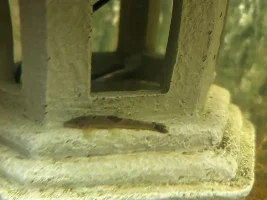
I have a 67L Jewel tank, that currently has 3 x cory's, 2 x glassfish, 2 x danio's and 2 x adult bristlenose plecos that have spawned 2 sets of eggs.

The problem is that I have now about 60/70 bristlenose babies in the tank. This was accidential, I had no plans to breed and I was sold 2 females, but one he turned out to be a she and by the time I knew it was too late. I know this is far too many fish for one tank, but unfortunately I don't currently have the means to house another tank. I am in the process of getting them homed in a LFS, but they can only take so many at the time, I don't trust the other store as I gave them 10 fish already and all but 1 died. I am homing another 15 tomorrow.

Anyway, the tank gets very dirty, I have been using the gravel cleaner once a week now, but the water is still quite bad even though I cleaned it yesterday, doing a 33% water change. How many water changes can I do without badly affecting the equilibrium in the tank? I was tempted to give it another 33% change today again, but thought I would leave it until I got further advice.

Can't wait until they are homed, I need to get more glassfish but can't risk it just now.


get some 5 gallon buckets from the hardware and put some of the catfish in it... give them an air stone and feed them algae pellets till you can rehouse them...
 
get some 5 gallon buckets from the hardware and put some of the catfish in it... give them an air stone and feed them algae pellets till you can rehouse them...

Not that it's bad advice, but I'm hoping Mushroom hasn't waited around almost 2 years for this reply.

The original pressing information at the top probably isn't all that pressing anymore, but if there are more questions about what I wrote, I'll be glad to answer them.
 

Most reactions

Back
Top