Melanotaenia Praecox Bloated?

Schmill

Fish Herder
Joined
Apr 9, 2008
Messages
1,329
Reaction score
1
Location
GB
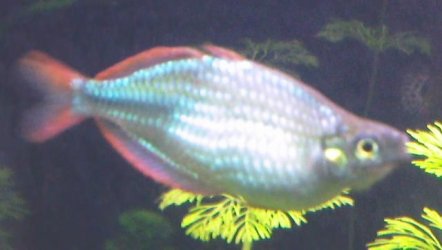
I've noticed that one of my Male praecox has a very swollen abdomen towards the front of his body.

His fins are up and full.
He is swimming fine.
He is eating fine.
I cannot comment on pooing as I have never seen him do it, (but then I have never seen any of the Praecox do it!)

He is at least twice as wide as the other males in the tank, and is 'perhaps' breathing his gills a bit faster than the others.

I've tried peas, but he shows absolutely no interest what-so-ever in going near them!

All in all he seems fine other than this bloating, but it can't be normal so I don't really know where to start...

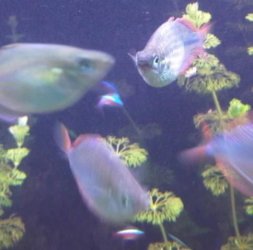
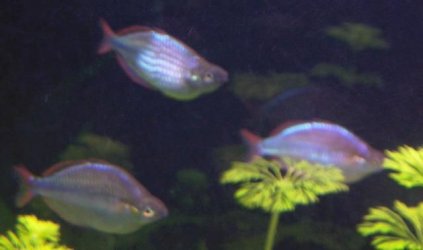
There are a few pictures of him below, and I've tried to include a 'normal' one as well, but they don't keep very still so it's tricky!

(He is the top red finned male in the first & last pictures)
 

Attachments

  • Photo_0172_e.jpg
    Photo_0172_e.jpg
    22.3 KB · Views: 201
  • Photo_0174_e.jpg
    Photo_0174_e.jpg
    26.4 KB · Views: 241
  • Photo_0202_e.jpg
    Photo_0202_e.jpg
    26.9 KB · Views: 145
Are scales sticking out.
Is his anus enlarged or red and inflamed.
What do you feed the fish.

Don't feed the fish for two days.
Epson salt baths to help draw the fluids out.

Size of tank in gallons or litres.
How many fish and which type.
Water stats in ammonia, nitrite, nitrate, and ph.
 
Are scales sticking out.
Is his anus enlarged or red and inflamed.
What do you feed the fish.

Don't feed the fish for two days.
Epson salt baths to help draw the fluids out.

Size of tank in gallons or litres.
How many fish and which type.
Water stats in ammonia, nitrite, nitrate, and ph.

Scales sticking out
Nope

Is his anus enlarged or red and inflamed.
Other than being bloated the fish looks normal.

What do you feed the fish.
King British Flake food, Algae Flakes, Nishi Growth Pellets (ground and in small qtys), Earth Worm Pellets, King British Catfish Pellets, frozen (but thawed out) Bloodworms.

Don't feed the fish for two days.
I'll have to starve all the fish in the tank, as I would prefer to not put him into the fairly small breeding trap that I have. That will be ok?

Epson salt baths to help draw the fluids out.
Where would I get Epson salts?

Size of tank in gallons or litres.
300L

How many fish and which type.
Cardinal Tetra, Corydoras, Praecox, Guppies, Bulldog Pleco.
All other fish are fine apart from this one praecox, and tank is stocked at less than 1.5"/gallon taking into account full adult sizes, which many of the fish are less than.

Water stats in ammonia, nitrite, nitrate, and ph.
I don't have the exact figures to hand, but I know that the ammonia and nitrIte are both 0, (if they hadn't been i would have been busily trying to sort that out!), and NitrAte is around 40-60 ish according to my API liquid test, if the test results are to be believed.
 
To many dried foods can lead to bloating and constipation.

Research the fish diet needs.
Get some frozen daphnia as that helps the fish digest its food. Also fish tend to love brime shrimp.
Over feeding bloodworms can lead to bloating.
Don't feed bloodworms for a week.
Also research if your fish can eat green veg.

The only test kit in api that not very good is the nitrate one. Its not that accurate. Try the tetra brand as I use that and its good.
 
I believe it may have been the bloodworms that did it, as the praecox are a bit glutten when the bloodworms are in tank.

I haven't been feeding the fish, only leaving it peas to eat, but so far it hasn't touched them. I have just bought some more peas, and got my hands on some Epsom Salts.
Can you please tell me the ratios for making up the Epsom Bath? Also how long do I leave the fish in there for?

I am 90% certain it is constipation now, (hence the salts and the peas), as he is still in the bredding trap, and there is no poo on the floor of the trap.
 
It mentions both a low-dose long-term bath on there, and also a higher-dose short-term.

As a cure for fungus, or to help relieving swelling, use can use a tablespoon of salt per gallon.

Use sodium chloride (Aquarium, rock, or kosher Salt) for fungus;
use magnesium sulfate (Epson Salt) for internal swelling or constipation.

These are appropriate concentrations for short term dips intended to last from 5-10 minutes, or up to 30 at longest.
So a TABLESPOON per Gallon (3.8L presuming it's a US Gallon) for 5-30 minutes, (guessing try 10 and if no effect do it longer then next day?)

Use a teaspoon per gallon if you want to add this to the fish's tank as a live-in bath: change 25% of the water weekly and do not add additional salt.
So a TEASPOON per Gallon (3.8L presuming it's a US Gallon) as a 'permanent' bath until the problem is resolved.

I have neither a spare tank, heater or filter, so the best I could do would be a large bowl with an airstone at room temperature. For this reason I am thinking perhaps the short-term 'dip' rather than the long term 'bath' would be better?

I'd like to know which way is recommended and if people have had results with it?
 
You can use higher doses.

But I would try the standard dose first to see how the fish handles it.

Epson salt baths help draw the fluids out. It work sometimes but not always.

You can use cod liver oil. A drop in the fish mouth. But you can't feed the fish for two days.
 
Ok so he is currently in a bowl with around 3L of water, and just under a teaspoon of Epsom Salts disolved in.
He's been in there around 15 minutes now.

Should I notice anything? Should he start pooing whilst in the solution, or is it literally just a case of leave him in for some time, then transfer back to the floating breeding trap and then see what happens?

Whilst he is in the bowl, thanks to it's magnifying effect, I can see his scales seem to have started to lift too, (before he went in the bowl, not caused by the salt bath!)
 
Sounds like dropsy if the scales are sticking out.
Add another teaspoon to the bowl but stir the salt in some water before you add it to the bowl water.

Dropsy


Symptoms:

This disease is very common among African Cichlids, and is commonly called "Malawi Bloat," even though it affects fish from Lakes Tanganyika and Victoria. Dropsy is also very common within the Carp family and among Anabantids. It is characterized by swelling of the body and especially abdomen, which causes the scales to stand out with a pine cone appearance. Eyes may protrude or cave in. Reddening at the vent and/or base of fins may be observable as well as body ulcers and long pale feces. In advanced cases, skin discoloration and scale loss may also occur. Sick fish will not show any desire for food. They will often hang near the bottom, resting on the gravel, or at the top, gasping for air. In the latter stages of this disease, the fish may lose its equilibrium and hence ability to swim properly.


Cause:

Three main causes for Dropsy have been identified. The over use of salt (NaCl), prolonged exposure to poor water conditions, and improper diet, which lead to a parasitic infection. Other causes include poisoning, internal injuries and cancerous tumors. The swelling is not the disease itself, but rather a symptom, which is caused by a build-up of fluids in the body cavity due to internal organ failure.


Treatment:

Treatment of this disease is difficult, as by the time it is recognized, permanent damage to the internal organs of the fish will have occurred. Immediate treatment must be performed if there is to be any chance for survival. Metronidazole (Flagyl) and or Clout are the best medications for treatment of Dropsy. Notwithstanding, not much is known for certain about the etiology of this disease and some experienced aquarists use antibiotics to fight Dropsy. For oxytetracycline, baths of 20-100 mg/litre for five days is suggested. For tetracycline hydrochloride, treat with baths of 40-100 mg/litre for five days. And for minocycline hydrochloride a dilution of 250mg/10 gallons of water is recommended. On day 2 change all the water and add the medicine again at the same dose for another 2 days. Increase aeration during treatment. Do not use minocycline a third time in a row. Caution: tetracyclines are photo sensitive so turn the tank lights off during treatment and cover the whole tank with a blanket. If the fish is still eating, you can soak the food in a concentrated solution of the antibiotic before feeding.
 
Cheers -_-

Will add some more salts, and leave him in there for a while, then put him back into the floating trap in the tank, and add some more anti-bac (esha 2000) to the tank, and maybe try some chopped peas.

Fingers crossed...
 
Good Luck.
It's really best to issolate fish with dropsy, as if the other fish peck on his body body they can get infected.
 
I can't isolate him into 'other water' as I have no spare heater / filter.
However I have a floating breeding trap that I have been keeping him in, which allows me to target feed him and also keep the other fish away from him.
It is similar to this one:
A931.gif

The water will mix with the main tank, but the fish itself will be isolated, this is why I am dosing the tank with esha 2000 as well.
 
The little breeder box will have to do. There not great.
If he's stressed it won't help him get better.

Once scales start to stick out it the last stage of dropsy organ failure.
Hope he makes it.
 

Most reactions

Back
Top