How do you read API pH test?

FishFriend0

Fish Fanatic
Joined
Dec 31, 2023
Messages
134
Reaction score
40
Location
Salisbury, UK
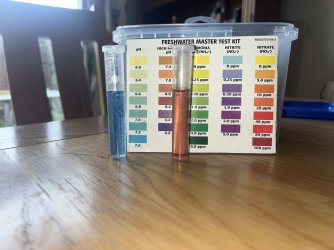
I am currently doing research for my second fish tank and am trying to determine the pH of my water but I am struggling. I will attach a picture and maybe one of you can see it clearer (it is the normal and higher range tests)

Also, I was wondering (because this is from my tank) what makes the pH of tap water differ from the pH of tank water? Is it true that tannins in the water lower the pH. But if so, what else?
Thanks, FishFriend0
 

Attachments

  • IMG_3495.jpeg
    IMG_3495.jpeg
    235.8 KB · Views: 21
That looks like a pH of 8 to me. I know if I stare at the results of my own tests too long I'll begin to question what I'm seeing. Good light helps, and a second opinion can confirm what you're seeing if you've got someone else around to take a look. I wouldn't worry about it too much if the tank is stable.
Tannins do lower pH so that could account for the difference between your tap and tank water. Not much else we'd normally put in our tanks lowers pH.
 
To me, it looks like it's between 8.0 and 8.2. Tannins can have an effect on pH levels, along with many other things. What sort of substate do you have in the tank? Aquasoil usually impacts pH levels (Fluval Stratum is an example). Gravel or sand can sometimes contain traces of limestone, which can buffer pH as well. If you have harder tap water, the KH levels can act as a buffer to stop acids from reducing the pH, leading to above-neutral pH levels.
 
pH isn't always an important reading. Water hardness is what matters, and pH is usually (not always) an indicator of that. Yours looks to me to be a high pH, around 8, so that suggests hard water.
I'm an ocean away, but doesn't your region have chalky soil? That would increase hardness, and no amount of additives would change the pH much. Rainwater or reverse osmosis water would, but that is a whole set of problems.

It appears to me you'll be looking up info on fish that like hard, mineral rich water...
 
There is more to pH than a simple test. Water chemistry is somewhat complex. Here is an iimportant consideration in what can hold pH stable or result it it dropping or rising. The info below comes from the FINS site. To learn more about basic water chemistry nin simples terms I usually usggest people have a read here: https://fins.actwin.com/mirror/begin-chem.html
The general FINS site information is here https://fins.actwin.com/aquariafaq.html


Buffering Capacity (KH, Alkalinity)​

Buffering capacity refers to water's ability to keep the pH stable as acids or bases are added. pH and buffering capacity are intertwined with one another; although one might think that adding equal volumes of an acid and neutral water would result in a pH halfway in between, this rarely happens in practice. If the water has sufficient buffering capacity, the buffering capacity can absorb and neutralize the added acid without significantly changing the pH. Conceptually, a buffer acts somewhat like a large sponge. As more acid is added, the ``sponge'' absorbs the acid without changing the pH much. The ``sponge's'' capacity is limited however; once the buffering capacity is used up, the pH changes more rapidly as acids are added.

Buffering has both positive and negative consequences. On the plus side, the nitrogen cycle produces nitric acid (nitrate). Without buffering, your tank's pH would drop over time (a bad thing). With sufficient buffering, the pH stays stable (a good thing). On the negative side, hard tap water often almost always has a large buffering capacity. If the pH of the water is too high for your fish, the buffering capacity makes it difficult to lower the pH to a more appropriate value. Naive attempts to change the pH of water usually fail because buffering effects are ignored.

In freshwater aquariums, most of water's buffering capacity is due to carbonates and bicarbonates. Thus, the terms ``carbonate hardness''(KH), ``alkalinity'' and ``buffering capacity'' are used interchangeably. Although technically not the same things, they are equivalent inpractice in the context of fishkeeping. Note: the term ``alkalinity''should not be confused with the term ``alkaline''. Alkalinity refers to buffering, while alkaline refers to a solution that is a base (i.e., pH> 7).

How much buffering does your tank need? Most aquarium buffering capacity test kits actually measure KH. The larger the KH, the more resistant to pH changes your water will be. A tank's KH should be high enough to prevent large pH swings in your tank over time. If your KH is below roughly 4.5 dH, you should pay special attention to your tank's pH (e.g, test weekly, until you get a feel for how stable the pH is). This is ESPECIALLY important if you neglect to do frequent partial water changes. In particular, the nitrogen cycle creates a tendency for an established tank's pH to decrease over time. The exact amount of pH change depends on the quantity and rate of nitrates produced, as well as the KH. If your pH drops more than roughly two tenths of a point over a month, you should consider increasing the KH or performing partial water changes more frequently. KH doesn'taffect fish directly, so there is no need to match fish species to aparticular KH.

Note: it is not a good idea to use distilled water in your tank. By definition, distilled water has essentially no KH. That means that adding even a little bit of acid will change the pH significantly (stressing fish). Because of its instability, distilled (or any essentially pure water) is never used directly. Tap water or other salts must first be added to it in order to increase its GH and KH.


One other thing to know here is that what constitutes KH in tanks are carbonates and bicarbonates. The bacteria which handle ammonia and nitrite require inorganic carbon to function. The most obvious source for this is CO2, But, when this is not available in sufficient amounts, the bacteria can use carbonates and bicarbonates. When we fail to do water changes it is possible for the KH components to be used up and if this use is great enough, the result is to lower the KH. This is what happens in Old Tank Syndrome. The result is that the pH in such tanks will drop.

For years I have had to set up a number of temporary tanks either for summer use or because I was using them as a vendor at weekend fish events. I do not cycles the tanks individually. Instead, I set up a bio-farm in which I can cycle the filters for 6-8 tanks quickly (about 2 weeks). One of the things I need to monitor and handle is KH. Because there are filters for all the tanks being ccyled in a single tank, it is very easy for the carboneates and bicarbonates (KH) to get depleted. So, I have to take steps to insure this does not happen. I can do this by adding a big bag or crushed coral to the bio-farm.

Coral is basically calcium carbonate. The crushed coral in the farm is dissolved by acid in the water. This then helps to keep the KH remain stable. As the pH becomes less acid, less coral is dissolved. When one is having problems with pH tending to drop in a tank, the solution is usually to add a bag of crushed coral to a filter. Over time as the coral is dissolved it needs to be replenished.

 
With the API pH testers, if the reading is above the highest level/below the lowest level on the scale they will show the highest/lowest colour regardless of the actual reading. Always go by the one that has the colour somewhere on the scale.
If standard shows the highest and high range the lowest, the pH is in the overlap level.
 
There is more to pH than a simple test. Water chemistry is somewhat complex. Here is an iimportant consideration in what can hold pH stable or result it it dropping or rising. The info below comes from the FINS site. To learn more about basic water chemistry nin simples terms I usually usggest people have a read here: https://fins.actwin.com/mirror/begin-chem.html
The general FINS site information is here https://fins.actwin.com/aquariafaq.html


Buffering Capacity (KH, Alkalinity)​

Buffering capacity refers to water's ability to keep the pH stable as acids or bases are added. pH and buffering capacity are intertwined with one another; although one might think that adding equal volumes of an acid and neutral water would result in a pH halfway in between, this rarely happens in practice. If the water has sufficient buffering capacity, the buffering capacity can absorb and neutralize the added acid without significantly changing the pH. Conceptually, a buffer acts somewhat like a large sponge. As more acid is added, the ``sponge'' absorbs the acid without changing the pH much. The ``sponge's'' capacity is limited however; once the buffering capacity is used up, the pH changes more rapidly as acids are added.

Buffering has both positive and negative consequences. On the plus side, the nitrogen cycle produces nitric acid (nitrate). Without buffering, your tank's pH would drop over time (a bad thing). With sufficient buffering, the pH stays stable (a good thing). On the negative side, hard tap water often almost always has a large buffering capacity. If the pH of the water is too high for your fish, the buffering capacity makes it difficult to lower the pH to a more appropriate value. Naive attempts to change the pH of water usually fail because buffering effects are ignored.

In freshwater aquariums, most of water's buffering capacity is due to carbonates and bicarbonates. Thus, the terms ``carbonate hardness''(KH), ``alkalinity'' and ``buffering capacity'' are used interchangeably. Although technically not the same things, they are equivalent inpractice in the context of fishkeeping. Note: the term ``alkalinity''should not be confused with the term ``alkaline''. Alkalinity refers to buffering, while alkaline refers to a solution that is a base (i.e., pH> 7).

How much buffering does your tank need? Most aquarium buffering capacity test kits actually measure KH. The larger the KH, the more resistant to pH changes your water will be. A tank's KH should be high enough to prevent large pH swings in your tank over time. If your KH is below roughly 4.5 dH, you should pay special attention to your tank's pH (e.g, test weekly, until you get a feel for how stable the pH is). This is ESPECIALLY important if you neglect to do frequent partial water changes. In particular, the nitrogen cycle creates a tendency for an established tank's pH to decrease over time. The exact amount of pH change depends on the quantity and rate of nitrates produced, as well as the KH. If your pH drops more than roughly two tenths of a point over a month, you should consider increasing the KH or performing partial water changes more frequently. KH doesn'taffect fish directly, so there is no need to match fish species to aparticular KH.

Note: it is not a good idea to use distilled water in your tank. By definition, distilled water has essentially no KH. That means that adding even a little bit of acid will change the pH significantly (stressing fish). Because of its instability, distilled (or any essentially pure water) is never used directly. Tap water or other salts must first be added to it in order to increase its GH and KH.


One other thing to know here is that what constitutes KH in tanks are carbonates and bicarbonates. The bacteria which handle ammonia and nitrite require inorganic carbon to function. The most obvious source for this is CO2, But, when this is not available in sufficient amounts, the bacteria can use carbonates and bicarbonates. When we fail to do water changes it is possible for the KH components to be used up and if this use is great enough, the result is to lower the KH. This is what happens in Old Tank Syndrome. The result is that the pH in such tanks will drop.

For years I have had to set up a number of temporary tanks either for summer use or because I was using them as a vendor at weekend fish events. I do not cycles the tanks individually. Instead, I set up a bio-farm in which I can cycle the filters for 6-8 tanks quickly (about 2 weeks). One of the things I need to monitor and handle is KH. Because there are filters for all the tanks being ccyled in a single tank, it is very easy for the carboneates and bicarbonates (KH) to get depleted. So, I have to take steps to insure this does not happen. I can do this by adding a big bag or crushed coral to the bio-farm.

Coral is basically calcium carbonate. The crushed coral in the farm is dissolved by acid in the water. This then helps to keep the KH remain stable. As the pH becomes less acid, less coral is dissolved. When one is having problems with pH tending to drop in a tank, the solution is usually to add a bag of crushed coral to a filter. Over time as the coral is dissolved it needs to be replenished.
Thanks, this is very useful :)
 
pH isn't always an important reading. Water hardness is what matters, and pH is usually (not always) an indicator of that. Yours looks to me to be a high pH, around 8, so that suggests hard water.
I'm an ocean away, but doesn't your region have chalky soil? That would increase hardness, and no amount of additives would change the pH much. Rainwater or reverse osmosis water would, but that is a whole set of problems.

It appears to me you'll be looking up info on fish that like hard, mineral rich water...
Yes I have pretty hard water (15.7 GDH). I am going to test my KH as I think I have a test for it somewhere and get back to you!
 
I looked on my water company's website and it gives these results:
Screenshot 2026-02-27 161259.jpg

From this I can see that the hardness has changed since I last checked to 16.37 dH but how would I determine the KH in degrees?
 
API makes a dual test kit. One is for GH and the other for KH. It works by adding 1 drop at a time, capping and shaking the test tube. What you are looking for is the color to turn yellow. So, count the drops it takes for this to happen.

In the API Carbonate Hardness (KH) test kit, each drop added to the 5ml water sample represents 1 German Degree of hardness (°dKH or dKH). You count the number of drops it takes to turn the water from blue to yellow, and that number is your KH value.

Conversion to Parts Per Million (ppm): Each drop (1 °dKH) is equivalent to 17.9 ppm (or 17.86 ppm) of Calcium Carbonate.

The GH test works in a similar way except the color starts our orange and turns green. The test reault uses the same 17.9 ppm conversion per degree.

API GH.KH Test Kit on Amazon price is $11.84.

While it is true that hardness matters more than pH, this does not mean big pH swings are OK to have in most cases. Many of us tend to use a TDS tester rather than the KH and GH tests.

TDS stands for Total Dissolved Solids, representing the total concentration of dissolved organic and inorganic substances—such as minerals, salts, and metals—in aquarium water. Measured in parts per million (ppm) via a conductivity meter, it acts as a general indicator of water quality, stability, and purity, rather than a specific nutrient test.

However, the KH and GH tests will get you into the ballpark. A hand helt digital TDS tester is not expensive. I use this one HM Digital TDS-3 Handheld TDS Meter It costs $12.00. However, It measures the temperatur in C not F, so you may need to run the result trough and online C--> F conversion calculator. Just type "C to F" into Google search.

1772211248266.gif
 
Last edited:
API makes a dual test kit. One is for GH and the other for KH. It works by adding 1 drop at a time, capping and shaking the test tube. What you are looking for is the color to turn yellow. So, count the drops it takes for this to happen.

In the API Carbonate Hardness (KH) test kit, each drop added to the 5ml water sample represents 1 German Degree of hardness (°dKH or dKH). You count the number of drops it takes to turn the water from blue to yellow, and that number is your KH value.

Conversion to Parts Per Million (ppm): Each drop (1 °dKH) is equivalent to 17.9 ppm (or 17.86 ppm) of Calcium Carbonate.

The GH test works in a similar way except the color starts our orange and turns green. The test reault uses the same 17.9 ppm conversion per degree.

API GH.KH Test Kit on Amazon price is $11.84.

While it is true that hardness matters more than pH, this does not mean big pH swings are OK to have in most cases. Many of us tend to use a TDS tester rather than the KH and GH tests.


However, the KH and GH tests will get you into the ballpark. A hand helt digital TDS tester is not expensive. I use this one HM Digital TDS-3 Handheld TDS Meter It costs $12.00. However, It measures the temperatur in C not F, so you may need to run the result trough and online C--> F conversion calculator. Just type "C to F" into Google search.

View attachment 377827
I tested using the KH test (even though it is out of date) and it took 10 drops so 10dKH. How accurate do you think this could be?

How to you determine how much of the TDS are calcium/magnesium ions and how much are calcium carbonate? Or is it just a predictable ratio?
 
Also, I got a bristlenose pleco a week or so ago, do you think the pH is too high for her? On the Seriously Fish website it says that they tolerate 5.5-7.5?
 
I throw out test kits past their expiration date and replace them.

TDS ppm are the total of everything and how much of what constitutes it can not be determined from using a TDS pen. The same applies to KH and GH as well as TDS. The only way to do this it to evaporate all the water in a sample which leaves behind the solids. These can then be analyzed to determine exactly what they are.

Since your pH is above 8, that argues for there being a decent level of KH to jold i there. But it coild be a bit lower or higher than 10 gh which works out to about 197 ppm.

BN are pretty forgiving in terms of hardness, However, they do not spawn in harder water. As for pH they would prefer to have lower than you have, but they can tolerate it. They will actually do better at 8.0 than at much below 6.0. Unless you have a wild caught BN, the ones bred in tanks are more forgiving of parameters than those from the wild.

There are over 70 species of Ancistrus aka BN. However, the ones in the hobby are mostly: "Common Aquarium Species: The most frequently kept aquarium bristlenose, often just called "bristlenose pleco" is generally a captive-bred variant often labeled Ancistrus cf. cirrhosus or Ancistrus sp."

BN are Aufwuchs feeders which means they eat algae which has an assorment of small "critters" living in it. You can feed them algae wafers, fresh zucchini and other veggies. They like veggie stick or wafer. However, they will eat other thing s as well.

The best site for information on catfish, which includes BN, is https://www.planetcatfish.com/ you can find a list of all the Ancistrus here: https://www.planetcatfish.com/common/genus.php?genus_id=4#1
 

Most reactions

Back
Top