What's new

Help with 'moderately hard' water please

Jennet

Fish Crazy
Supporting Member ⭐
Joined
Jul 20, 2026
Messages
220
Reaction score
286
Points
63
Location
Stourbridge, UK
My water provider lists our water hardness as 'moderately hard'. I have done my first water test following cycling for 10 days and test shows score of 500 on Hovarium 7 in 1 test strips. The mopani wood I was going to use is slightly too wide unless I want to leave the tank lid off, which I don't as living in an old house, I can already get issues with damp. I am looking to get smaller mopani wood and put some plants in there. Will this be likely to help enough do you think?
I have re-started with tank which is small 80cm W x 30cm D x 45cm H (free off neighbour who is just moving). I would be really grateful for your idea's on how to help soften the water please. Kept tanks before in both 70's (1 x community tank and 1 x Angel tank), and 90's Malawi Cichlids. Am definitely not going the RO way, nothing against anyone for whom this is right, I just don't want to. Thanks.
 
Is that 500 on the test strip in ppm (mg/l calcium carbonate)? If it is that is incredibly hard not moderately hard. Water companies use 'moderately hard' for 150 to 200 ppm (8.4 to 11.2 dH). The highest they give on their charts is 'very hard = over 300 ppm'

Can I suggest you test some tap water to see if that gives the same readings as the tank water. If tank hardness is much higher, it suggests something in there is raising GH.

The only way to reduce hardness is to mix tap water with pure water - a 50:50 mix will halve GH; 75 pure/25 tap with lower it to a quarter of tap level .
 
Is that 500 on the test strip in ppm (mg/l calcium carbonate)? If it is that is incredibly hard not moderately hard. Water companies use 'moderately hard' for 150 to 200 ppm (8.4 to 11.2 dH). The highest they give on their charts is 'very hard = over 300 ppm'

Can I suggest you test some tap water to see if that gives the same readings as the tank water. If tank hardness is much higher, it suggests something in there is raising GH.

The only way to reduce hardness is to mix tap water with pure water - a 50:50 mix will halve GH; 75 pure/25 tap with lower it to a quarter of tap level .
That is both tap water and in tank. No difference in colour at all. What do you mean by pure water please? The moderately hard came from my water company website which is Severn Trent. I don't really do science, never was any good at school, so once eyes started to cross with trying to understand their web site, I gave up.
 
If your water is indeed as hard as you suggest adding wood (or anything else) won't make any difference. As @Essjay says, you would need to mix your tap water with soft pure water (RO water or distilled water).
Or check what fish thrive in very hard water and keep those.
 
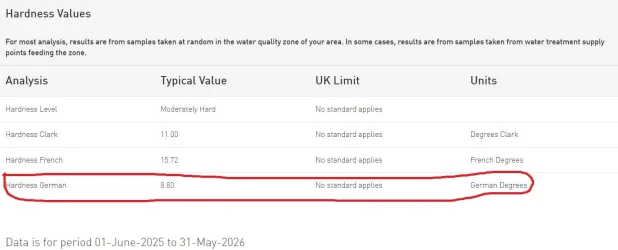
This is from the water quality report for Boots in the centre of Stourbridge

Severn Trent.webp

They give the hardness as dH 8.8 which converts to 157.5 ppm. Assuming your hardness is similar, this is way lower than the strips say. As far as I'm aware, there are hardly any fish which could survive at 500 ppm but there are plenty which would be fine at 157 ppm hardness.
Something is amiss here; there are 3 possibilities -
  • The unit on the strips is not ppm, but a unit I've not come across before (it's a brand I've not heard of before now)
  • The strips are giving a false reading
  • You are not using the strips correctly. Are you following the instructions to the letter - immersing the strips in water for the right length of time, waiting the right number of seconds before comparing the colour to the chart?

The testing lab uses expensive equipment so they are more likely to be correct than home testing strips. My younger son used to work as an analyst for that testing company!


The water quality report includes nitrite and nitrate but not ammonia. What do the strips give for nitrite and nitrate in your tap water? Severn Trent's report for the centre of Stourbridge says
Nitrite - zero
Nitrate - 24.76 (average)

If those are also different I would not trust the strips.
 
I use the same test strips. The total hardness is measured in mg/L, with an OK range of 50-250
 
Well, now you have to find out exactly how hard your water is for sure. 8.8 degrees vs 500mg/L
If you do end up wanting to soften your water and you don’t want to mess with distilled or RO, then then the only other practical option is rain water. Just know that rain can have impurities in it.

For now, focus on getting your exact hardness number. You may, or may not have to mix/soften your water depending on the results. Oh, btw…..what is your pH and KH? Just curious.
 
The website I don't understand link to my address copied from web site. https://www.stwater.co.uk/my-supply/water-quality/check-my-water-quality/

Says German 8.80 French 15.72 Clark 11 if that's of any use.

Just rushing out to dentist, and then taking a sample of my water to local fish shop to get them to test it for me.

Ph is7.9 KH is 120 on test I did. Speak later.

Thanks. J
 
Last edited:
There are conversions for different hardness measurements. For German Degrees the conversion to ppm or mg/l is 17.8. So your water is 8.8 x 17.8 = 156.64. here is harness info:
General Hardness
0 - 4 dH, 0 - 70 ppm : very soft
4 - 8 dH, 70 - 140 ppm : soft
8 - 12 dH, 140 - 210 ppm : medium hard
12 - 18 dH, 210 - 320 ppm : fairly hard
18 - 30 dH, 320 - 530 ppm : hard
higher : liquid rock (Lake Malawi and Los Angeles, CA)

So your water is indeed fairly hard.

So the advice re mixing your tap with RO water which is about 10 ppm or RO/DI (DI= de-ionized) is which 0 ppm is the solution. I know this because for a number of years I ran a tank I had to make soft and had an RO/DI unit for this. I needed 10 gals of RO/DI water/week. Using distilled would have cost me at least $10-$12/week which would mean between $520 and $624/year. My 75 gpd RO/DI unit cost me about $145. I used it for almost 10 years. I did have to spend about $60 to change the RO membrane. (1 Pound sterling equals 1.33 United States Dollar as of my typing this.)

The reason for using some level of "pure" water to reduce parameters is that there are not many chemical solutions which would be safe for fish. Going in the opposite direction means raising parameters which can be done with additives. By using RO or RO/DI water you are diluting everything, So not only will it drop the hardness but it should also lower the pH some. How much depends on your KH level as that is what holds pH steady at any given level. The higher the pH, the higher the KH must be to hold it there.

There is an easy way to double check our strips. Get one bottle of distilled water and test that. This should give you a reading close to zero for hardness and a few of the other params. If it does not, then the strips may be expired or corrupted somehow. Is there an expiration date on the strips?

When I asked Google, "do Hoviran 7-1 Aquarium test strips expire" here is there reply I got:

AI Overview

Yes, Hoviran and other 7-way aquarium test strips do expire. Over time, the chemical pads on the strips lose their ability to react correctly.

Why Test Strips Go Bad
    • Chemical breakdown: The dry reagents on the plastic pads lose potency as they age.
    • Moisture exposure: Humid air or wet fingers touching the container ruin the remaining strips very quickly.
    • Oxygen damage: Air getting inside the bottle causes the colors to degrade. [1, 2, 3]

Lifespan and Storage Tips
    • Unopened shelf life: Generally last about 2 years from the date they were made.
    • Opened life: Best used within 90 days (3 months) after opening the container.
    • Proper storage: Keep the cap tightly closed in a cool, dark, and dry place.

 

Attachments

  • 1785336151758.webp
    1785336151758.webp
    514 bytes · Views: 28
German 8.80
This is the number you need, it is the same as dH. It converts to 157 ppm, which is a tiny bit over 'medium hard' .
Your test strip reading is 500 ppm which is at the top of TwoTankAmin's table and totally different from Severn Water's value.

You need to know which is the accurate level as fish which will thrive in 157 ppm would not do well in 500 ppm and vice versa.
 
There are conversions for different hardness measurements. For German Degrees the conversion to ppm or mg/l is 17.8. So your water is 8.8 x 17.8 = 156.64. here is harness info:
General Hardness
0 - 4 dH, 0 - 70 ppm : very soft
4 - 8 dH, 70 - 140 ppm : soft
8 - 12 dH, 140 - 210 ppm : medium hard
12 - 18 dH, 210 - 320 ppm : fairly hard
18 - 30 dH, 320 - 530 ppm : hard
higher : liquid rock (Lake Malawi and Los Angeles, CA)

So your water is indeed fairly hard.

So the advice re mixing your tap with RO water which is about 10 ppm or RO/DI (DI= de-ionized) is which 0 ppm is the solution. I know this because for a number of years I ran a tank I had to make soft and had an RO/DI unit for this. I needed 10 gals of RO/DI water/week. Using distilled would have cost me at least $10-$12/week which would mean between $520 and $624/year. My 75 gpd RO/DI unit cost me about $145. I used it for almost 10 years. I did have to spend about $60 to change the RO membrane. (1 Pound sterling equals 1.33 United States Dollar as of my typing this.)

The reason for using some level of "pure" water to reduce parameters is that there are not many chemical solutions which would be safe for fish. Going in the opposite direction means raising parameters which can be done with additives. By using RO or RO/DI water you are diluting everything, So not only will it drop the hardness but it should also lower the pH some. How much depends on your KH level as that is what holds pH steady at any given level. The higher the pH, the higher the KH must be to hold it there.

There is an easy way to double check our strips. Get one bottle of distilled water and test that. This should give you a reading close to zero for hardness and a few of the other params. If it does not, then the strips may be expired or corrupted somehow. Is there an expiration date on the strips?

When I asked Google, "do Hoviran 7-1 Aquarium test strips expire" here is there reply I got:

AI Overview

Yes, Hoviran and other 7-way aquarium test strips do expire. Over time, the chemical pads on the strips lose their ability to react correctly.

Why Test Strips Go Bad
    • Chemical breakdown: The dry reagents on the plastic pads lose potency as they age.
    • Moisture exposure: Humid air or wet fingers touching the container ruin the remaining strips very quickly.
    • Oxygen damage: Air getting inside the bottle causes the colors to degrade. [1, 2, 3]

Lifespan and Storage Tips
    • Unopened shelf life: Generally last about 2 years from the date they were made.
    • Opened life: Best used within 90 days (3 months) after opening the container.
    • Proper storage: Keep the cap tightly closed in a cool, dark, and dry place.
Thank you very much. This has given me some really useful information. I had the aquarium water tested and it came in as 9. He used a drip test to turn it to yellow(ish), and told me what the number was. So that looks around 150/160 ppm?
Not sure what the heck happened with the test strip. The other values seemed to be ok and within parameters.

Obviously why I did really well with Malawi's in the 90's when I had my last tanks.

I bought a drip test that the guy in the shop used, so will use that tomorrow to confirm, when my half a brain cell has had time to rest and catch up. 😜
 
The drip test came out at 9, so I have now sent for an API Master Test Kit so I can use that in future.

Thanks for all your support, I'm really grateful.
 
The drip test came out at 9, so I have now sent for an API Master Test Kit so I can use that in future.

Thanks for all your support, I'm really grateful.
If its not too late to cancel you could save some money. It tends not to change over time.
 
If its not too late to cancel you could save some money. It tends not to change over time.
I am getting it due to new tank cycling and much better than test strips I'm using, plus only £29.99 on Amazon. It's a learning curve for me. (Yeah, I don't get out much) 😜
 
It's only the GH/KH test kit you don't need as those don't change. The master kit is ammonia, nitrite, nitrite and pH.

The nitrate tester has 2 bottles and bottle #2 needs to be shaken well. This is because one of the reagents settles on the bottom of the bottle and the shaking is needed to get it back into the liquid. Follow the instructions :)
 

Most reactions

Back
Top