Heater Failure

Archerfish

Fishaholic
Joined
Nov 14, 2022
Messages
465
Reaction score
508
Points
93
Location
Florida
We have discussed the potential for heater failure many times on this forum. Last evening, I placed a barely used and 'trusted' 250 Watt heater into my Archerfish mixing-and-seasoning tank (a 50 gallon rain barrel) to bring the temp up from 73 to 76 F (22.7-24.4 C) overnight. Never trust a heater. Not even new heaters. @GaryE and a few of us recently warned other members to use caution with heaters by using two smaller units rather than one large heater. It is best to avoid using a heater if at all possible. They fail. And, also potentially present an electrical hazard. Consider keeping cooler water fish if your tank is in a cool location. My picture says it all.
 

Attachments
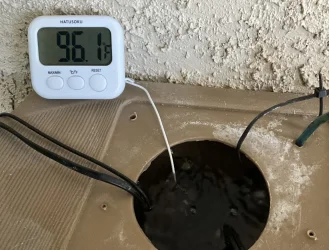
  • Heater Failure 23 February 2026.webp
    Heater Failure 23 February 2026.webp
    217.6 KB · Views: 127
Last edited:
This has been a problem since the dawn of the hobby. As a kid and teen I probably murdered more fish for this reason than any other, The tech has gotten better over the years but it is still not without issues. My heaters are unplugged most of the time. Especially since I no longer keep Discus or Rams.
 
You guys are scaring me. I have heaters in each of seven tanks. I try to remember to check the water temperature daily but I miss on some days. Are there aquarium alarm systems for heaters?
 
There are electronic sockets available with temperature sensors that stop supplying power when the temperature rises above the set value.
 
You guys are scaring me. I have heaters in each of seven tanks. I try to remember to check the water temperature daily but I miss on some days. Are there aquarium alarm systems for heaters?
I use thermometers with high/low alarms in my aquariums. I think I'll start using one in my mixing tank too! This one I present is just to give you an idea of what I use. The ones I use (General brand) have a very loud alarm and that is important. Unfortunately, General doesn't seem to make the product any longer. Anyway, here is something similar:
 
I kept many tanks of plecos from the Xingu which at the peak of the dry season can see water temps in the low 90s. If I have to runb a dry.raint season I get the tanks up to 92F before in 24-36 hours I drop the temps into the 76 range. After that I plug heaters back in and move it to 80-82F. I normally keep the tanks between 82 and 86F.

So I have no choice but to use heaters/ I also consider them to be the least reliable piece of equipment we use in tanks. For the pleco tanks, I have all the heaters attached to a temperature controller. But this only protects against heaters getting stuck full on and making fish soup. A controller cannot help when the issue is heater failure and the subsequent drop in temp.

Almost all of my tanks have two heaters. My favorite and most reliable heaters have proven to be the Hydor in-lines. But I only use them with canisters and I often have a second in tank heater. I do not hook the in-lines to a controller. I had 3 such heater in use until I started to downsize. One finally failed and I had to replace it, but that was over 20 years in use before it happened.

To protect against the controller failing in some cases I set the heater a couple of degrees higher than at where the controller is set. This way if the the controller just passes current but does no controlling, the heaters will still come one to keep the tank warm. I normally feed tanks close to daily, so I can usually detect when a tank is too cold. It the controller fails to turn of the current, the settings on the heaters act as a back-up.
To date, almost all of my heater failures have been on the too hot side and never a failure to heat. The use of dual heaters in tanks has saved me from a single heater quitting and a tank getting too cold. Two heaters also work more effectively than one as the heat is generated in different parts of the tank. I also almost always place them horizontally near the bottom of tanks. Heat rise and this configuration provides maximum heating. Further, since heated water rises, this configuration gives the best boost to circulation as well as heating. it pulls water from the bottom of the tank towards the surface. it also makes it easier to hide heaters so they are out of sight.
 
You guys are scaring me. I have heaters in each of seven tanks. I try to remember to check the water temperature daily but I miss on some days. Are there aquarium alarm systems for heaters?
I have had super cheap unbranded Chinese heater work flawlessly for years and expensive ones fail within weeks. Nowadays I have Inkbird controllers in all my tanks. Those work as @Gertrudae describes. It doesn't matter how loud the alarm is if you're not home.
 
I have had super cheap unbranded Chinese heater work flawlessly for years and expensive ones fail within weeks. Nowadays I have Inkbird controllers in all my tanks. Those work as @Gertrudae describes. It doesn't matter how loud the alarm is if you're not home.
I just ordered an Inkbird. Thanks.
 
In a box in my garage, I have 3 100 watt clip on heaters. They were accurate, but only these 3 out of I don't know how many I owned, and I put them aside as backups decades ago. I'll never use them now. I looked at them last week and thought about how physically dangerous they were. It was easy to knock them into tanks, where they zapped you.
It beat the real old timers with slate bottomed tanks and candles under them.

I have another box of submersible heaters of many brands, all marked off (tape on the wires) to what temperatures they froze at. They can't be adjusted, but if I want to breed a fish in their exact range, I use them. I keep very few high temperature (above 25c is high temp to me) species of fish, and if I can avoid heaters, I do. They are untrustworthy and expensive to run.

It's remarkable how many fish we keep at the very top limits of their natural range.
 
I think many people base their decisions on the air temperatures in the home region of a species, but water is usually a few degrees colder due to evaporative cooling.
 
I think many people base their decisions on the air temperatures in the home region of a species, but water is usually a few degrees colder due to evaporative cooling.
If you go to species descriptions (you need the Latin name) you'll usually get temperature info. Fishbase can help out a lot. I know I go on and on about fish catching, but livebearers in Guatemala were around 24c, and most of the Gabonese biotopes were at 22 or so, dry season. Shade from the forest canopy, water coming from higher elevations, evaporation - the air was always 26c. We were hot, but we had to protect the fish to keep them alive.

My understanding is Amazonian water is warmer, but it's worth researching species by species.

Sometimes, we need heaters and I trust them like I trust billionaires. They are disasters waiting to happen but we live with that because we often have no choice. Tech can help mitigate the damage, and if they shut off and chill our fish it's generally better than if they cook them.
 
This week the forum has me paranoid. Now I am waiting for a heater failure or my own electrocution. I am also waiting for a leak of unknown origin. How about a fish disease that I cannot diagnose or treat? Have I left something out?
 
This week the forum has me paranoid. Now I am waiting for a heater failure or my own electrocution. I am also waiting for a leak of unknown origin. How about a fish disease that I cannot diagnose or treat? Have I left something out?

You know when a tank leaks streams of water that's on fire and causes pustules to form on the soles of your feet? Man, I hate that. Or that thing when fish jump but explode and send shrapnel everywhere - hatchet shaped shards?

When Ancistrus cirrhosis outgrows your tank, or when your snails carry worms that burrow through your eyeballs? It's so inconvenient.

Fish diseases? When velvet gets loose in your apartment and transforms all the pictures on the wall into Elvis fighting bulls with a tear in his eye? I've only seen that a few times.
 

Most reactions

Back
Top