What's new

Feed back requested on large west african aquarium

anewbie

Fish Aficionado
Tank of the Month 🏆
Fish of the Month 🌟
Joined
May 30, 2021
Messages
3,588
Reaction score
4,224
Points
113
Location
usa
After i move in approx 18 to 20 months I'm thinking of setting up the following acidic african aquarium:
8ft long 5 ft wide and 18 inches high with the following stocking:

8 to 12 elephant fishes (maybe gnathonemus something - maybe petersii)
maybe Nanochromis teugelsi
maybe Pelvicachromis kribensis Polongwe or Pelvicachromis kribensis Lokuenji or p. cf. pulcher Ndonga
(only 2 species of pairing dwawrf cichild) - another option might be A thomasi
maybe 50 or 100 Enteromius jae (probably a bad idea)
maybe 20 congo tetra
maybe 5 or 10 pantodon bucholzei
maybe a few upside down catfishes Synodontis nigriventris
-
open to suggestions
-
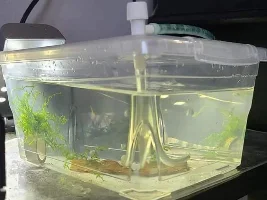
If i can work out a few details the water will flow right to left the length of the aquarium and will have a drip system of approx 8 gallons per hour (192 a day) on a tank of approx 400 gallons - this is predicated on recycling system working as expected for the water.

Suggestions/comments/tweaks on stocking ?
 
That's a difficult one. You like several different enough habitats there.

8 to 12 elephant fishes (maybe gnathonemus something - maybe petersii)
I took a liking to Mormyrids in Africa. I've never kept any and they have made me curious, because I caught so many different species without being able to identify them. I plan to read up heavily on keeping them, but don't know now.
maybe Nanochromis teugelsi
A margins of fast water species. They aren't robust, but are aggressive among themselves. Beautiful little fish though.
maybe Pelvicachromis kribensis Polongwe or Pelvicachromis kribensis Lokuenji or p. cf. pulcher Ndonga
The kribensis are smaller and easier going than the Ndonga pulcher. @gwand has kept Ndonga. They come from flowing water, but different from Nanochromis. I don't know how they'd work with a Nanochromis. The size difference in case of conflict might cost you the Nanos.
(only 2 species of pairing dwawrf cichild) - another option might be A thomasi
I always argue for one cave spawner and one open spawner. In a tank that size, I'd add a mouthbrooder. thomasi are northern fish, 1500 km away from the ones you like. If I had access to the large US market, I would be looking for Benitochromis instead. Or Thysochromis as my open spawner in a tank that size.
maybe 50 or 100 Enteromius jae (probably a bad idea)
I'd say a bad idea. They are small, edible and from very still waters. Entermomius fasciolatus are around stores here, and they are larger and colourful. To me, jae are single species tank fish, like hulstaerti.
maybe 20 congo tetra
Always a good idea in water flow. Alestopetersius are also fantastic.
maybe 5 or 10 pantodon bucholzei
maybe a few upside down catfishes Synodontis nigriventris

Pantodon might get spooked by Cichlids below, and I think they like still waters. Synos need to come from trustworthy dealers as they sell a lot of sh*** species under that name. Some get big and ugly with time. They are frequently misidentified.
-
open to suggestions
-
If i can work out a few details the water will flow right to left the length of the aquarium and will have a drip system of approx 8 gallons per hour (192 a day) on a tank of approx 400 gallons - this is predicated on recycling system working as expected for the water.

Suggestions/comments/tweaks on stocking ?
 
That's a difficult one. You like several different enough habitats there.
Yea (your inline got embeded with my post and i don't have the ability to edit your post to bring them out); a couple of comments on your comments - one if the big issue with aggression is putting a fish in a box too small for its territory having said that i'm not sure many people have kept any of the dwarf cichild in larger boxes or large enough box to comment on at what point the aggression is no longer an issue.

You mentioned Benitochromis and i'm finding several different species in the genus such as nigrodorsalis, riomuniensis and finelyi. Is there a particular one you would recommend looking into or are they all pretty much the same with slight variation.

With regards to Synodontis nigriventris I'm familiar that there are other species of synodontis (not that i can differentiate them when young) and some are quite large and aggressive. There are several reliable stores but of course when buying wc fishes there are frequent mix catches or misidentified species mixed in.

I'll have to look into Entermomius fasciolatus; drop the Pantodon or maybe try one as an experiment. I'll have to think about the Alestopetersius and even the congo tetra as i find the larger tetras change the characterisitic of the aquarium even if the aquarium is large enough to support them. I'm used to keeping morse code, tucano and n. marilyn in 100+ gallon aquariums over the larger tetra/pencil fishes.
--
Current is an open question - Obviously i'll have a pump to push the circulation a bit and prevent stagnation but it is not clear to me how fast it will go - a bit of thought still needs to be put into the design on how to get the water to flow right to left instead of the more traditional back to front. The issue is that I don't want to put overflow boxes on the side the of the tank as they create too much obstruction. I was thinking of 5 or 6 1/2 inch or 3/8 inch tubes which will constrain flow a bit but i can probably still get 400 or 500 gph easily enough. If i figure on 3/8 tubing 5 of them would allow for in theory around 1500 gph. There are of course other issues with this design since the bulkhead has be below the frame limiting the water height to around 16 inches - but i'll have to talk to the vendor if there is a way to get them a bit higher - closer to 17 inch mark (overflows solve this problem but having the exit holes higher than the bulkhead; and in theory I could do something similar ad-hoc - maybe - the advantage of the smaller diameter is the hose are easier to hide along the frame or lip of the aquarium and won't obstruct the side).
 
It's a dream project - a tank that size.

I have only had Benitochromis once, and liked them all. B. finleyi tends to be more water adaptable than the others, which tend to blackwater needs. Plus Lee Finley is a nice guy who has contributed a lot to the hobby, and "his" fish should be more common.

I had a four foot 75 gallon tank running with Bathyaethiops greeni (I may have spelled that right) and Parananochromis gabonicus. I never saw interaction, but now that the greeni have been moved out, I have had 2 gabonicus spawns. I had none when they were together.
One was the day I left for Africa, so was doomed. This one has my fingers crossed, as I think it happened last night. But there was no activity I could see when the tetras were in there, so your point about tetras affecting the dynamics is well taken. B greeni are only half the size of adult Phenacogrammus or Alestos.

I once saw a beautiful tank in a store. It was an eight footer, designed with three clusters of driftwood and sand in between, like a lot of streams in the forest. Each driftwood piece had a pair of Pelvicachromis sacrimontis, all guarding fry. The black and red morph of that fish is stunning. They get bigger than pulcher tends to though. On the surface, there was a shoal of a larger Epiplatys. In those days, I didn't know enough to identify them, but they were probably chaperi.

That was a tank to see.
 
It's a dream project - a tank that size.

I have only had Benitochromis once, and liked them all. B. finleyi tends to be more water adaptable than the others, which tend to blackwater needs. Plus Lee Finley is a nice guy who has contributed a lot to the hobby, and "his" fish should be more common.

I had a four foot 75 gallon tank running with Bathyaethiops greeni (I may have spelled that right) and Parananochromis gabonicus. I never saw interaction, but now that the greeni have been moved out, I have had 2 gabonicus spawns. I had none when they were together.
One was the day I left for Africa, so was doomed. This one has my fingers crossed, as I think it happened last night. But there was no activity I could see when the tetras were in there, so your point about tetras affecting the dynamics is well taken. B greeni are only half the size of adult Phenacogrammus or Alestos.

I once saw a beautiful tank in a store. It was an eight footer, designed with three clusters of driftwood and sand in between, like a lot of streams in the forest. Each driftwood piece had a pair of Pelvicachromis sacrimontis, all guarding fry. The black and red morph of that fish is stunning. They get bigger than pulcher tends to though. On the surface, there was a shoal of a larger Epiplatys. In those days, I didn't know enough to identify them, but they were probably chaperi.

That was a tank to see.
So i did not specify it but the tank will be blackwater with a target ec of below 40 - so i'm not too worry about fishes that require soft acidic water.

I did look up Alestopetersius chaperi and they do have a bit of eye candy to them but of course they are also very very expensive - a school of 20 would be north of $1000; though i could probably get a hefty discount on a large school. Still this is 2 years out and a lot can change.

I will have to look up the other species you mentioned in this last post when i get home (though it wasn't clear you were actually recommending them). So killi might be another option if i want a smaller dither and drop the predator butterflies.

--
Maybe Nanochromis teugelsi, p. krib pownee and a species of Benitochromis perhaps finleyi or the more colourful nigrodorsalis (moliwe variant as there are different colour morph); there is also a very colourful variant riomuniensis. So three breeding dwarf cichild, 8 elephant fishes, 5 to 10 cats that are flipped over (the small peaceful nigriventris) and something you just mentioned or rob a fish store for a bunch of a. chaperi - or buy 2 today and spend 3 years trying to breed them. Hum....
-
I'll read up on the other species you mentioned and write a better post when i get home or tomorrow.
--
big mistake it is the lovely Alestopetersius brichardi that are an arm and leg not the a. chaperi which does not exist. I guess you meant e. chaperi (killi fish).
 
There's time. I'm loathe to suggest, and prefer just to offer possibilities. I was just thinking a Guinean tank might appeal at that size, with some Wallaceochromis. I'm toying with some signatus or humilis for my six footer, to go with geographically incorrect Chromidotilapia kingsleyae I have now. All tough fish...

Alestopetersius caudalis is the one I like. They are mass produced now, and go at around 10 bucks CAD, which is about 7USD. It's just that no one here seems to order them in.

Alesto brichardi is rarer, but a great fish. Weird eyes, but lovely ways.

Maybe I would stay south if I could get Benitochromis. I am going to try if the war ends soon and the disruptions settle. If I get to Europe in the winter next year, they should be available where I'll be. The ultimate would be Benitochromis uffermani.

Plus good old Pelvicachromis kribensis Moliwe is still one of the nicest dwarfs out there.

Do you have anything on how Mormyrids get along in groups? I need to explore that.
 
Well just keep in mind please that the primary fish will be the Elephant fish of some species. the other stuff is more flexible but if not compatible with them then they will automagically not be suitable.

From my reading the Mormyrids prefer groups as long as there is enough room to separate if there is aggression. From what i've read 125 gallons is recommended for 8 and at least 6 feet. Of course this aquarium would be much larger and i would not object to tweaking the number up or down. From what i've read one is better than two and a group is better than two. The general thought is the front 2 feet square would largely be open area with some drift wood and the 3 feet on either side and full back would be densely planted with driftwood similar to many of my other aquariums.


I haven't posted this to the forums but i have a young 'pair' of Pelvicachromis kribensis Moliwe; the female i'm not 100% sure is female the male is just getting some reds on his dorsal fin but has a long ways to go to colour up - my guess is it will be 8 to 14 months before they are full grown. They are in a small aquarium right now but once they get larger i'll probably need a larger home. The male is a bit on the aggressive side even though it is not yet mature - more aggressive than i expected. The tank mates are a young female a. bluketa i was holding for someone and should be removed in the next week or two - she is larger than the male but also more timid and 6 or 8 jelly beans. The aquarium has been setup for about 2 years as i had some rams in there i moved over to the discus tank to make room for them.

Of course one big negative is putting in any kribs in such an aquarium will be population control since they are prolific very good parents. If they sucked as parents it would be a different story.
 
Female Moliwe have a spot at the back of the dorsal. It shows by 1/3 of an inch.

I'd consider burglarizing your house... but you can trust me (and I'm too far away). Moliwe was once a common morph, as befits a beautiful colour form, but the habitat is under pressure, and the front lines of a local warzone generally affect any collecting of new ones.
 
Female Moliwe have a spot at the back of the dorsal. It shows by 1/3 of an inch.

I'd consider burglarizing your house... but you can trust me (and I'm too far away). Moliwe was once a common morph, as befits a beautiful colour form, but the habitat is under pressure, and the front lines of a local warzone generally affect any collecting of new ones.
My mistake I had passed on the Moliwe and I have the Lokuenji.
 
Nice fish as well.

I think I'll do a deep dive on elephant noses and Mormyrids if I get time today. I don't generally keep fish I can't try to breed, but I am curious. Their size and the effect of aquarium conditions on their electrical fields have stopped me. We caught so many diverse ones in Gabon, and I was surprised at how common they were in dark habitats. In some streams, we caught more of them than any other fish.

I think the theory of aquariums making their electrical communication impossible, and therefore making them unable to breed probably holds water. It's the most likely reason I won't ever keep them, as interesting as they may look.
 
Nice fish as well.

I think I'll do a deep dive on elephant noses and Mormyrids if I get time today. I don't generally keep fish I can't try to breed, but I am curious. Their size and the effect of aquarium conditions on their electrical fields have stopped me. We caught so many diverse ones in Gabon, and I was surprised at how common they were in dark habitats. In some streams, we caught more of them than any other fish.

I think the theory of aquariums making their electrical communication impossible, and therefore making them unable to breed probably holds water. It's the most likely reason I won't ever keep them, as interesting as they may look.
I wonder how large an aquarium has to be to allow them to be able to communicate with each other without interference. Also if there needs to be damping around pumps, heaters and similar items. In truth these things are a couple of feet below the aquarium but perhaps some special care is required.
 
They have really sensitive electrical fields, and it's been suggested even household current interferes. I used to vaguely know a researcher into fish electrical fields who talked about some really detailed studies on other electrical species. We found Mormyrids in all sorts of water, usually along the banks with some flow. They're just overall sensitive creatures.

According to the locals, they make superlative broth for fish soups.
 
They have really sensitive electrical fields, and it's been suggested even household current interferes. I used to vaguely know a researcher into fish electrical fields who talked about some really detailed studies on other electrical species. We found Mormyrids in all sorts of water, usually along the banks with some flow. They're just overall sensitive creatures.

According to the locals, they make superlative broth for fish soups.
That's a true damper; while breeding isn't everything it sounds like it would be unhealthy for them to be kept in captivity. If you learn more let me know - i'm willing to pass on them if it is not a good environment for them.
 
The only resources I have now are on the internet, as yet unresearched. I don't know what I'll find, but we should share. They are fish that come in with a lot of importations, but they vanish and seems like no one really discusses them after. They sell well but for a lot of people, they're probably short lived curiosities.

I get tempted by these things, but then I talk myself out of them.
 
The only resources I have now are on the internet, as yet unresearched. I don't know what I'll find, but we should share. They are fish that come in with a lot of importations, but they vanish and seems like no one really discusses them after. They sell well but for a lot of people, they're probably short lived curiosities.

I get tempted by these things, but then I talk myself out of them.
I found one person who knows someone who has kept 15 in a 10ftx2ft aquarium. Will try to get more details.
 

Most reactions

Back
Top