What's new

Corydoras feeding plan in a community aquarium

Beastije

Fish Addict
Joined
Sep 7, 2021
Messages
935
Reaction score
676
Points
93
Location
Czech republic
Hi guys

for years I have struggled keeping corydoras, and I think a big part of the problem is my feeding. I am a sparse feeder and assumed they will get their fill of some things, but in community tanks, all the schooling and upper level fish are gluttons that are not afraid to dive under decor to gorge themselves (looking at you rummynose tetras and pearl gouramis). I also feed a lot of small live foods and I simply think they were not good at catching that.


I bought a new group of corydoras, because I missed them, and while the tank may not be the very best for them (has some pebbles, but the previous were all sand and they still died), I really need a detailed help how when and how much to feed them, ideally with pictures, like for a dummy


Here is what I have:
live food - microworms, (new) grindall worms culture, hatched bbs, occasional live mosquito larvae
frozen - cyclops, rotifers, daphnia, brine shrimp, mosquito larvae, blood worms, tubiflex, mysis
dried - hikari micro pellets, dennerle nanogran, sera vipan fry food, jbl novo tabs, local brand, vibra bites, pure spirulina tablets ( bought them for myself, yuck, fish appreciate them better), repashy super green, hikari cichlid gold, dried daphnia. None of these have insect content or any high percentage of it, cause fluval bug bites is impossible to buy here and the only other insect brand dry food has been out of stock for months.

The way I feed my community tanks is I usually combine smaller foods with larger foods. For example I will defrost cyclops and mosquito larvae, squirt the cyclops to entertain the faster feeders and target feed the mosquito larvae. This is how I did this in this particular tank before I added the corydoras. Or I would do the micro pellets and the vibra bites that would fall to the bottom. Or spirulina tablet, crushed to many smaller pieces, and a microworms/bbs.

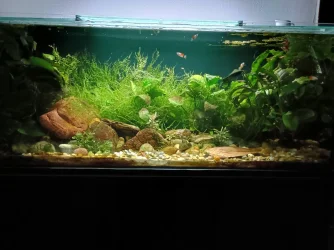
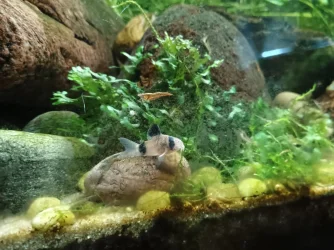
The tank inhabitants are: 5 adult platy fish and many babies, 5 panda garra (that I target fed with a dripper the mosquito larvaes into their mouths to ensure they get something before the platies) and now 16 corydoras, a mix of 8 panda and 8 black Venezuelan

So please, tell me how often, how much and what to feed my new fish to also feed the other fish and to not have them eat it all, and to not be too small to fall too down between the pebbles...?

Thank you!
 
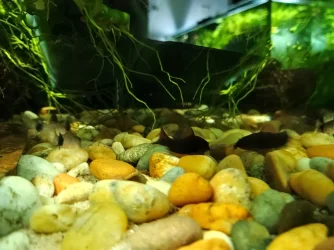
The pebbles. Right away, you have a problem there. If we put aside the natural needs of Corys as sand sifters, we also have exposure to pollution as an issue for fish that hug the bottom. Pebbles are a food trap, and ammonia will leak out. It will directly affect these substrate needing fish. I was going to write 'substrate loving', but they need the right substrate. They're eartheaters, as much as Apistogramma or geophagus are. It's in the form of their bodies.

You've noticed the Cory group doesn't lunge at food as it falls. When I feed live to my Corys, they don't get it right away. Their feeding method is to work the sand, grabbing worms and insect larvae that live in it. They don't scavenge or clean up in nature. They hunt a different zone than shoalers. When they eat the live foods we give them, it's when it has settled on the bottom. They get right on to white worms or grindals, because they act like the food they're adapted to hunt. But those are rich foods given occasionally, or to condition breeders.

I find small sized insect or black fly larvae pellets to be excellent for them. They sink fast and get past the shoalers, who can be drawn to another corner of the tank with a flake food given right before the pellets go in. But if the pellets fall between the pebbles (it all depends on the pebble size), then your Corys are in trouble.

I have a mental image of rounded river pebbles about one cm in size, which another member has in one of his tanks. I hope I'm wrong.
 
The pebbles. Right away, you have a problem there. If we put aside the natural needs of Corys as sand sifters, we also have exposure to pollution as an issue for fish that hug the bottom. Pebbles are a food trap, and ammonia will leak out. It will directly affect these substrate needing fish. I was going to write 'substrate loving', but they need the right substrate. They're eartheaters, as much as Apistogramma or geophagus are. It's in the form of their bodies.

You've noticed the Cory group doesn't lunge at food as it falls. When I feed live to my Corys, they don't get it right away. Their feeding method is to work the sand, grabbing worms and insect larvae that live in it. They don't scavenge or clean up in nature. They hunt a different zone than shoalers. When they eat the live foods we give them, it's when it has settled on the bottom. They get right on to white worms or grindals, because they act like the food they're adapted to hunt. But those are rich foods given occasionally, or to condition breeders.

I find small sized insect or black fly larvae pellets to be excellent for them. They sink fast and get past the shoalers, who can be drawn to another corner of the tank with a flake food given right before the pellets go in. But if the pellets fall between the pebbles (it all depends on the pebble size), then your Corys are in trouble.

I have a mental image of rounded river pebbles about one cm in size, which another member has in one of his tanks. I hope I'm wrong.
It is river sand, in the front there are pebbles, under the plants in the back there is just sand. I lifted the moss and the Anubias so there is a gap between that and the substrate for them to move in.

I can remove a few stones here and there to create less of pebble sea and more of a spotty stones. Would that be better?
 

Attachments

  • IMG_20250714_210656660_HDR.webp
    IMG_20250714_210656660_HDR.webp
    197.3 KB · Views: 120
  • IMG_20250729_210722865.webp
    IMG_20250729_210722865.webp
    170.3 KB · Views: 129
  • IMG_20250729_210812222.webp
    IMG_20250729_210812222.webp
    138.1 KB · Views: 138
That would work. I thought it was all pebbles, but pebbles on sand/gravel is good. You'll be fine.
 
I'm not convinced this is about food. What are your water parameters and temperature?
 
I'm not convinced this is about food. What are your water parameters and temperature?
For sure that is possible. My ph is 7, I don't measure much other than NO2 and ammonia which are 0, and I keep the temp at 25°C, I for sure lost some due to protozoan infection after introducing a new batch (after quarantine!!!) of corydoras that wiped half of the previous group but none other fish in the tank.

In 2021 I bought 15 sterbai, a year later I had 10, bought 10 more, different breeder and by 2025 I have lost all one by one by one.
I attempted with five juvenile paleatus in a different tank no heater, bought them 08/24 and kept losing one by one until 01/25. That tank was fed exclusively microworms and BBS and once a week some pellets. All fish that died had sunken bellies in, like a hole between the plates and different darker color. Hardly ever was there a fungus or snout abrasions. There are some threads around from 2022 where I described the situation that within three months wiped 10 sterbais and nothing I did helped. But I didnt ever treat for parasites.
 
1754406970024.webp
26/27

I have 5 Albino Corys who are about 8 years old, and have never had sand in the tank, nor every suffered any illness. In fact I cannot remember the last time I had illness in the tank, and most or my fish are 10/15 years old. I even have one cardinal tetra which is also 8 years old and is huge.

I do not know my secret, but will tell you how I operate. Ammonia and Nitrites are Nil. Because Nitrates are high in our tap water which I use, nitrate level is 40 ppm. PH is 7.8. General Hardness is 18 dGH. Water temperature normally about 26/27C.

40% water changes are done weekly with the gravel vacuumed, and the Juwel sponges in the filter washed out in the water taken from the tank. Once a month I clean out the internals of the pump. I use Seachem Prime, Stability and Pristine weekly.

The fish are fed 3 times a week only with a mixture of Tetra Pleco Spirulina Wafers, Tetra Prima Granules and Tetra Tetramin Flakes.

My tank is overstocked with 31 fish currently in a 180 litre Juwel tank, including Clown Loaches, Boesmani Rainbowfish, Congo Tetras and Golden Gourami as well as 4 plecs including a large common plec.

My tank became stable once I moved to the Juwel tank with filter, weekly water changes, sparse feeding, and using the Seachem products.

I know that people will criticise the overstocking, 4 clown loaches (now 15 years old) in a 180 litre tank, gravel for the corys and a common plec (my last one lasted 28 years and the new one is 5 years old). But all the fish appear healthy and happy, i don't lose fish, and they all grow to an old age.

I hope you can gain something from my experience.
https://www.amazon.co.uk/dp/B005BAE03W?ref_=ppx_hzsearch_conn_dt_b_fed_asin_title_1
 
As to food I noticed that everything you listed is either floating or slow sinking. I would get some small fast sinking pellets with a mix of plant and protein. Many think Corys are herbivores but they are omnivores and DO need protein.

When feeding I'd feed all the other fish at one end of the tank. When they are feeding I'd drop some fast sinking pellets in the other end of the tank for the Corys.
 
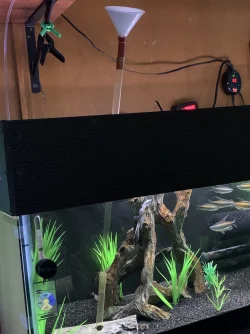
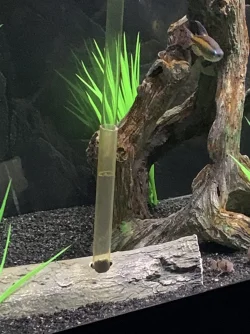
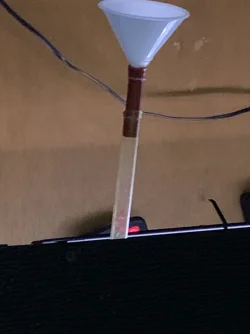
I realize this thread has some age but maybe J can suggest something to help all us CoryCat lovers who see their food get snatched up. My Congo Tetras will intercept falling pellets and rob them from the Cories. So, I cut a hollow plastic fake log and drilled a hole at the top. Then when the other fish are feeding, I slip this tube from the tank top to the hole and drop my pellets. Then the Cories have access to their food away from the goofy Congos.
The whole thing from front.
IMG_0161.jpeg
Close up of tube sitting in hole at top of fake log.
IMG_0162.jpeg
A view of the top where I insert the pellets.
IMG_0163.jpeg
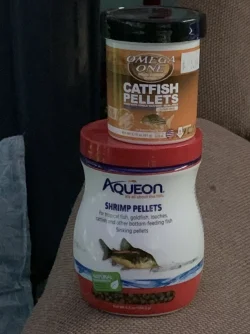
Finally….the two main foods the Cories get…..fast sinking Aqueon Shrimp Pelkets or Omega Catfish Pellets. Oddly, sometimes the Cories themselves swim to the top to rob some of the freeze dried black worms I feed the Congos.
IMG_0164.jpeg
 
Last edited:
This is an old thread, but it's popped back to life with interesting ideas.

The cory group could be considered predators in a roundabout way. They sift sand for food, but the food they want is tiny worms and insect larvae. It's not hunting per se, but that sifting of sand is effective and they're well adapted to it. They're sifters, not chasers, and I find they don't do well on live brine shrimp, for example. Grindal worms are a big hit, as are fast sinking pellets.

The clean up crew stories from 50 years ago have killed untold numbers of them. Myths like that are harmful.

I could see them not getting enough food in an overstocked tank, but my suspicions lie elsewhere. The description of the bellies makes me wonder about Mycobacteriosis. The armour these fish have hides an awful lot from our eyes, and such communicable diseases can be active without our seeing them. If affected fish die, the cory group will scavenge and that's the ideal way for myco to transmit.

It's easy to play fish doctor from an armchair half a planet away though. But I would suspect disease over nutrition.
 
That hollow-log setup is brilliant @bgarthe. For a no-DIY version, a turkey baster pre-filled with soaked sinking pellets aimed at substrate near the cories does the same job — food reaches the bottom before the upper-level fish notice.

For pellet choice, anything with insect protein first (Repashy Bottom Scratcher, Fluval Bug Bites, Hikari Vibra Bites) tends to outperform standard wafers for cories — closer to what they'd hunt naturally.
 
I use turkey basters all the time for fish things. Even when I do the hollow log thing, some angelfish try to go in sideways and….sometimes the CoryCats are careless and move the pellets to the outer edge where the goofy Congos or even Cardinal tetras snatch/swarm feed on the pellets. I used to feed the tetras etc at one end of the tank and drop pellets in the other end, but that also failed. ATM, in order to feed the cats, I have to do the log thing. I can’t just hope they get enough left overs from the other fish.
 

Most reactions

Back
Top