What's new

About Cardinal tetra

Karel Zahradka

New Member
Joined
Jul 26, 2026
Messages
29
Reaction score
16
Points
8
Location
Lisovice
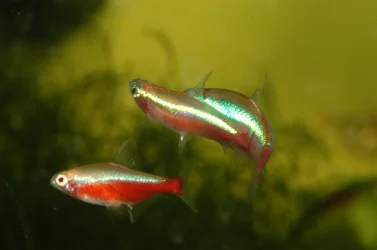
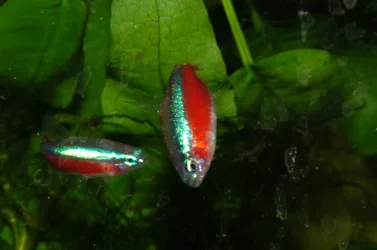
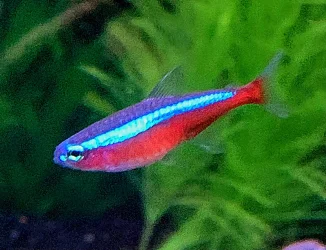
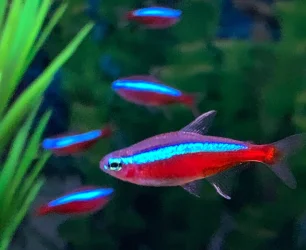
Just a little history about the cardinal tetra (Cheirodon axelrodi), which we call "Red neon tetra" in the Czech Republic. The name cardinal tetra originated from the first scientific description, when on February 21, 1956 George Sprague Myers and Stanley H. Weitzman described this fish as Hyphessobrycon cardinalis (i.e. cardinal tetra). But one day before, on February 20, 1956, it had already been described by Leonard Peter Schultz as Cheirodon axelrodi. The English name "Cardinal tetra" was first used by businessman Fred Cochu (a trader and organizer of large-scale collection), who based his name on Myers's and Weitzman's name and was the first to start catching and importing fish in large quantities to the USA. Then there were disputes and primacy in the description for some time, several people tried to claim that they had discovered it, but that would be another chapter.
 
One of the odd things I have seen in my years of fishkeeping is the neon versus cardinal developments. When neons were wild caught, they were among the toughest tetras in aquariums. Even when breeding them was first figured out and they began to be mass produced, they were hardy little fish that tolerated the cooler waters most aquarists had in then low technology tanks. Cardinals died in droves and had a reputation as difficult tetras, as they need warmer temperatures.

Now, farmed neons are fragile fish. I doubt it's genetics as they are produced on a massive scale. There is something wrong in how they are mass produced, and they often die soon after sales. Pet store guppies have the same issue here. Cardinals, meanwhile, have become the hardier fish. We have warmer tanks, often warmer than we need them to be, and the cardinal is a more beautiful species.

I've bred and raised a lot of fish. Cardinals are one I'm proud of, even if they are "common". The first time I spotted a tiny one in their breeding tank and realized it had worked, I was really pleased. I've never been able to produce many, but I have a nice shoal of ones I bred, their parents and a group of 30 I picked up a couple of months ago. I'll never not be impressed by the sight of a group of them.
 
Yea - my dad when i was a kid love neon tetra; but it was cardinal tetras in the early 90s that i fell in love with and i remember discussing it with my Dad once and told him they had the full red bar vs neon 1/2 bars. Of course that is not the only difference with cardinals being larger and wanting warmer waters. I have a book somewhere from the 70s or 60s that is one of the best fishes books (at least back then). I should find it as i never bothered to look up the author.

Today i have two groups - one of 20 in black-water aquarium that is pretty stunning when the water is dark (it has dark/light phases depending on last group of leaves) and another group of 30 in a 180 tap water with some emperor tetra and serpae. Not a big fan of emperor tetra but the serpae is another common robust tetra that has always have been a favorite (i have 50 in a 600 with my chocolate cidhild and red-nose head standards (a larger fish that is eye candy for vistors).

Anyway i keep wondering if the cardinals in the 100 blackwater will breed and if they did if i would notice. The bottom of the tank is quite dark with lots of cover but not sure that meets their light requirements.
 
I've never had them breed in a regular tank. I cover all sides of the tank because of the problems with light for the fry. It's hard to catch and remove the adults with the darkness you need.

I find their colours change with heavy tannins, and become really intriguing. When the babies first get colour (early in life) they are spectacular in their still dimly lit tanks.

I expect that they lay eggs all breeding season, but the light, water and tankmates kill them.
 
I originally wanted to post this to a discussion about nomenclature, pointing out that in English it is "cardinal tetra" and in our country it is red neon. I posted this in the wrong thread, it should have been for a recent discussion about Latin nomenclature and simple local nomenclature in different languages, which can cause mistakes. Since the discussion has moved on to breeding (which I did not intend), I am adding some interesting information. Maybe helpfull for all.
 
Spawning at night and dark.
 

Attachments

  • Cardinal tetra  014 - kopie.webp
    Cardinal tetra 014 - kopie.webp
    52 KB · Views: 39
  • Cardinal tetra  019 - kopie.webp
    Cardinal tetra 019 - kopie.webp
    74.1 KB · Views: 35
I have never bred them, but one of my favorite tanks in my fish room is the 33g long with only a group of 40 CTs in it. They are common, but, imho, drop-dead-gorgeous to watch serenely swimming around and occasionally quickly shoaling up when the dog comes in or I move too fast.
IMG_1766.webp


IMG_1894.webp
 
I originally wanted to post this to a discussion about nomenclature, pointing out that in English it is "cardinal tetra" and in our country it is red neon.
The conversation will drift, but no matter how you look at it the Cardinal Tetra, or Red Neon, is a very interesting fish.
 
I had a lovely school of neon tetra in the 70' in a community tank and they were very robust fish. I loved them. But I have to say I love the cardinals above.
 
The conversation will drift, but no matter how you look at it the Cardinal Tetra, or Red Neon, is a very interesting fish.
I agree, this discussion is tending to drift regarding Paracheirodon axelrodi (Latin) as the common names do vary considerably.;)
 
I definitely want some red neon but only if they are cardinals with inverted blue/red stripes ;)
 
Never managed to breed them. I have around 60 in a 200l tank. This used to be a strictly South American tank but a while ago I rationalised the number of tanks I had and added a small group of lambchops (Trigonostigma espei). It may not be authentic but they make a gorgeous combination, both in colour and behaviour together
full
 
Many years ago I have a school of 65 cardinals in my planted 75 gal. They often will not school and, instead, may meander. Schooling is a moistly a defensive behavior. That means they need to feel threatened to school tightly. The problem is mostly what makes them school are predators. Of course we do not want to put cardinal eating fish in with our cards.

My solution was to find a few big enough fish to scare them but which would not eat them.My solution was SAEs. They are big enough to scare them but have no desired to chow down on then. It worked great. The SAE helped with algae and kept the cards schooling a lot. Watching that size group in action is truly amazing.

What was more amazing was when one of the cards developed a swimming issue. It could not stay right side up and beg having to swim upside down. I spotted it this way across the room in the middle of the school. There reversal of the colors to blue under red made it stand out like a sore thumb despite the numbers.

Unfortunately, two things coincided to cause me to lose a lot of my pictured which included what I had taken of the cards. ATT host pics way back when and they decided to stop doing it, I lost everything I had uploaded. Plus, I got a new PC. Back then there were still not really easy ways to transfer data between an old and a new machine and I was not that skilled, I gave away the old box which got sent to S. America and I lost all the pictures on it as well.

And then Photobucket which was still free back then stopped accepting new accounts. Ultimately. I began using a paid service- called Smug Mug. I still use it today. Unfortunately, I did not use it when I had the pics on my old PC.

SmugMug is a paid online photo storage, sharing, and website-building platform designed for both amateur and professional photographers. It offers unlimited high-resolution uploads, customizable portfolio templates, and e-commerce tools to sell prints through partner labs.

Since 1987 I have only owned 5 different PCs and windows 3.0/3.1, 98, XP, 7 and 10. I am still using 10 with the extended paid Microsoft support.

 

Most reactions

Back
Top