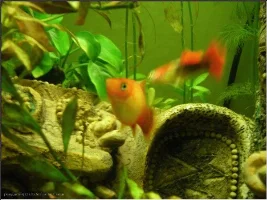
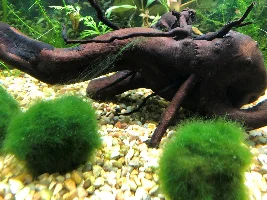
3 season porch tank with native fish…

a better picture without the trees reflecting in the tank…
IMG_9976.webp
 
Last edited:
it’s in the mid 80’s degrees out right now, at 2:00 pm. but starting out cooler this morning the tank is only 73 degrees right now … I think I’m only going to have a “hot tank” during a month or two during the summer, when the low temps don’t drop below 80 degrees…
… and of course I can always do more, less volume, cold well water changes during those months, maybe even a 5 gallon change twice a week, or every other day in the extreme heat, to protect the tank from the extreme heat…
 
I added a handfull of rosy minnows, and looked this up today, concerning them getting eaten by the blue spot sunfish, when they get bigger….


IMG_9982.webp
 
Last edited:
I know the colder the water the less active the nitrifying bacteria become. Since my coolest tank never gets below aby 76F andi susually a tad higher, I have not done much research on this tipic. So I asked Google about this and got this back.

Nitrifying bacteria slow down significantly in cold water, cutting their ammonia-removal and growth rates in half for every 18°F (10°C) drop in temperature. [1]

How Cold Water Affects Nitrification
  • Slower Metabolism: Standard nitrifying bacteria thrive between 77°F and 90°F (25°–32°C). Below 59°F (15°C), their activity drops sharply, and near 41°F (5°C) or lower, standard biological nitrification nearly stops or goes dormant. [1, 2, 3]
  • Nitrite Vulnerability: Nitrite-oxidizing bacteria (like Nitrobacter) are often more sensitive to cold than ammonia-oxidizing bacteria, which can lead to dangerous nitrite spikes in cold systems. [1, 2]
  • Specialized Strains: Specially formulated cold-water beneficial bacteria can remain active at temperatures down to 35°F (1.6°C) to help manage waste in outdoor ponds during winter.
From what I can tell the nitrite bacteria- the Nitrospira are more sensitive to cold than the ammonia ones are. This can be more os a problem since it was discovered that some of the strains of Nitrospira found in tanks are actually able to convert ammonia directly into nitrate in one step. So if these are also cold intolerant it might be an issue for ammonia levels. The Nitrosomonas that do the ammonia are more able to deal with colder temps but even they stop working if the water heads toward the 40s.

I would think that the nitrfiers which can work well in colder water colonize in that similar to how the bacteria we have colonize a tank. I conclude from this that the way to get the cold tolerant strains would be to do a fishless cycling in cold water. Otherwis they might be available for sale. But I di not try to determine what happens to these cold tolerant strains if the water gets warmer- say in the high 70sF.

Before you say that the coldest you expect the tank to get would be the 59 which is the lowest setting on the heaters. The problem is that when you read heater specs they tell us how many degrees +/- they are accurate to. This implies your tanks could get a few degrees below 59 when everything is working correctly.

Also, I assume the heater controllers you have facing int the house will not be insulated, Are you sure theycan withsyand freezing temperatures to which they might be exposed?

I am not trying to find reasons you might have cause you problems. I am trying to make you aware of the potential for these. What you are trying is a bit beyond what most of us in the hobby will ever try. So It is a bit difficult to anticipate some of the more unique issues colder than we usually. get might cause.

I am always questioning everything about the hobby. It is the best way to avoid being surprised because I did not know what I might need to deal with before it happens. When you surround the tank with the winter insulation, I assume you will not be able to see inside the tank. One way to know if anything ios wrong with the fish is that you can see them change their behavior.

And to offer one more potential issue. How will you be able to do needed work inside the tank in the dead of winter? The water might be 59 but the air sure wont be that warm.

In Southern Minnesota, winter temperatures regularly drop below freezing with average low temperatures in January falling between 0°F and 15°F (-18°C to -9°C), and extreme cold snaps frequently reaching -25°F (-32°C) or lower.

Now lets say you have a sick fish you need to catch in January and it is 0 degrees outside. Or maybe the air hose on one of the sponges slips off. How will you deal with this. How can you do a water change? The colder below 20F it gets the greater the potential dangers.

@Magnum Man
The first two songs for this weekends musical treat I dedicate to you and this project.
 
I’m not taking the info the wrong way, I appreciate it…

the heater controllers not actually working would be devastating…
the nitrifying bacteria information is interesting… the tank will be as well planted as I can manage, but expect colder temps, and lower light, will also reduce the plants normal capacity to remove impurities… so the stocking levels will be kept sane ( for me)… also I’m running 2 sponge filters, that each is rated for 65 gallons, in this 55 gallon tank, so I’m offering up as much space for the bacteria, as possible… that side of this 100 year old house, is not super insulated, so I’m installing several large roll shades to cover the screens during the winter, which should cut the wind from blowing through the screens quite a bit, thus raising the air temp in the porch, guessing maybe 10 degrees or more, with the heat that leaks from the house walls, and old windows… plus what is added to the room, leaching from the tank, with these improved “room” conditions, and to that the designs I’ve been looking at doing for the foam tank cover( I should be able to easily slip the whole cover off and on, and with the lights being hung by the ceiling ) so I can inspect as needed weekly, on the nicest of days each week…

there is still much that can go wrong during the winter months, but most things, even like the heaters ( which could be replaced with the old style that had the knobs on the tops, and were not completely immersed… I still have several of those in storage in totes ) that and they are predicting a record warm year this winter, may help, with working my way through the bugs…

it is an interesting experiment
 
Last edited:
BTW… my newly discovered local pet store, seems to keep ghost shrimp in stock, as a “feeder” item… they may be a great live food for the blue spot sunfish, as they grow, with bug bites being a staple food…
 
interesting humidity problem, I’m glad I used treated wood… it’s only in the 80’s F. for temps today, but the heat index was over 100 degrees, because of the crazy high humidity… the tank settled in the low 70’s over night, but because of the humidity and heat index today, the tank is fogged over
IMG_9986.webp
 
my needle leaved java ferns are here, I put them in the tank, but have been outside all day in this heat, fencing, so I’ll attach them later…

any idea how long a rhizome plant can stay potted in the rock wool stuff in the pots???
IMG_9987.webp
 
Well the ones I bought were still in the rockwool for maybe two or more weeks before I threw them out so probably long enough for you to get a round tuit 😜 (that may be a British joke that may not be understood over there)?
 
There are so many different species of nitrifying bacteria that no two populations are alike. You may have different species than I do even though we both have "warm" water aquariums. Nitrosomanas, Nitrobacter, and Nitrospira just scratch the surface of nitrifiers, not to mention Archaea. Scientists are only just realizing how many bacteria do the job we need them to.


I have some smarter than me scientific friends working on nitrification and populations of different bacteria.
Screenshot_20260831_201610_Chrome.webp


However I will warn against temperature shocking your bacteria. When you clean your filter, try and keep the water you rinse in close to the tank temperature. Perhaps set up your maintenance so nothing has to be done filterwise, in the winter months.

 
my 5 rainbow shiners showed up today, 2 of the 5 have blue fins, out of their bags, so guessing I got 3 females and 2 males???

BTW… the rosy minnows are schooling with the shiners…
We want photos next spring when the males are in spawning coloration.
You have seen them in breeding dress right?
You'll probably want more of them.
 
I did also order the blue spot sunfish, however after 3 try’s through Zimmermans with no response, I had to order 10 from live aquaponics… they are supposed to be 3/4 inch long… ideally I wanted 5-6, if all make it here alive, I’ll part with 4-5 of them before winter…
 

Most reactions

Back
Top