stoneagedinosaur
Fishaholic
What colour do fish see in? There seems to be a lot of blue in fish colours so we were wondering which spectrum of light do fish see in?
Ta
Ta


here is someting i found last year when this subject came up on another site:
there is research that suggest that fish are colour blind and they only see a small selection of the colour spectrum and they mostly see shades of gray,and their eye's are only capable of seeing short distances clearly after this everything becomes shades and the fish only perceive this as movement of dark item against a lighter background (silhouettes)the colours that they do see have a higher light refraction level like silvers ,golds,yellows and red in various hue's and situations other colours seem to be neutral and possibly appear as shades of gray colours like brown ,green and blues & purples ect,game fish Salmonidae (Salmonids) do however seem to have hightened vision and are able to distinguish more colours than their coarse counterparts
now in nature the colour red normally signifies danger but with
fish(and sharks)it stimulates feeding.after all it's the colour
of blood and as fish are cannibalistic by nature it tends to get
them going.
camouflage therefore is useless as at most what fish will see through surface water is silhouettes against a lighter sky ect
which is why fishing on a dull overcast day is better than days
when it's bright and sunny and any shadows(pole)falling on the water will spook the fish and sky lining is detrimental to our sport.
(sourced from an american site ,i've made it easier to understand by simplifing technicle gargon and correcting their
yanky spellings)
another view on fish seeing colours:
Once upon a time some scientists believed that fish were colour blind. However modern research has shown that nearly all our coarse fish have excellent colour vision.
However, it does differ from our own, and even differs from sea fish. For instance, our eyes can disriminate shades of green best, which isn't surprising when you consider we evolved in the treetops.
Sea fish are most adapted to blue light, this being the colour that penetrates deepest in the ocean.
Freshwater fish tend to live in shallow water that is often stained by suspended mud and rotting vegetation, the latter being coloured by yellowish-red pigments. Additionally this suspended matter scatters the light and creates a murky effect. Photographers have long known that a red filter will cut through such haze.
As a result coarse fish tend to be more sensitive to colours towards the red end of the spectrum (i.e. the opposite to sea fish).
This is especially marked in perch, which can see more into the infra-red than other species. Indeed, perch eyes contain a chemical called porphyropsin that absorbs further into the infra-red than any other known pigment.
Additionally, the cornea of a perch's eye prevents any blue light from reaching the retina, and moreover they have no blue-sensitive cones here, only green and red ones.
Note that perch may still be able to distinguish blue by the difference in stimulation on their green and red cones. This is similar to the human eye's ability to distinguish red, even though we have only yellow, green and blue-sensitive cones. Indeed, this is almost certain as perch have a blue patch under their chin, that often goes unnoticed by the angler, but presumably not by the perch.
What does all this mean in practice?
Well, firstly, perch see red very well. Whether they see red best in a given situation though depends on a number of other factors, including the background. However, I always make sure when maggot fishing for perch that I have some red ones as well as white. Additionally, I like my perch lures to have at least some red on them.
It also means that perch see particular well in murky waters - contrary to what a lot of authors, including some modern ones, write! In fact, of our coarse fish only zander have better eyesight in these conditions.
This gives perch a big advantage in dim light over their poorer-sighted prey, especially in the reddened light of dawn and dusk or in coloured water. Hence this is when they feed best. Indeed, perch rely so much on their vision rather than their other senses that it's extremely rare for them to hunt after dark.
i hope this helps clarify things a little

Usually creatures that are brightly colored can see most colors of the spectrum of visible light like birds for example. That article has some very good points. It would be interesting to be able to see like fish do.


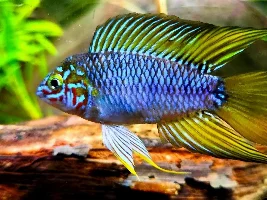
If they couldn't, what would be the point of the breeding colours that many fish have?