Water Conditioner Question

Well Mr andywg I suggest you practice what you preach and do some research from proper sources before spouting your mouth off with incorrect rubbish that Chlorine is not harmful to fish.

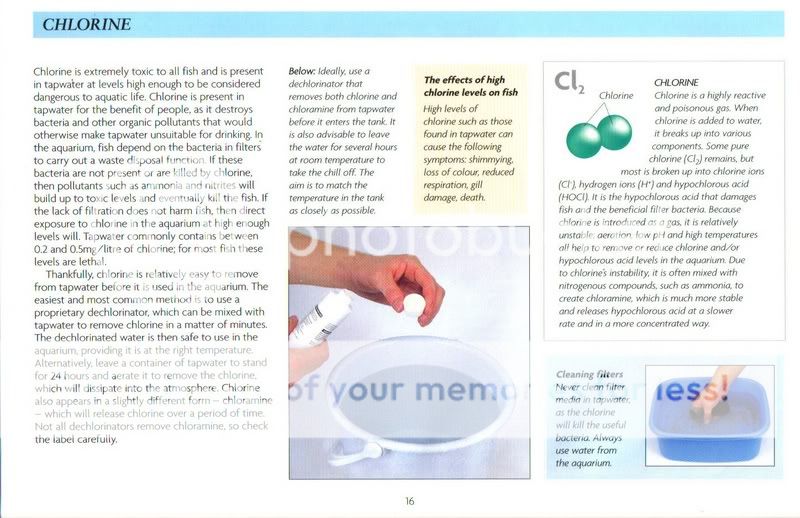
Enclosed is the section on Chlorine from the Interpet Tankmaster range of reference books on Water Quality.

Read and learn from people that will have forgotten more than you will ever know about fish tank water quality!

Chlorine2.jpg


So the point you made about people stating incorrect things on this forum is a fact...its you !! :lol:
 
You are right Fillet

Me, Tolak, CFC, Paul_MTS have all been poisoning our fish for years. That's how we all keep succesfful fish, a number of them extremely sensitive. All those fish I have in my tanks must just be the ghosts as they are swimming happily.

[/sarcasm]

First off, tell me where I said that chlorine doesn't harm fish. I said the concentration in tap water after water changing does not harm the fish. I don't say this just cos it sounds good. I say it because of the experience I have had and that of others who are far more "senior" or "expert" at keeping fish than I am, or ever will be with FW.

Secondly, might I give you a quick piece of advice on research? Always check the source.

In the same way that one should never blindly trust a piece of science research on Climate Change funded by an Oil company, one should be careful taking the writings of a company that wants to sell you de-chlorinator as the gospel truth on chlorine and how to ensure it is not a problem in the fish tank.

For example: that piece above talks about not all de-chlorinators removing chloramine.

Most (if not all) chemical dechlorination takes place by using the chemical Sodium thiosulphate. This chemical neutralises chlorine. It also breaks the bond between chlorine and ammonia to neutralise the chlorine found in that compound. But then they couldn't charge you more for putting on the side "Removes Chlorine AND Chloramine".

Does that leaflet point out that chlromination of water supplies seems to massively increase the numbers of the bacteria present in aquarium filters? No. So it seems while they have forgotten more than I will ever know, they have forgotten a pretty bloody important fact, n'est pas?

Face it, most people with large or multiple tanks put dechlor straight in the tank and then put water in (and would you believe it, some of use water straight from the cold tap!) and it causes no problems at all. Buckets are fine for smaller tanks. But I seriously doubt if more than 1% of owners of 200+gallon tanks use buckets for water changes.
 
Fillet this is a quote from Bignose, based on a scientific paper. Would you class this as a "proper source".
Well, a quick perusal of the scientific literature came up with some rather surprising results.

Firstly, and most surprising to me, the problem ammonia oxidizing bacteria (AOB) and nitrite oxidizing bacteria (NOB) growing in water utilities' facilities is becoming a somewhat serious issue. The chloramine does in fact, promote the growth of AOB and NOB, with the consequences -- written is a nice non-threatening way as -- "...the addition of chloramines can lead to biological instability in a drinking water distribution system by promoting the growth of nitrifying bacteria..." and "The resulting reduction in chloramine residual and development of a microbial community in the distribution system lead to water quality deterioration and violation of drinking water regulations." I think that I might very well have put a little more emphasis on violations of the drinking water regulations.

Basically, because the AOB and NOB grow, they excrete other organic compounds allowing other bacteria to grow. At the very minimum, this additional bacteria will require more chloramine to kill it off, but then, more chloramine promotes more growth of AOB and NOB, and I think you can see where this cycle is going... Here is the really bad news, with this extra growth, all that stuff we don't want in there could grow now, like the coliform bacteria (E. coli -- think spinach), and viruses, and Guardia lamblia and so on. All of these are pretty strictly required to be below certain levels by the U.S. EPA, and similarly in other countries.

Secondly, the really interesting part is that in lab test after lab test, the recommended exposure times and concentrations of chloramines do their jobs. The chloramines in the lab kill off all the organics, including the AOB and NOB. However, at the utility side of the issue, nitrification episodes are rather commonplace. One recent study found 63% of U.S. chloramining utilities and 64% of Southern Australian utilities tested positive for nitrifying bacteria.

One hypothesis for the discrepancy between the laboratory studies and operating results is that there are AOB strains
growing in full-scale systems that possess a greater chloramine resistance than those studied in the kinetic experiments. Whether the AOB strains used in earlier kinetic studies are representative of significant strains involved in full-scale nitrification episodes has not been confirmed, since there are no published evaluations of AOB diversity in chloraminated distribution systems.

This quote, and the above ones, from Regan, Harrington, and Noguera: "Ammonia- and Nitrite-Oxidizing Bacterial Communities in a Pilot-Scale Chloraminated Drinking Water Distribution System" Applied and Enviromental Microbiology 2002. The study where the %'s came from was Wolfe et al. "Occurrence of nitrification in chloranimated distribution systems" Journal (American Water Works Association), 1996

In other words, the strains that are in the water utilities have become more resistant to chloramines, and can indeed use the ammonia present as sustenance.

And, back to fishtanks, where do the AOB and NOB come from in the first place? Well, if you used tap water, they probably came from your water utility, and if a resistant strain has grown there... that same chloramine resistant strain is probably now growing in your tank too. The Regan et al. study cited above and Regan et al. "Diversity of nitrifying bacteria in full-scale cloranimated distribution systems" Water Research, 2003, was among the first to use DNA sequencing to distinguish all the different AOB and NOB that are growing. Some of the names should be pretty familiar: AOBs Nitrosospira, Nm. oligotropha and NOBs Nitrospira, Nitrobacter

So, it seems that AOB and so on can become resistant, or at the very least, as mentioned in the above posts, the chloramine levels are certainly not designed to sterilize a colony of bacteria as large in number as we culture in our tanks and so chloraminated water probably is not going to ruin a fishtank.

 
First off, tell me where I said that chlorine doesn't harm fish.

Here

The chlorine in the water does not greatly affect the fish.

Here

If it really is so bad for the fish, why do all mine swim around the new water being piped in?


In the same way that one should never blindly trust a piece of science research on Climate Change funded by an Oil company, one should be careful taking the writings of a company that wants to sell you de-chlorinator as the gospel truth on chlorine and how to ensure it is not a problem in the fish tank.
The page was from a reference book on water quality not a dechlor suppliers brochure. I am fairly sure the publisher has no interest in dechlor supplies. There are pages on ammonia and Nitrite also, Im sure they dont supply those to the public either!

I would rather trust a proper reference book than the aggressive ramblings from someone such as yourself.
As I have said before just because your fish are still alive, it does not mean it does not affect them. :no:

I fail to see how you can criticise me for using pre-treated buckets. That is my choice, so why the aggressive stance toward that? My first mail objected to your stance that it does not affect the fish. Show me a published aquatic reference book to say otherwise.
 
You stated that was from Interpet's book. Forgive me if I am wrong, but this looks like a product from Interpet called a water conditioner. I repeat, check your source. And on the subject of science, I see nothing in that extract that refers to scientific research.

Also, did I say chlorine doesn't affect fish? No. I said the levels in tap water will not greatly affect fish as your kind quoting has shown, especially since it gasses off so quickly.

My problem was your inference that adding dechlor to the tank was a completely stupid thing to do that would endanger the fish. That is just wrong. There are so many people who do it without any problems at all with extremely sensitive fish. Too many people put things like "You must de-chglor in a bucket" or "you must match the temperature during a water change" when it just isn't true, and there are plenty of fishkeepers that can show that.

If putting tap water into the aquarium the way I do was actually that bad, do you think the Python system would be so popular?
 
You stated that was from Interpet's book. Forgive me if I am wrong, but this looks like a product from Interpet called a water conditioner. I repeat, check your source. And on the subject of science, I see nothing in that extract that refers to scientific research.
If they supply dechlor why would it bother them if you added it before or after placing the water in the tank, so long as you buy the stuff?
If they and their chemists have manufactured the dechlor then surely they should know when and how it should be added?
Your arguement does not stack up!!

My problem was your inference that adding dechlor to the tank was a completely stupid thing to do that would endanger the fish. That is just wrong. There are so many people who do it without any problems at all with extremely sensitive fish. Too many people put things like "You must de-chglor in a bucket" or "you must match the temperature during a water change" when it just isn't true, and there are plenty of fishkeepers that can show that.
I have never used the word 'must' in my posts, just said the way I do it. I have never commented on temperature change either.
You seem to be clutching at straws to continue your agressive stance and arguement.

If putting tap water into the aquarium the way I do was actually that bad, do you think the Python system would be so popular?
why is smoking popular? does not mean it is good for you?

I am amazed that all these posts have stemmed from your aggressive stance on those that add dechlor in buckets prior to adding new water to a tank are wrong.
I have been astounded on the number of PM's i have received from other members regarding this thread, from people not agreeing or disagreeing on when you should add dechlor, but telling me not to bother exchanging views and posting back to you as they put it you are 'a bully' on this forum and try to impose your views on others even though they are unfounded. Some saying it is a waste of time as you are so aggressive in your views and never listen to anyone, etc etc.
 
If they supply dechlor why would it bother them if you added it before or after placing the water in the tank, so long as you buy the stuff?
If they and their chemists have manufactured the dechlor then surely they should know when and how it should be added?
Your arguement does not stack up!!

My point is that their information is far from complete. Re-read my point about almost all dechlorinators making chloramines safe for the fish by dint of the sodium thiosulphate breaking the bond between chlorine and ammonia and neutralising the chlroine. They have not put that in. They also neglect the points mentioned earlier about chloramines apparently feeding filter bacteria, which is supported by citing scientific peer reviewed papers.


If putting tap water into the aquarium the way I do was actually that bad, do you think the Python system would be so popular?

why is smoking popular? does not mean it is good for you?
And you stated that I am clutching at straws. Smoking is a life choice by people, not a tool purchased to aid people who like keeping fish to keep them healthier. My point was, if using a python system is that bad, why do we not start to hear anyone saying that could be linked to any problems? Smoking is considered bad as a link can be seen between smoking and the ill health of the smoker (through at least statistics, and I seem to recall they have identified the actual reactions that cause the damage, though I may be recalling in error there).

I know of no such links in fish keeping between putting tap water straight into the tank. My point on temperature was to show that there are a number of "myths" about things that must be done that are often reported as gospel on here. Another example would be people saying nitrates should be less than 40ppm when the only research I have seen shows 100ppm the point at which one starts to see long term damage.


I am amazed that all these posts have stemmed from your aggressive stance on those that add dechlor in buckets prior to adding new water to a tank are wrong.
I have been astounded on the number of PM's i have received from other members regarding this thread, from people not agreeing or disagreeing on when you should add dechlor, but telling me not to bother exchanging views and posting back to you as they put it you are 'a bully' on this forum and try to impose your views on others even though they are unfounded. Some saying it is a waste of time as you are so aggressive in your views and never listen to anyone, etc etc.

As stated repeatedly, it was not your method, but your inference that a different, perfectly acceptable (and highly recommended on larger tanks) method is completely wrong. If you think the posts are purely for my hatred of buckets, then to quote yourself: "You are clutching at straws", particularly when you have to bring an unspecified amount of anonymous PMs that are supporting you.

I often listen to people and change my mind, but unfortunately for most of the people on this forum, I tend only to listen to peer reviewed papers on matters such as this. How awful it must be when I cite scientific resources for why someone is wrong when trying to "impose my view" on others.
 
oww, i do love a good argument-this thread is good read.

in a perfect world we all (probably) would use dechlor before we add to our tanks, and we would have 0 ppm nitrate, and add perfect temp water to our ranks-but it has been proven that fish can servive and thrive in tanks that dont have this.

(pleese dont flame me!)

i personally used declore in the bucket for 4 years with my 50 gallon(i still do now), but when changing water in my 125 gallon this is just to time consuming and i have not seen any change in the fishes behavior or health because of it.

chlorine is nasty stuff and we dont really know if it irritates the fish even in low quantities, we dont know what there feeling..(mabie it affects them just a little bit)-this is a guess. but the fish are still alive and healthy.

andywg "the bully" :lol:
 
Filet, I don't care if you fill your tank with a bucket, a hose, or a paper cup. If filling your tank with a bucket of dechlored water works for you, that's fine. If you have been doing this for any amount of time you will know that what works for one aquarist sometimes works very well for another, and sometimes doesn't, there are often several options. A blanket statement pointing a finger at an aquarist accusing them of trying to take a short cut that jeopardizes their fishes’ health is bound to get a person riled up.

There is much scientific literature published on the necessity of dechlorinator. A publication by Interpet is not purely scientific, it’s part sales. I really doubt a company that sells dechlorinator wants anyone to think the product they sell is unneeded. I’m sure you could look at any major company’s products, and see that half are basically snake oil, products to make the aquarist feel better.

As Andy stated, some things get researched, and tend to change a person’s opinion. Science advances knowledge. Many years ago, water changes were thought to be bad. At one point ugf were the cat’s meow. If you keep up on the cutting edge research done on any subject concerning aquatics you are doing what is best for your fish. In this quest for knowledge, I’m still wondering if you personally have had a problem hosing water in, or if you are going by sales publications. By the research done on the necessity of dechlorinator, I’m a couple of weeks away from setting aside a tank to see if the research holds true in my case, as it has in other’s.
 

Most reactions

Back
Top