waiting ( not so patiently ) for your fish to mature...

Magnum Man

Fish Connoisseur
Tank of the Month 🏆
Fish of the Month 🌟
Joined
Jun 21, 2023
Messages
6,820
Reaction score
5,769
Location
Southern MN
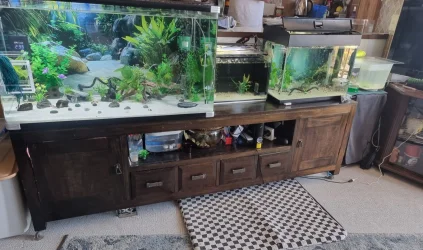
so, there is a big difference between mature fish, and the baby's most places sell... I'm not a patient man, and a hobbyist sees the picture ( when buying on line ) ... of coarse it's the super model of the fish world, and almost always a male, in breeding colors... then you get the baby shipped to you, and it looks like a female guppy... my tanks have changed a lot over the last couple years... for one thing, it's easy to over crowd a tank, when the fish come in a fraction of the size they'll grow to... but the tank is so much more spectacular to view, when the fish are mature... I was drinking my caffeine this morning, at 1st tank light, and the male sailfin tetra, was out from his hollow log, his dorsal has gotten impressive... sure the little guys do cool things too... when my panda gara gang was tiny, the little 1/2 long fish would come and steal food right from the mouth of adult tin foil barbs... I thought for sure they were going to get eaten... now as a mature group, there is a lot of yellow / oranges in their finage, at 4 inches... most tanks in my main group now, have mature fish, but I still have babies in the bitterling tank just getting going, there are baby panda garas in that tank as well, but they are like female guppies at 1 inch right now... maybe it's better when the fish mature with each other???
 
Last edited:
It's an interesting point. I just moved a batch of black neons that hatched Oct 12 (it's Dec 17 as I type). By Christmas they'll be the size we get them in stores. They are pretty little fish, but that growth is a contributor to why they're so common. Slower growing fish are rarer, because the farms have less profit from using the space to grow them.

When I see a fish I'm unfamiliar with, I first check origin and water needs. Then temperature. And then adult size. They may be tiny, but I buy them as if they are full adults. If I know it'll take 3 years for them to get there, I assume I'm a good enough fishkeeper I won't kill them in the next 3 years. In planning stocking, there's no such thing as a one inch fish it it grows to six inches. It's always a six inch fish.

How many of us have become attached to a pleco or goldfish, and had to get rid of it because it outgrew our tanks? Stores sell them predicting we suck at fishkeeping and they'll die from us. If we have proper maintenance routines and care, they'll live.

I have waited for some developments in fish when I knew those things were coming. It's fun to see their changes, and to see the final result. A lot of the most beautiful fish we can keep are slow growers.

There's a myth that if they grow up together, they'll be fine. I've had a few Cichlids I bought really small bust that one. They grew and seemed tolerant of their childhood friend tankmates, til one day they ate them all.
 
Depends on the tank size and species. There are many species that will go bonzka on each other in a 29 and get along great in a 48 or 96 - it all depend if the fish is territorial when mature, how much space they need and if their territory is only during breeding or forever.

I mostly keep sa dwarf cicihld and there is really a wide range of behavior and aggression level but even some of my pencil fishes are demonstrating extreme territorial behavior - this picture i took this morning shows one particular devil who wants close to 1/3 of the aquarium:
p4.jpg
p3.jpg


While i did not take a video he actively attack anyone (esp those of the same species) who gets any closer than the one seen in the full image.

The biggest problem with growing them together pre maturity is that it can form a false sense of security. I see this all the time with angelfishes - put 8 in a 120 or 200 and 5 years later you only have 2 or 4 (dependent on sexes et all).
 
I love watching the babies grow. Seem to go from a pair of swimming eyeballs into actual fish quickly. We keep them for about 10 - 12 weeks before rehoming or taking to the fish store for credit.

We have not bought fish in a while but that will change shortly. I am sure whatever we buy will be very immature unless we have them ordered special.
 
but even some of my pencil fishes are demonstrating extreme territorial behavior - this picture i took this morning shows one particular devil who wants close to 1/3 of the aquarium:
View attachment 375208
That's classic N. trifasciatus behavior. VERY territorial--all the trifasciatus 'variants.' Also true of N. nitidus and farmed N. beckfordi from Asian farms.
 
Also overhere at my place there are species that don't grow up that fast. When it comes to breeding purposes, it's not always that fun when it takes so long before they reach adulthood. And the other frustration is that certain species show their actual sex when fully grown. So, until that time, you won't be sure if you've got both sexes.
 
That's classic N. trifasciatus behavior. VERY territorial--all the trifasciatus 'variants.' Also true of N. nitidus and farmed N. beckfordi from Asian farms.
I've been told elsewhere that n. eques (which i do not own) and n. unifasciatus (which i own but have not observed such behavior) are also territorial. My primary reason for mentioning is to beg the question are these lipstick a variant of trifasciatus or some other species of undetermined nature ;)
 
I think my primary point is that many (most?) sa fishes are not territorial when young and in fact many species prefer to be in a group for safety but quite a few will become territorial when they mature and having been raised together will not change this aspect. Of course i limit my comment to sa fishes and as we know there are many regions of freshwater fishes with many different behavior and i suppose there are some species that if grown together will stay friendly but otherwise be hostile though i cannot name any such species explicitly.

The issue is that if someone raises a bunch of young fishes together but do not understand the behavior upon maturity they might form a false sense of tranquility that they are unprepared to deal with when behavior changes.
 
I've been told elsewhere that n. eques (which i do not own) and n. unifasciatus (which i own but have not observed such behavior) are also territorial. My primary reason for mentioning is to beg the question are these lipstick a variant of trifasciatus or some other species of undetermined nature ;)
I find the two nose-up species, N. eques and N. unifasciatus to be among the least territorial and fractious together with N. espei and N. marilynae. Males will nudge each other and flare but nothing as fierce as N. trifasciatus, N. nitidus or N. mortenthaleri.

The lipstick form is certainly a member of the N. trifasciatus species group. Whether it will be determined to be a distinct species, as they recently elevated N. erythrurus, or a variant, awaits the verdict of the ichthyologists.
 
Last edited:
I would agree that growing up several youngsters of a given species can have changing dynamics as they mature. It can also change things up if fish are moved to a new tank. Suddenly, they're not known "buddies" from hatching, they're potential mates or competitors...& all heck may break out!!
 
All I can say is that happy fish who get along make babies! After a shocking beginning 14 months ago when I thought it would be nice to have a few friendly fish , I'm happy to say that, once i rectified all of my mistakes, my panda corydoras spawn almost every 4 days, my peppered about the same, and my 5 kuhli loaches whenever they feel like it! Most of the peppers eat as they lay on the glass, but I do harvest quite a few. Everyone loves it when the kuhlis release their eggs,feasting happily. The panda corydoras lay in their mops and I harvest most of their eggs and bring up the baby's with very few losses.
This is my entire set up!
 

Attachments

  • 20251215_164442.jpg
    20251215_164442.jpg
    374.9 KB · Views: 43

Most reactions

Back
Top