The Way We Were

Innesfan

Supporting Member
Tank of the Month 🏆
Joined
Dec 28, 2024
Messages
955
Reaction score
1,837
Location
New York
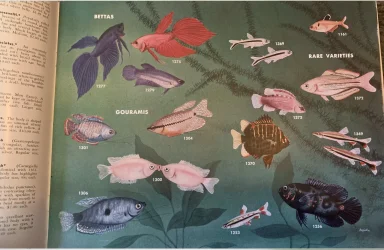
I was tidying my desk and found this in a stack of stuff. It was gifted to me my last birthday: the 1955 catalogue from the legendary Aquarium Stock Co whose NYC store lasted from 1910 to the early 1980s while its second location on Beverly Blvd in Los Angeles, CA lasted a bit longer. I visited both often depending on which coast I found myself. The reason why the NYC store has two addresses is that it ran the length of an entire city block from Warren to Murray streets, downtown. It was Mecca. Here are a few of the 60 pages in the catalogue. You'll recognize most of the species on the cover, I'm sure. The Nannostomus are N. harrisoni, common in those days, a rarity now.

1.png


2.png


3.png


4.png


5.png

6.png

7.png
 

Attachments

  • 2.png
    2.png
    2.6 MB · Views: 66
Last edited:
The equipment sure has gotten better with time. In the 1950s my dad put a small tank in the entrance foyer of the house, It ran an air powered box filter filled with fiberglass. I do not remember the fish. but I do remember it was a slate bottom tank with chrome frames and had a light over it. I was very young, but it struck me as being very small. I am thinking under 10 gallons.

My first tanks was in the 1970s. I shared a place with 3 partners in the sound company. So it was a community owned tank. We were all pretty ignorant re fish keeping back then. It was over 25 years later that I got my first tank in Jan. 2001.

My first fish came from the fish department of a local pet store. over the next 25 years I bought very little from shops. I sourced my fish elsewhere.
 
I do not remember the fish. but I do remember it was a slate bottom tank with chrome frames and had a light over it. I was very young, but it struck me as being very small. I am thinking under 10 gallons.
That's an interesting and, in my experience, fairly unique response. I have found most of us as kids remember things to be larger than we find them to be as adults. Perhaps it is relative based on our individual experience. Our first slate-bottomed, metal-framed 10 gallon seemed huge to me after having only had the experience of a 5 gallon tank and 2 gallon drum bowl previously. And when our first 20g arrived, well, I though it was a swimming pool.
 
Any time you get into catalogues of past objects in any domain, it's entertaining.

It is the way 'we' were, even if that we wasn't born yet. What we have tech-wise is far better, even if it's disposably built. I've seen the Aqua Stock Deluxe Air Pump in operation, and it barely worked. It didn't produce much air, and while it was very well made, it was not a loss when it was replaced.

We'll never go back to an economy where the visible customer is more important than the invisible shareholder. Well made equipment lasts too long, and doesn't need to be rebought.

When I was young I had this interest in talking to old people, and had friends sometimes forty or fifty years older than me. Some were aquarists, and from them, I got the impression tat at the start, this was was a hobby for the rich. In time, especially after WW2, it became a working class hobby, as the price of equipment fell and air cargo allowed for cheaper fish. Now, I think we're at one of many crossroads. It'll be interesting to see where we go.

When I was in my 30s, we had a club member in his mid nineties who brought in a box from his basement. He had run a fish store and had had cutting edge tech. It was a lot of fun to set up the equipment and watch it work. Air pumps produced one bubble a second...
 
This is great stuff ! I see they had the original wild type Aplocheilus lineatus but then what else would they have ? The Golden Wonder had not yet appeared back then . Also , you are right about young eyes seeing things differently . I always thought my first five gallon was pretty big but when I first saw a twenty I thought it was enormous !
 
I had some of the first golden wonders imported from the farms - they showed up in the early nineties. Up til then, I had only seen 'real' lineatus, and given my choice, they're all I'd keep now if I decided to keep Asian killies again.
The first young from those vividly lime green golden wonders sold like crazy.

I love looking at the old stuff, but I'm not nostalgic. Time marches on and we're still here.
 
I had some of the first golden wonders imported from the farms - they showed up in the early nineties. Up til then, I had only seen 'real' lineatus, and given my choice, they're all I'd keep now if I decided to keep Asian killies again.
The first young from those vividly lime green golden wonders sold like crazy.

I love looking at the old stuff, but I'm not nostalgic. Time marches on and we're still here.
Which brings up a question . Was that vividly lime green Golden Wonder color always sleeping deep within the genetic makeup of Aplocheilus lineatus just waiting to appear when conditions were right ? That color would make them too obvious in the wild and they’d be preyed upon savagely . A guy on the AKA forum told me to watch my fry for throwbacks to the wild type but I never saw any ever except for the occasional one or two that would show some striping at about a month old but lose it quickly . The Golden Wonder form seems to be the dominant color now . I would sure like to know the whole story of the dawn of the Golden Wonder era . I’ve never read it anywhere .
 
Which brings up a question . Was that vividly lime green Golden Wonder color always sleeping deep within the genetic makeup of Aplocheilus lineatus just waiting to appear when conditions were right ? That color would make them too obvious in the wild and they’d be preyed upon savagely . A guy on the AKA forum told me to watch my fry for throwbacks to the wild type but I never saw any ever except for the occasional one or two that would show some striping at about a month old but lose it quickly . The Golden Wonder form seems to be the dominant color now . I would sure like to know the whole story of the dawn of the Golden Wonder era . I’ve never read it anywhere .

Every xanthic variant I can think of, whether they be killies, livebearers, bettas, goldfish, cichlids etc, is recessive to the wild form. So I doubt the 'Golden Wonders' would ever throw wild type since the dominant gene (wild) needs to be absent for the recessive (yellow) to prevail.

I did think of you when I saw the image of the wild colored A. lineatus. They were commonplace once. It is odd to think now that many of the species depicted in the catalogue were once commonly offered in shops--Rivulus, Aphyosemion, Epiplatys, Nannostomus unifasciatus and N. harrisoni, Scats...

In that regard I disagree with @GaryE ; I AM nostalgic for that, and the experience of great aquarium shops, owned by people who were hobbyists at heart, and staffed by knowledgeable and enthusiastic workers. That hasn't been equaled or replaced by anything better. Sure the internet opportunities are, some of them, terrific. But the experience of going to a great aquarium shop stocked with an exciting inventory was one of the hobby's greatest joys but is now, with just a scant few exceptions, all but vanished.
 
Last edited:
@Innesfan I’m with you there . We once had three very nice locally owned tropical fish shops in town that were owned by hobbyists . Not all at once but intermittently over the years and I’ve never seen oddballs or rarities like they had since . Yes , I AM nostalgic for that as well .
One of these days my own personal Holy Grail of Killies will come to me , the wild type A. lineatus , and I will buy every single one they have . Those and the Port Cichlids that I want .
 
We've lost a lot, and I preferred the transition point - when we had lots of independent stores but when they competed to bring in unexpected sights. I expect what members in New York or other large cities got to see was different from what people in small centres missed out on.

I think the golden wonder mutation was very set when the fish hit the market. Mine threw no wild types back in the last century.

Within a year of my getting them, they were common in shops, and I have seen 'real' lineatus once in a store since then. Before that, those beautiful fish were regulars at a couple of better local stores. I've seen some fantastic youtube footage of wild ones in nature, but as far as the hobby goes they're another species wild form that we didn't have enough people breeding, and that largely vanished as a result. Even in the KIlli Club de France, a club that breeds lot of species of killies, there are only two listed keepers, both of the gold morph.
 
.
One of these days my own personal Holy Grail of Killies will come to me , the wild type A. lineatus , and I will buy every single one they have . Those and the Port Cichlids that I want .
I've seen wild A.lineatus every now and then and will keep an eye out for you. Ports are tricky. They are listed on aquabid from time to time but they are often misidentified C. bimaculatum, the so-called 'Black Port" which is, in my opinion, the Port's dull cousin. Conversely I've seen fish listed as C. dimerus or C. amazonarum that were in fact C. portalegrense. The pattern on the base of the caudal peduncle is unique to the true Port and that's how you can identify the genuine article. I'd snatch them up too--like you I love the species-- but I never solved the issue of what to do with thousands of baby Ports. They breed like bunnies.
 

Most reactions

Back
Top