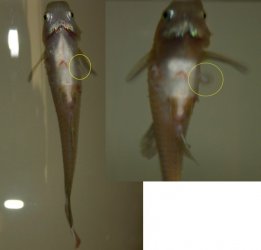
Sick vertical Guppy Female

stephend

New Member
Joined
Sep 24, 2004
Messages
51
Reaction score
0
Location
Scotland
I wonder if any of you might know what's up with one of my femail guppies. I noticed a few of days ago she was spending a lot of time at the top of the tank in the corner.

Then two days ago, I found her almost vertical in the water at the top. She has lost a lot of weight, and her colour is fading. I notice her gills are wide open too. She hardly moves, except when disturbed (when she swims almost normally for a brief moment), and she is eating, but not much. She seems to be getting worse.

My other two female and three male guppies are all in perfect condition.

My tank chemicals are as follows (ppm): Ammonia 0, Nitrite 0.1, Nitrate 6.

My ph is too high, at about 7.9, and I am working to bring it down, but would ph affect only one of the fish?

Temperature is about 25.5ºC/78ºF (it was about 24.4ºC/76ºF for quite some time).

Another thing I am not sure about is whether she was pregnant recently. One of them was, and none are now.

I've segregated er from the rest of the fish to give her a bit of peace. Photo attached.

Any ideas?

Cheers,

Stephen.
 

Attachments

  • guppy.jpg
    guppy.jpg
    39.9 KB · Views: 46
Issolate her straight away can you examine behind the gills for parasites, don't mess with the ph, plus you have a slight nitrite reading need to do a water change.
 
loosing weight and color can be a sign of fish TB. Does she look like she is literally a swimming skeleton or her head is way too big for her body?

Your nitrites are a little high, as they should always be zero. You should be doing daily water changes until this returns to zero.

Also, how are you attempting to lower the pH?
 
Does anything on here sound like yours.

Gill Disease
Symptoms
Rapid gill movements, and swollen or discoloured gills. The fish are likely to stop feeding and may gasp either at the surface or laying motionless on the bottom.

Causes
The disease can be caused by infections of fungi, bacteria and parasites, and poor water quality is likely to be a contributory factor.

Possible cures
An improvement in water quality may be the first step in treatment - avoid overfeeding and overcrowding, and carry out frequent partial water changes. Use a water conditioner during water changes to avoid irritation of the gill membranes by chlorine. It may be necessary to add an anti-bacterial to the water. If gill parasites are suspected, it may be necessary to treat with formalin or copper based medications.
 
The guppys isn't going to make it, are the other fish flicking and rubbing on objects, any heavy breathing, look at there gills are they red and inflamed or pale.
 
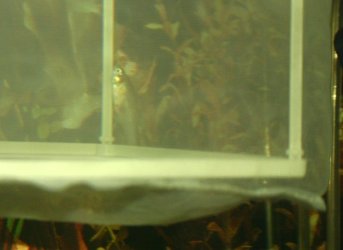
I isolated her, and found something quite disturbing. Quite a few red veins, and a fluffy white growth on her side - see photo below:

guppy2.jpg

Is it possible she was injured and fungus is attacking some dead flesh? I do hope it isn't contagious.
 
Columnaris with a secondary infection of septicemia, hard to cure now i'm afraid, as she is laboured breathing and the gills are affected.
 
Not the writer of this information.


Flexibacter columnaris (Columnaris disease or Saddleback disease)


Gram negative slender rods (3-8 microns)

The disease is a serious disease of young salmonids, catfish and many other fish.

This is a highly communicable disease. Lesions usually first appear as small white spots on the caudal fin and progresses towards the head. The caudal fin and anal fins may become severely eroded. As the disease progresses, the skin is often involved with numerous gray white ulcers. Gills are a common site of damage and may be the only affected area. The gill lesions are characterized by necrosis of the distal end of the gill filament that progresses basally to involve the entire filament.

Flexibacter columnaris infections are frequently associated with stress conditions. Predisposing factors for Columnaris disease are high water temperature (25°C-32°C.), crowding, injury, and poor water quality (low oxygen and increased concentrations of free ammonia).

Flexibacter maritimus: cause similar problems in salt-water environment.

Flexibacter psychrophilus causes Cold Water Disease or Peduncle disease. Fish develop dark skin, hemorrhage at the base of fins, and anemia with pale gills with increase mucus. Hemorrhage into the muscles is common. Periostitis of cranial and vertebral bones is common in chronic cases. A chronic meningoencephalitis occasionally is observed with abnormal and erratic swimming
 
It's sounds like it's suffering, need to get it out of the tank, i would do some water changes daily on the tank, and observe the other daily, the fish is in a bad way and the gills have been destroyed it won't survive, sorry.
 
I'm gutted - my first death - though she does seem to be suffering terribly.

Thank you very much for your prompt assistance.

One final question, in addition to the daily water changes should I treat tank with medication?

Regards,

Stephen.
 
It's not advised, but she got it pretty bad, try the water changes for now, it's up to you, but if you do treat the main tank you will need anti internal bacteria med, good luck.
 
I would advise adding some salt to the tank, as columnaris hates salt, but i need to see your stock list to see if all your fish can tolerate it.
 
tttnjfttt said:
Also, how are you attempting to lower the pH?
[snapback]866009[/snapback]​

My LFS suggested adding some marble to the tank. I was surprised by this at first, but on reflection my tank ph always creeps up, so perhaps a permanent counter to this would be a good thing.

Does that seem a sensible suggestion?

Cheers,

Stephen.
 

Most reactions

Back
Top