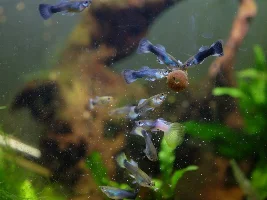
New shrimp and crab tank.

Sorry for your losses. You aren't alone. Several of us on here have mentioned having bad luck with drip acclimation over the years. It has something to do with the chemistry of ammonia; it is less toxic in a high-CO2/lower pH environment (which tends to develop in shipping bags) but becomes more toxic when exposed to fresh, oxygenated tank water and the pH comes up a little bit. Your losses fit the pattern.

A lot of us have moved away from drip acclimation toward "drop and plop." Float the bags for 20 minutes or so, then either fish the critters out of the bag with a small net, or pour the water through a net into a bucket and plop them straight into the tank. There is a slight danger of osmotic shock if the hardness levels are drastically different, but that is generally considered less dangerous than the exposure to ammonia in the bag water.
I did that with my amano shrimp and they were fine. Granted that amanos are hardier than cherries. Still though, it couldn't really have gone any worse so why not try something different?
 
Yeah, ain't that just the way it goes? :lol: Our hobby is always growing and progressing and learning. I still cringe to think about the suffering I inflicted on my tanks when I was younger, just from not knowing better. But drip acclimation isn't even that. It's kind of unfair because it makes sense that it would be the right way to do it. Turns out it usually isn't.
What about cup acclimation? As in floating the bag in the tank. Take out 1/4 cup of the bag water and replace it with 1/4 of tank water. Do this every 15-20 minutes for 2-3 hours.
 
What about cup acclimation? As in floating the bag in the tank. Take out 1/4 cup of the bag water and replace it with 1/4 of tank water. Do this every 15-20 minutes for 2-3 hours.
It's just drip acclimation with fewer, bigger changes and less transition. I'm not sure scientifically but if I had to guess you are introducing the same problem that drip acclimation seems to have, but reaping less of the benefits (main benefits that people promoted this method for was the smooth transition that the fauna receive during the acclimation, instead of dumping them straight into different water).

I would do my research if I were you, but I suspect minimal improvements and less benefits through that. I have switched back to bag acclimation for most casual transfers, but I still drip acclimatise for fry and breeding purposes since fry are almost always extremely sensitive to water change, and drip acclimation is 100% the more delicate method.
 
What about cup acclimation? As in floating the bag in the tank. Take out 1/4 cup of the bag water and replace it with 1/4 of tank water. Do this every 15-20 minutes for 2-3 hours.
I think you're going to have the same problem. As for your amanos surviving, yes, that too. It's inconsistent because it depends on the amount of time the critters spend in the bag during shipping, the pH of the shipping water, the amount of said water relative to the biomass/waste products of animals, the hardiness of the animals themselves, and probably other variables that I'm not thinking of. Those are a lot of variables. Sometimes it isn't a problem at all. Sometimes it is.
 
It's not all bad news. The ramshorn snails that I got for 20 cents each are doing just fine.
 
A lot of us have moved away from drip acclimation toward "drop and plop." Float the bags for 20 minutes or so, then either fish the critters out of the bag with a small net, or pour the water through a net into a bucket and plop them straight into the tank. There is a slight danger of osmotic shock if the hardness levels are drastically different, but that is generally considered less dangerous than the exposure to ammonia in the bag water.
I've done this for a long time with fish but not shrimp. All change now - I got some yellow neos shipped 2 days ago. I know that these are not nearly as fragile as most people assume so they went straight in. Of the 10 I bought 12 are swimming around 2 days later - thanks to the seller for putting an extra 2 in the bag :whistle: .

I don't do this often enough to be statistically signicant but when I bought my red rilis I lost 30% within the first 12 hours using drip acclimation. So I am going to stick with get them into clean, fresh water asap.
 
I don't do this often enough to be statistically signicant but when I bought my red rilis I lost 30% within the first 12 hours using drip acclimation. So I am going to stick with get them into clean, fresh water asap.
Completely agree, follow this advice on your second try. @WhistlingBadger explained this very well at the top of the thread:
It has something to do with the chemistry of ammonia; it is less toxic in a high-CO2/lower pH environment (which tends to develop in shipping bags) but becomes more toxic when exposed to fresh, oxygenated tank water and the pH comes up a little bit.
 
So I got some more shrimps yesterday. And I did 2 and a half hours of cup acclimation. It went a lot better. So far no deaths that I can see. That doesn't mean that there aren't any. But none died in the bag or at the time of transfer. Which happened last time.
They've been mostly hiding today. Which is to be expected. But a few come out at a time.
 
So far so good. I fed them a half a veggie stick yesterday then removed what was left after a couple hours. Five of them ate from it. But this tank has been going a while so there's plenty of bio film for them to eat,
I'll feed twice a week alternating between Ken's Vegetable Sticks w/calcium, Fluval Algae Crisps and some kind of blanched vegetable. I'll boil up some frozen green beans this weekend.
 

Most reactions

Back
Top