Chronic columnaris?

FishFriend0

Fish Fanatic
Tank of the Month 🏆
Joined
Dec 31, 2023
Messages
145
Reaction score
51
Points
28
Location
Salisbury, UK
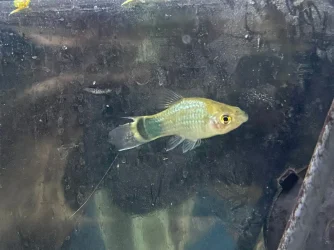
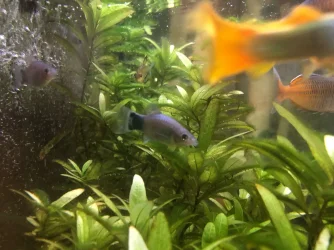
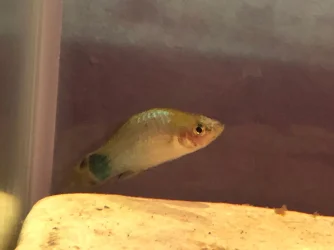
In the past I have had issues with what I am almost certain is columnaris bacteria. I have been dealing with it from over a year now and for some time it stopped appearing in my fish. But recently it has started again with one fish showing severe symptoms with a rotting tail and gasping at the surface and another that has no visible tail rotting but is gasping at the surface often
When a fish is infected by it, it usually follows this pattern:
1. Gasping at surface
2. Grey spot begins to form on the tail
3. Becomes thinner
4. Tail gets worse as a the spot becomes a small hole then a gash out of the bottom of the tail. The tail continues to worsen until it begins to look stringy.
5. The fish wedges itself by the filter output and stays there most of the day until it dies
There was also one time where a fish’s head was rotting rather than the tail.
This has only occurred in my livebearers (guppies and platys) but it happens more often in the platys as they are likely quite inbred at this point. Another important point I feel is that it usually only affects one fish at a time. This means that it is not necessarily an outbreak or tank destroying but it persists nonetheless.

The main issue is that it appears to be untreatable (at least with meds I can get in the uk). I have tried acriflavine and eSHa 2000 but neither had any effect. This leads me to believe that this is a more persistent strain of columnaris that is unable to take a hold of the tank in full but is resistant to these meds. I have seen that you can use meds like kanamycin and nitrofurazone but I cannot get those here. I will attach a couple of photos so you can see the symptoms.

I am really struggling to figure out what to do as it somewhat feels that I cannot do much more. It was largely gone for about 6 months but has come back again.
 

Attachments

  • e23b986d-96e4-4f48-9b2e-c22d691f729c.webp
    e23b986d-96e4-4f48-9b2e-c22d691f729c.webp
    76.3 KB · Views: 70
  • e73159ed-0894-485c-ac21-fbc808848efc.webp
    e73159ed-0894-485c-ac21-fbc808848efc.webp
    268.1 KB · Views: 49
  • 700746c9-4b29-49a7-b735-6ccc8d8728ea.webp
    700746c9-4b29-49a7-b735-6ccc8d8728ea.webp
    199.9 KB · Views: 60
First off, columnaris gets blamed a lot for a wide wide spectrum of internal bacterial infections, moulds and fungi. I guess we can add parasites too, but acriflavene (strictly an anti-parasitic) would have killed most of the likely suspects, and the problem is ongoing.

It's a livebearer issue, and it comes through the supply chain. It can be affected by too few and too small water changes, and can also come from stress related to having soft water for your hardwater fish. Inbreeding isn't a likely cause. This is a disease, or a spectrum of diseases. Which one of many is an issue.

I looked up eSHa 2000, and none of its ingredients would help. We don't see it in my country. It has antiseptics, and antiparasitics for external problems, but what you're seeing is internal.

Interestingly that bodily collapse appears often in livebearer females after they've dropped young, a time of high physical stress. So stressors - environmental conditions, water quality and temperature could be behind what you're seeing. The fish are probably carrying it, but if you escaped it for 6 months, it was probably dormant. Something let it take off again. I'd review that first, to see if water changes are regular, especially with the heat we read of the UK getting recently.

I change 30% of my tank water every 7 to 10 days, with dechlorinated tapwater. I am especially careful when it gets hot (not often where I am, yet) as many dangerous bacteria love warm water.
 
Yes it is possible that it could have taken off again due to the increasing temperature. Perhaps I will increase my water change schedule and see if that makes any difference. I think I will euthanise the severely affected fish as it is in quite a horrible condition.
 
Just as an additional piece of information, Columnaris or more properly
the Flavobacterium columnare group, which includes four distinct species: F. columnare, F. oreochromis, F. covae, and F. davisii.

Is clearly a more complex disease than most of us realize. What I have gleaned from reading papers on this the different species have differing levels of virulence. Moreover, it turns out the different species have resistance to different drugs, What this means for us a fish keepers is we cannot easily determine which species out infected fish might have. Thus out choice of treatment we choose may be the wrong drug.

This is complicated by the fact the different forms of Columnaris tend to attack different species of fish. However, despite the fact that some Flavobacteria are resistant to it, the likely beast treatment option is Tetracycline which is "a broad-spectrum antibiotic that treats bacterial infections by preventing bacterial protein synthesis."

If you cannot find tetracycline, be sure to look for another option which is also a broad spectrum antibiotic. Bacteria are divided into gram negative or gram positive groups. There are different antibiotics normally suggested for each group. However, broad spectrum means it treats bacteria from both groups though that may not mean all or most of the potential bacteria in either group.

It is safe to combine Fritz Maracyn and Maracyn2.

The active ingredient in Maracyn is Erythromycin,

Fritz Maracyn

  • Highly Effective Treatment for Bacterial Infections in Fish
  • May be Used Along with Coppersafe®, Maracyn® Two, or Maracyn® Oxy
  • Easy to Measure Packet Dosing System
  • Bulk Jars Available for Larger Systems
  • Safe for Fresh and Saltwater Systems
  • Effective Against Gram-Positive Pathogenic Organisms

The active ingredient in Maracyn Two is minocycline, which is broader range and covers both gram positive and negative

Fritz Maracyn® Two

  • Highly Effective Treatment for Bacterial Infections in Fish
  • May be Used Along with Coppersafe®, Maracyn®, or Maracyn® Oxy
  • Easy to Measure Packet Dosing System
  • Bulk Jars Available for Larger Systems
  • Safe for Fresh and Saltwater Systems
  • Effective Against Internal and External Infections of Gram-Negative Pathogenic Organism.
 
Just as an additional piece of information, Columnaris or more properly


Is clearly a more complex disease than most of us realize. What I have gleaned from reading papers on this the different species have differing levels of virulence. Moreover, it turns out the different species have resistance to different drugs, What this means for us a fish keepers is we cannot easily determine which species out infected fish might have. Thus out choice of treatment we choose may be the wrong drug.

This is complicated by the fact the different forms of Columnaris tend to attack different species of fish. However, despite the fact that some Flavobacteria are resistant to it, the likely beast treatment option is Tetracycline which is "a broad-spectrum antibiotic that treats bacterial infections by preventing bacterial protein synthesis."

If you cannot find tetracycline, be sure to look for another option which is also a broad spectrum antibiotic. Bacteria are divided into gram negative or gram positive groups. There are different antibiotics normally suggested for each group. However, broad spectrum means it treats bacteria from both groups though that may not mean all or most of the potential bacteria in either group.

It is safe to combine Fritz Maracyn and Maracyn2.
Due to the fact that the bacteria has only affected my livebearers suggests that it is likely F. Columnare, which is a gram negative bacteria (correct me if I’m wrong).

With regards to medication, I have seen that tetracycline can become ineffective in hard water, which I have. I have also seen that oxytetracycline is used in medicated foods? If it is true that it is F. Columnare then Fritz Maracyn would be ineffective? But perhaps Maracyn2 could work?

Thanks for the response.
 
This is an aside, but what is legal availability in the UK? In Canada, all aquarium antibiotics are illegal except with a veterinary prescription, and veterinarians who deal with fish are rare to non existent in most areas. There's a black market at some aquarium stores, but you have to know the characters who sell.

In the US, antibiotics are easy to get. But availability varies across countries, and that affects advice people can give. I tend to be fatalistic with diseases like what you're seeing, because my options are limited.
 
It's the same in the UK, antibiotics are available only on a vet's prescription - if you can find one willing to prescribe for fish.
 
Not to be an alarmist, but could you please fill out the Emergency Template and tell us your water parameters, especially GH, KH, pH, and temperature? Knowing these things, and more, from the ET will better enable us to suggest possible strategies.
 
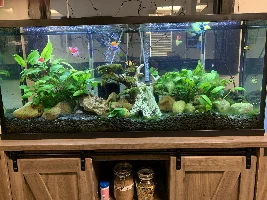
Tank size: 250l (65 gallons)
tank age: 2 years
pH: ~8-8.2
ammonia: 0
nitrite: 0
nitrate: 5ppm
kH: ?
gH: 16 degrees / 280ppm
tank temp: 25 but there has been a heatwave in the uk so it may have gone to like 26 (the heatwave is over now)


Fish Symptoms:
Rotting tail, rotting head (once), gasping, getting thinner, lethargic

Volume and Frequency of water changes:
50 percent every 1-2 weeks

Chemical Additives or Media in your tank: sponge and bio media in filter, no ferts, prime dechlorianator

Tank inhabitants: 12 platys
6 boesemani rainbows
8 lemon tetras
Bladder snails

Recent additions to your tank: none for a long time

Exposure to chemicals: no
 

Most reactions

Back
Top