Black Beard Algae Growing On My Fish

Rockatteer

New Member
Joined
Aug 4, 2008
Messages
15
Reaction score
0
Hi guys,

I've been having an ongoing fight with black beard algae in my tank for several months now.

I don't know where it came from because i haven't added any new fish or anything else for a very long time.

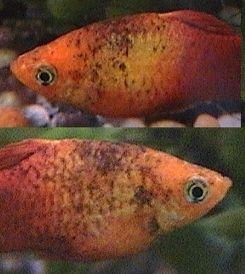
But anyway two of my Sunsets now appear to have the stuff actually growing on them :crazy:

Does anyone know how to deal with this?

Thanks

Rocky
 
Im so sorry....but did you really mean on the fish themselves???

Well off the top off my head I would say.....well honestly at this point I would move all fish into quarintine tanks and nuke that tank. Dry it out. I had that stuff in my tank about 2 yrs ago and I couldnt get it to die for anything. So I played musical fish tanks, and dried out the offending tank. -_-

Sorry I wasnt more helpful....hopefully someone who had better luck then I did can come on here....
 
Im so sorry....but did you really mean on the fish themselves???

Well off the top off my head I would say.....well honestly at this point I would move all fish into quarintine tanks and nuke that tank. Dry it out. I had that stuff in my tank about 2 yrs ago and I couldnt get it to die for anything. So I played musical fish tanks, and dried out the offending tank. -_-

Sorry I wasnt more helpful....hopefully someone who had better luck then I did can come on here....
Yeah ON the fish.

I've attached some not so good pictures so you can get an idea of what I'm talking about. You can't see the black stuff as well int he photos as you can in real life.. its quite prominent and has only recently appeared on the fish. This fish seems the worst, one other sunset is starting to get it, but the other fish seem ok...so far.
 

Attachments

  • fish.jpg
    fish.jpg
    16.2 KB · Views: 112
the black markings on the fish is cell damage (like bruising) that is usually caused by exposure to chemicals. Chlorine in tapwater, high levels of ammonia or nitrite, or really acid water can cause it. Also overdosing with algicides and medications can cause it.
Make sure you dechlorinate any tapwater before it is added to the tank.
Don't overdose with medications.

To work out the volume of water in the tank
measure Length x Width x Height in cm
divide by 1000
equals volume in litres

When measuring the height, measure from the top of the gravel to the top of the water level. If you have big rocks or driftwood in the tank, remove them before measuring the height.

There are 3.785litres in a US gallon and 4.5litres in a UK gallon.

Adding carbon to the filter can help remove chemicals but the carbon should be replaced frequently, every month or more often.

The fish should heal up and look normal in a month or so as long as they aren't exposed to anything else.
 
The tank is a 60 litre tank.

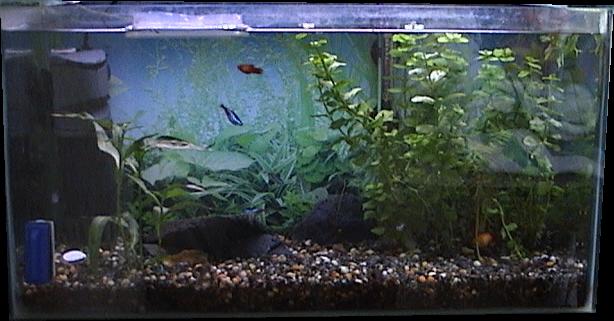
has 10 fish in it... 5 Tetras, 3 sunsets 1 Zebra Danio and 1 Plecostomus

PH is 7.0, although it has been sitting around 6.7 for a little the last few weeks, but I've brought it back up to 7 again now.

Can't test for anything else in the water because I only have a basic PH test kit.

Water changes are done weekly with gravel vacuum and a basic tank cleaning (glass cleaned, remove any dead/algae covered plants etc)

Heres a picture of the tank so you get an idea of whats what. (note: This picture was taken just after the new plants where put in, they look a bit darker and algea-covered now)

dsc01243.jpg
 
the black markings on the fish is cell damage (like bruising) that is usually caused by exposure to chemicals. Chlorine in tapwater, high levels of ammonia or nitrite, or really acid water can cause it. Also overdosing with algicides and medications can cause it.
Make sure you dechlorinate any tapwater before it is added to the tank.
Don't overdose with medications.

Adding carbon to the filter can help remove chemicals but the carbon should be replaced frequently, every month or more often.

The fish should heal up and look normal in a month or so as long as they aren't exposed to anything else.
Thanks for that information Colin. Very much appreciated.

I always use water conditioners when changing the water. Over the last couple of months I've been using a product called "Safe Start" which claims to also neutralize heavy metals and provide a slim coat and electrolytes for the fish. But thats the only change in routine I've made, so I'm thinking I should get a decent testing kit and check out the nitrite and ammonia levels.
 
The water conditioner should be fine but if possible make up the water (add the conditioner) and stir it up before it goes into the tank. This allows the dechlorinator to break down the chlorine before the water is added to the tank with the fish.

Testing the water for ammonia or nitrite might give you results but the damage was done when the fish went black. It only takes a few minutes/ moments of exposure for it to occur and there might not be any ammonia or nitrite left to provide a reading. However, it is always a good idea to check the water quality when there is a fish health issue. You can even take a sample of tank water to the LFS and have them test it.
 
The water conditioner should be fine but if possible make up the water (add the conditioner) and stir it up before it goes into the tank. This allows the dechlorinator to break down the chlorine before the water is added to the tank with the fish.

Testing the water for ammonia or nitrite might give you results but the damage was done when the fish went black. It only takes a few minutes/ moments of exposure for it to occur and there might not be any ammonia or nitrite left to provide a reading. However, it is always a good idea to check the water quality when there is a fish health issue. You can even take a sample of tank water to the LFS and have them test it.
Yeah I've always done water treatment before it goes into the tank and I have a separate bucket which has only ever been used for water changes. So I'm at a bit of a loss as to what could have caused the fish damage other than water condition. I'm starting to wonder about my tap water actually.

I just tried an interesting little experiment using a water test kit from a swimming pool. It tests for Chlorine, PH and alkaline.. Ph and alkaline are ok, but the chlorine showed a low reading.. I would have expected it to have a zero reading since there's not spose to be chlorine in the water.

Anyway I'm heading over to my LFS tomorrow to get a decent test kit to so I can see whats going on with my water.
 
if you tested the tap water for chlorine then there should have been a reading. All tapwater in most civilised countries has chlorine or chloramine in it.
 
if you tested the tap water for chlorine then there should have been a reading. All tapwater in most civilised countries has chlorine or chloramine in it.
No, I was testing the fish water. :)
 
That’s a concern if there is chlorine in the tank water. Either the test kit is wrong or you have chlorine in the water and that would be really bad.
Try testing some tap water that has dechlorinator added to it. Also test tap water that hasn't had any added and see if there is any difference. It could be your dechlorinator isn't working and that caused the damage to the fish.
You can also try boiling some water and then aerating it for 24 hours. Then check that for chlorine. Boiling and aerating should get rid of any chlorine and give a 0 result.
Maybe ring your local water corporation and see if they add chloramine or chlorine to the water supply.
 
Fascinating.....

If chlorine gets to the tank, it will wipe out the bio cycle, and you will have ammonia. It will cause burns that Colin noticed on the photo, and dead cells on the fish may allow algae growth. Strange that the fish is still alive...

(I've never seen algae growing on fish, but I have snails with algae growing on their shells...does not hurt them.)

The cause is either chloramines (which are not handled by many conditioners) or insufficient dosing. Since you age the water, it is more likely chloramines, simple chlorine would dissipate quickly enough.

I'd head to a lfs to have them check the water, and to get at the very least an ammonia testkit.

hth

All tapwater in most civilised countries has chlorine or chloramine in it.

NYC water (US) has neither!
 
I brought a 5 in one test kit which showed Nitrates to be off the scale, so I assumed my bio cycle has been wiped out and have done a 50% water change with a double dose of Aqua Plus and Cycle.

I also purchased a bottle of Flurish Excel to deal with the black beard Algae.
 
Nitrates "off the scale" means that your cycle is working fine, but you are not doing enough water changes.

Cycle is a useless product.

Prime is a better conditioner than AquaPlus.

HTH
 

Most reactions

Back
Top