Anus is stuck with something black for 2 days

confused_aquarist

Fish Fanatic
Joined
Oct 2, 2024
Messages
110
Reaction score
8
Location
Tokyo
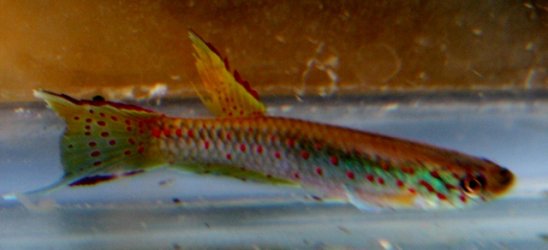
I am not sure if this is parasites or poop. It appeared overnight and seemed to get a bit bigger.by day 2.
It's black in color and if it's roundworms nothing is sticking out from the anus.
The anus itself is sticking out a little, but nothing has come out so it hasn't yet advanced to a prolapse.
スクリーンショット 2026-01-03 23.16.07.png

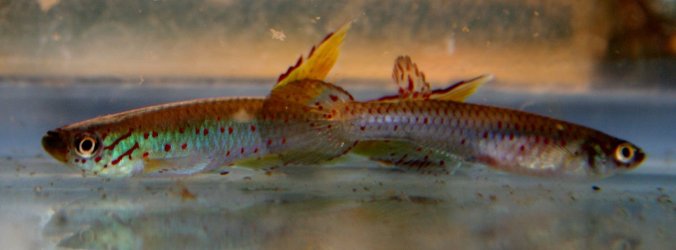
This is I think either A. christyi, A. decorsei, or A. polli, the fry each look very different with number of dots, color, etc.
Some yellow, some orange, some ~30 dots, some 3 dots
I cannot tell which species
The fry is F1 from wild-caught parents.
If this is poop I am not so sure if it can be stuck for so long.
Also wondering if possible other parasites like glugea, etc.
 
And also actually, I had a mysterious fry death a month ago. It happened when a fry jumped from a breeder box into another breeder box. I'm not sure if it had trouble during jumping or hit itself or what, but on the same day, it stopped eating, and it got bullied, started flipping and died.
I've also had bellysliders initially during tank setup. At the worst, 15/15 of the hatch ended up being bellysliders. The fertilization and hatch rates were perfect though, none ends up fungusing (and to this day it's still 100%)
I'm kind of mystified by this series of problems and wonder if they're all related somehow
Also I'm not sure if this is also related but all of my fry end up being males even though a lot of them initially look life females.
 
Last edited:
Actually, a huge one came out this morning with thin one trailing behind it so I'm pretty sure it was just poop 😆

I've seen diarrhea before, but constipation was a first.
It was probably due to a recent switch to feeding dry pellets. Some of the juveniles were still not adapted to eat dry food- even when I feed the fry with powdered foods sometimes they would bloat for a day or two.
It's very easy to overfeed them because dry food has little moisture.

The juveniles are very tame, but I've never had success taming the male father- which is why I've been suspecting latent disease issues with this bunch.
Each day he would eat 2 or 3 pellets and just spit out the rest. Also doesn't seem to like baby brine very much.
During feeding he would pretty much just chase around the female rather than being interested in food, it's been like that way for a year. I think he is not so young, based on size probably older than 2 years when I purchased them.
 
The juveniles are very tame, but I've never had success taming the male father- which is why I've been suspecting latent disease issues with this bunch.

I can't say for sure what you have there, but I have kept Aphyosemion polli, among others of the elegans group, and it looks similar. They are shy fish, so the behaviour males sense. I suspect that blockage was a pellet working though. I would never choose food like that for an Aphyosemion, and if the pellets are the size of the black dot, I would break them up. My suspicion is the difficulty the fish had is a message about that food.
 
I'm confused about your confusion about species identity. When you got the fish what were you told they were?
 
Last edited:
I unpacked probably 10 shipments of "elegans" or "cognatum" from KInshasa exporters over a period of 25 years. They were never elegans, though we got pseudoelegans once. We had never had cognatum. Most of the time, they were either christyi or polli, beautiful fish in their own right.

I used to send photos to a French expert in the elegans group to confirm my identifications. They aren't the easiest group, and exporters are intentionally vague about capture locations in case the fish is desirable and the competition wants to sell it too. I can see where the confusion would come from.

Killies are dirt cheap in Africa, and the fishermen don't like them for that. I've heard them called 'ditch fish', and the identification of species can be very, umm, relaxed. We used to only be able to get killies as box stuffers, in bags jammed in to keep the more expensive fish bags from moving.
 
I was told they were A. cognatum, but they look nothing like cognatum.
Ah. I agree. Not A. cognatum. Based on the photo and what you report, I think it's between two of the species you cite: A. poli and A. decorsei. I've kept the latter, albeit briefly, and the one thing you said that triggered my memory was the variability of the dotted pattern among the fry. That was certainly true for the A. decorsei that I kept. Some were barely spotted at all. I wound up working with a related, still undescribed species, A. sp. 'Lobaye', which, interestingly was thought to be A. decorsei for a while. But unlike that species, they are consistently more heavily spotted and the fry are all cookie-cutter alike in that regard. And there is no yellow or orange on them.
 
No one's ever going to find this discussion with that title - but...

A. decorsei isn't likely because of geography. Sometimes fishermen bring things down to sell them to wholesalers, but assuming these are a commercial import (there is no code with them) that species is a bit far off the beaten track. A. polli and christyi are closer to Kinshasa, and easier to get. A polli was showing up here fairly regularly as the standard killie in Congo shipments, if any Congo fish arrival can be considered regular.

It's such a beautiful, overlooked group of messy to identify killies. It isn't cognatum, which I kept for a long time, from a couple of different collections. I think it's polli.

Here are two day of arrival shots, with a later one, second generation shot in the middle.
 

Attachments

  • polli 006 (640x292).jpg
    polli 006 (640x292).jpg
    132.5 KB · Views: 9
  • Aphyosemion polli.jpg
    Aphyosemion polli.jpg
    302.4 KB · Views: 9
  • polli 004.JPG
    polli 004.JPG
    120.3 KB · Views: 9
I unpacked probably 10 shipments of "elegans" or "cognatum"
That's very good to know, and I was surprised that the exporters might be intentionally vague about the shipments so that they can be more profitable. I was wondering why thosee would be misidentified as cognatum when they so obviously are not. Like the photos that you posted, the F0 male is white, sparse dots with yellow fins and red borders. The proportion look just like the one in the middle, but I think mine has distorted fins. The tail fins where the edges stick out (I don't know what they're called) in mine is kind of distorted where they're both slightly inside the tail instead of being in the outer edge. I'm not sure how to express it but it looks like a power plug instead of a lyre harp. I don't know if these just sometimes fight and end up with torn fins that regenerate at wrong places...? All of the F1 are growing beautiful fins though. It's also good to know that the fry variability can be a characteristic of A. decorsei rather than polli, though the F0s definitely look like the ones in the photo. The fry certainly don't resemble each other very much at all in their patterns, proportions, etc. because I can easily tell apart which sibling is which. Some have the same colors as F0s, just yellow fins/white body, while others have orange fins and their entire backs are tinted orange. The orange ones tend to be the ones that are most aggressive I noticed. When I remove the aggressive ones the rest also start to develop orange colors, but this only happens early in growth like several months old. When they're yellow later on they're just stuck being yellow.

I was also amazed at how beautiful the proportion of the female was in the 3rd photo. It's so easy to overfeed and end up with plump female killifish but it's surprising how little food they can go with. Not very easy to grasp the ideal amount of feed because they always beg for more.
 
People often mock the killie hobby for having the codes after the species name, but they are important. Very often, where the fish was captured tells you what it is better than appearances do. Killies show that our dream of having neat lines between species as if they were made for us is wrong. The species differences are in the DNA, and often the differences don't show a lot in external appearances. Why should they, if you think about it?
There are a number of valid species that look alike, but are genetically distinct. It goes the other way too - fish that look different but are one species. Add individual variation, and it's a puzzle.

One thing I do is take google earth and look up the locations on the sites I linked. The place names often aren't there - tiny villages that move regularly. But you can find enough to know where the fish is from. Then, consider that killies don't pay well if you're a Congolese fisher. The fish are shipped from Kinshasa, so why go though the trouble of transporting fish for distances for pennies? Chances are a commercial import with no code will be from close to Kinshasa.

I'm going to Benin in a couple of months and any killies my friends and I catch and distribute will have tags on them. If you ever get one, preserve the code or location name and you should be able to look up gps coordinates, local water conditions and a description of the habitat. From that, as research continues, you may see info on name changes if any happen, so you can know what you have.
 
People often mock the killie hobby for having the codes after the species name
Hmm. I do remember that the location name was Nioki Mai-Ndombe. The link says only cognatum population is found in Mai-Ndombe. But then, I don't know what the Mai-Ndombe population looks like for this species, so I'm not sure whether I should believe this is indeed cognatum, or if it's a polli population in Mai-Ndombe, etc.
I don't know; the way you say it makes me think I should believe this is cognatum even though it looks like polli.

I'm also not sure if this means the fish is from a river near Nioki in the province of Mai-Ndombe, or if it means a local from Nioki got this fish from the Mai-Ndombe Lake. So geographically, I'm also not so sure where the fish came from based on this location name. Maybe I should just contact the store for more info..??

Maybe I'm missing something. Suppose I look for conditions in Nioki. If I google search it, I can find the local temperature but not the water temperature or the water chemistry. I'm not sure how to find this info.
 
Last edited:

Most reactions

Back
Top