And the evening involved me avoiding other work by clicking away on the camera. Here's today's crop.
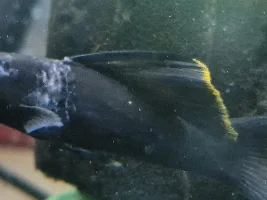
We start with the hard to photograph Bathyaethiops greeni (I think - it came as breuseghemi). The fish so reflective that the flash blots out colour - nice colour. They just look silvery in all photos. It's a high bodied, slightly larger African tetra from the Congo system.
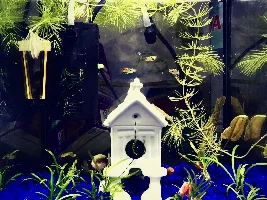
Behind it is a female Microctenopoma congicum, a Congolese species that was born in the fishroom almost 2 years back. Females have poor colour - males in breeding dress are stunners.
Now we come in with a really nice fish. I bought it as Corydoras sp, and it seems to be Hoplisoma brevirostris. I got 6, and lost 3 quickly to shipping damage. For close to a year, the fish were occasionally spotted in the tank. Then I found them again, and got six more, all of whom survived. They are all over their tank and fearless in a group of 9 - really delightful fish. IMHO - pretty too.
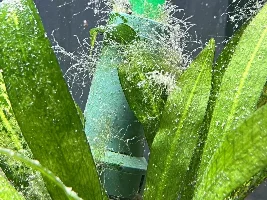
I'm calling special on this poor photograph. This is a tiny Distochodid 'tetra', Neolebias powelli. I got them out of a Nigerian shipment. It's a microfish I've only seen once before, 30 years ago. It's similar to the smallest Bororas species. It really resembles those completely unrelated Asian fish, down to the colour and behaviour. They are shyer, and have taken weeks to begin appearing in their tank. Males are deep red/orange, and females are paler. I like this tiny fish a lot.

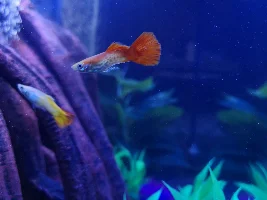
Last for this batch is a West African killifish. It's a lampeye, Procatopus similis. It came in the same Nigerian shipment, ostensibly from the Cross River, the Nigeria/Cameroon border. It has been reported there, but I wouldn't be surprised if the Nigerians bought them from a Cameroon fisherman. This is a fish that needs to grow into its looks. Right now, they're okay, but they will become beautiful, to my eye. I love the mid sized lampeyes of west and central Africa. They are a hair too young for breeding, but I bought as many as I could afford and have shoals in 3 tanks. This is a fish I intend to breed for as long as I keep fish. They are egg shooters, firing eggs at high velocity into cracks in wood and rock in nature, with incredible aim through wildly flowing waters. I use tightly tied acrylic mops. I've bred these and related species before, but have learned that you don't see them often enough to assume you'll ever see them for sale again. I have juveniles of their relatives, Procatopus nototaenia from eggs I bought from Europe, and am hoping for both sexes there.




 So, I live vicariously though you guys for the time being.