
Sick Mollie, Need Help

Byrdman

New Member
Joined
Feb 4, 2010
Messages
15
Reaction score
0
Tank size: 20 gallon
ammonia: 0ppm
nitrite: 0ppm
nitrate: 10-20ppm
tank temp: 80 F

Fish Symptoms (include full description including lesion, color, location, fish behavior):

There's a female mollie in the tank that has had popeye for a few weeks now. I've tried treating it with a full regime of Maracyn I and II, Coppersafe and Maracide, to no avail. Recently, it looks as though it has developed hole in the head, maybe ich. I'm confused as to what to do. Something similar (the hole in the head part) happened to one of my older male mollies, which even after treatment resulted in me having to euthanize him (he was dying anyway, felt horrible letting him suffer slowly, floating near the top of the tank barely moving and turning upside down for a bit). The rest of the fish in the tank are doing pretty good. I can't see any real signs of ich or anything in the others. I changed the tank since the other one died, and this tank is established and flourishing.

Volume and Frequency of water changes: I change about 5 gallons a week but this week.

Chemical Additives or Media in your tank: Just the carbon in the filters. Added Maracide and Coppersafe.

Tank inhabitants: 6 creamsicle lyretail mollies and 2 frys.

Recent additions to your tank (living or decoration): Nothing that wasn't in old tank.

Exposure to chemicals: Maracide and Coppersafe.

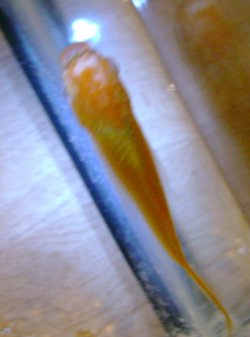
Digital photo (include if possible): Fish Sick.jpg
 
I just want to say, :hi: to TFF!

someone should be able to aid you shortly regarding your fish!

-FHM
 
Forgot to add, that picture isn't in my main tank, I do have crushed coral for my aggregate. The pH is also around 8.2, which may be a bit high. Also, the sick fish still has a hearty appetite, but so did the one that died, even at the end (The only thing that seemed to instill a little fight in 'em)
 
How long did you use maracyn one and two for.
Used far to many meds i'm afraid.

Any fluffy cotton wool on the fish body or fins.
Does it look like bleaching out of the skin.
Columnaris can caused ulceration of the skin.

Hole in the head usually starts of as pitting or spots.

Any signs of flicking and rubbing, excess mucas, darting, erratic swimming, laboured breating.
 
I used Maracyn I and II for one week, as per instructions, but that was weeks ago. No cotton wool anywhere. The skin doesn't look bleached, it looks like the scales on the head are gone. The pitting is kind of there. Its hard to see on the photo, I ended up taking about 20 pictures trying to get one that was easy to see and that was the best I could get. The only erratic behavior from the fish is when its trying to get away from the two males which ALWAYS pester the females trying to mate.

About two or three of the fish were flashing in the old tank, but after the regime of meds they were on that ceased and they now all act pretty normal in the new tank. No mucas or darting unless the mating thing is happening. I wouldn't say any of their breathing was labored, but once in awhile they're up near the top sucking in air with their mouths. I have a feeling I need to get an air stone in there pronto (my old one was a piece of junk, getting a new one after I finish writing this reply.

I feed them mostly tropical flake food, with some blood worms occasionally. Should I change their diet maybe?
 
Does she ever rub her head on the subsrate.

When you used the maracyn was there no improvement.
Any strands coming out of the pitted area.

If you think it is hole in the head, I would buy a hole in the head treatment.

Get you some info first to definately make sure.

Hexamita (a.k.a. Hole-In-The-Head)


Symptoms:

Indications for this disease are small holes in the body, particularly the head. These develop into tubular eruptions. Other symptoms may include yellow strings of mucous, which may trail from the lesions around the head. Sick fish may lose their appetite and become emaciated (sunken belly region). Their colors may fade and pale, stringy feces may also be observed.


Cause:

The flagellate Hexamita. This parasite infects the gallbladder, intestines and blood stream. Fibrosis of the gallbladder may occur as a result of infection. Low-level infestations may exist for quite some time unnoticed. Cichlids and Gourami are the species most commonly afflicted with this disease.


Treatment:

The medication Metronidazole (Flagyl). This infestation is contagious, therefore, all fish in the tank should be treated.
 
Stringy feces was something I just noticed, however no strands that I can see coming out of the pitted head area. However, something new that started today was the fins under her body (the anal fins I guess) appear opaque in color now, and a tad bit ragged. Still eats as much as I feed her. Haven't seen her rub her head in the substrate. When I fed them a second ago she wasn't at the top of the tank eating like the others, was going to the bottom to get what was falling down, not floating. Still ate quite a bit though.

Also, I started treating with penicillin yesterday, which the lady at the tropical fish store place told me to do. I showed her pictures, but she didn't seem like she could pin point the problem.

Symptoms so far
Missing scales on head area. Two holes on top of head near mouth which resemble sinus cavities
scales on side of head before gills inflamed looking. Same side eye has pop eye
anal fins opaque in color, little ragged looking

I keep checking the water quality, its perfect. I did a 20% change yesterday and filled it with water from the fish store. Don't know what to do.
 
I now think that it is Hexamita, since the fish has begun to hide in the corner with its head down. Combine that with the mucus-y poo, the literal hole in the head, and the fact that its still eating its the only thing I can find that fits. I'm going to stop the penicillin and move to the medication you suggested tomorrow.
 
I'm not convinced it is hole in the head.

For some reason it sounds more bacterial to me. I could be wrong.

Have you used the antibiotics in issolation. As they will wipe the beneifical bacteria out in the filter.

Long stringy white poo can be many things from constipation, parasites, bacterial.
What do you feed the fish?
 
Lost any fish to bent spines, or looking skinny, or bloated.


The symtoms you are describing can be anything from columnaris, fish tb, gill flukes.

The symtoms are.
Hole in the head region.
Finrot.
Red inflamed gills.
 
The only fish I've lost is the male mollie a couple months ago from what looked very similar. Now all the fish in the tank have what looks like (I know this sounds funny) dry looking scales on their heads, as though they needed moisturizer (no worries I'm not going to put that on them). I really think that its HITH or something like that. I've continued with the penicilin and am just going to finish the 5 day regime since if I stop early something could become immune to it. I'll put off starting something else till later. Oh, and the gills look fine. Its the scales on the part of the head before the gills that are starting to raise up and look like they're missing, just like how the head part started.
 
After looking at some pictures of fish with columnaris, I think you're right. It looks similar to that, with the area turning white first and then progressing further. I'm wondering then if the penicillin i'm using is the correct medication. Since you do all your responses early in the morning (my time) I'll just wait to hear from you before making any moves. Thank you for your help so far, I'm really worried about all my little mollies. Also, I think that raising the temperature was the worst thing I could have done, since everything seemed to progress faster on the other fish after I did (damnit)
 
Columnaris has so many disguises.
it can also look like peeling flaky skin.
Columanris can present it's self on the head region and affect the gills.

I would carry on with the antibiotics now.
Also raising the temp mulitplys bacteria.

Get you some info on the ideal temp for treating columnaris.

COLUMNARIS The hospital tank should be heated to approx. 74 degrees. 76 and above is the ideal breeding temperature for columnaris. Though there is some dispute over lowering the temperature, my experience has been that 72 is too low for the medication to work rapidly, 76+ causes the disease to breed more rapidly than the anti-biotic can kill, and 74 is "just right." Remember to keep this temperature stable.
 
hey just wanted to say one of my mollies had popeye a while ago all i did was add salt to the water and gave them a little spinich as a supplement and it cleared up with no problems since. if u have'nt already i would get some salt it doesnt bother the other fish and can only improve the mollies health . also ive heard a salt bath will do a sick molly good tho i have no idea of quantities.
 
I'm running a brackish tank, so there's already a ton of salt in there (its halfway between fresh water and salt water). Thanks for the advice though, I considered doing a salt bath for the first sick one but hesitated cause I thought I'd do it wrong.
 

Most reactions

Back
Top