Mixing Barbs

Hathaway

Fish Fanatic
Joined
Mar 11, 2012
Messages
66
Reaction score
4
Location
GB
I'm looking to get a mix of tiger, green tiger and black ruby barbs (probably 3 each). In particular I'd prefer to get just male black ruby barbs due to their colour, but I'm aware that they may not get on (or even display their full colour) if not kept with females. Which leads me to question whether they require female black ruby barbs, or if it's fine if they're kept with female tiger and/or green tiger barbs?
As I've heard that their aggression is best kept in check when in larger groups, would 9 be sufficient given there are only strictly 3 of each kind?
 
I've never kept barbs myself but my Dad is a big fan of them. He had 5 gold barbs and 5 black ruby at one time. Of the black ruby he had 4 females and one male. We never managed to sex the gold barbs. The male ruby would colour up under two circumstances - feeding time and breeding time. Whether he would have coloured up at feeding time if the females wern't there I do not know for certain but I can't see why not.
Tiger barbs are well known for their nippiness, and I've read the green variety is even more nippy. The rubies are said to be more placid but I can tell you that my Dad's gold barbs had no dorsel fins at all - the black rubies removed them fairly quickly. They then set about eating all his plants until there was nothing left. 
 
My gut feeling is that this won't work but someone else may completely disagree. There are a few barbs that are very placid so the nippy barb thing doesn't apply to all from this species. The lovely little cherry barb is a lovely colourful fish with a placid nature. My Dad currently has me researching the Odessa barb and from what I've read these are also more placid and easy going.
 
This is just my personal opinion so feel free to wait for others to reply. I can only speak from what I saw when my Dad had them :)
 
I'm not sure on this to be honest, but I would probably pick one of this species and keep just that. Tiger barbs are notoriously aggressive, and I'm not sure they will school with other species. If they do not, then 3 is not nearly enough to keep aggression down. One will most likely end up getting picked on constantly. Black rubies are great barbs and in my experience with my 11 in a community tank, they don't pick on other fish at all. I also don't know if they will show proper color without females, maybe around feeding time.

I don't know much about green barbs.
 
As Akasha said, this won't work, and for a couple of reasons.
 
First, you have two different species, the Black Ruby Barb. Pethia nigrofasciata, and the Tiger Barb (original and man-made green variety is the same species), Puntius anchisporus.  Both (like all barbs which are cyprinids) are shoaling fish, so each species must have a group of its own.  This is especially true of the Tiger, as having minimum 8 (regular and green is fine) in a 30 gallon/113 litre tank is the minimum, and they would be better with 10-12.  This assumes on their own...I've no idea of your aquarium size; any other fish means a larger tank.
 
The Black Ruby also needs a group, and here I would suggest no less than 8-9, with a mix of male/female roughly half each.  While this is not anywhere near as aggressive as the Tiger, it is still a barb and thus active and rather boisterous, and with such fish it is always safer to have more of them.  I have a group of 19 (six of these are fry that have appeared and survived) with six males and 13 females, more of the latter because interestingly all the fry have been female.  But you need a decent number of males because they interact (regardless of the females) and this is one of the joys of keeping this beautiful species.  To see two males, with a third sometimes attempting to join in, spinning around so fast they are a blur is a joy of the hobby.  And they drive the females, so more females than males is a good idea anyway.
 
I have mine in a 90g with a group (8) of Congo Tetra.  I was prepared to move these out into the 115g should the barbs become troublesome, but they have been together now for two years and not once has a barb even looked at the flowing fins of the Congo to nip.  That would never occur with Tiger Barb, which I had many years ago.  The female Black Ruby is very similar in pattern and colour to the Tiger, so with a decent-sized group of Black Rubys, you have the best of both worlds...the appearance of both species, with none of the aggressive problems.  Though the latter does depend a lot on tank size and numbers, and other tankmates.  Using your number of nine, if all Black Rubys with a mix of gender, you would have a very interesting and beautiful aquarium.  It needs to be at least 3 feet (90cm) in length, as these are very active swimmers, and fast.
 
Akasha mentioned issues with eating plants, and I would surmise that this may be due to the group size.  I have never seen this, and I've had two different groups of this species over the years, but they do pick plant leaves looking for food, and I can see how this might turn to leaf destruction depending upon the plant species and the tank size and especially numbers in the shoal.  My Botia kubotai loaches in this same tank have eaten holes in the swordplant.
 
Byron.

 
Dad's barbs made short work of Amazon swords, crytocoryne (we tried that because it's supposed to taste very bitter and we hoped they'd leave it alone) altnanthera, java ferns and even nibbled anubias. We do have another member that I warned about barbs and plants last year (I can't remember who it was now) that has had his tank decimated by the barbs. But I do suspect Byron may have a point with the shoal size and tank size having something to do with it though.
My Dad's tank is only 2ft and I told him it wasn't big enough for all the barbs. I suspect they were mildly stressed and took that out on the plants and the fins of the gold barbs. He's recently got 6 cherry barbs as he was down to a male platy, the 2 remaining elderly ruby barbs (both females) and an oto. The tank does look bare though and I'm trying to convince him to look at harlequins (he likes my gold headed purple harleys) cardinal tetra's or even a larger shoal of micro rasboras.
 
Ok thanks for your input guys. Think I'll be sticking with Ruby barbs on their own then. I didn't realise they were less aggressive which is interesting.

Edit: just to add the tank is 350 litres and 4 feet wide so hopefully that'll help any potential issues.
 
good luck with them. The ruby barb is a lovely looking fish and I'll keep everything crossed that they leave your plants alone. This seems to be a hit and miss thing, some do some don't. I hope you get one's that don't
smile.png
 
Akasha72 said:
Dad's barbs made short work of Amazon swords, crytocoryne (we tried that because it's supposed to taste very bitter and we hoped they'd leave it alone) altnanthera, java ferns and even nibbled anubias. We do have another member that I warned about barbs and plants last year (I can't remember who it was now) that has had his tank decimated by the barbs. But I do suspect Byron may have a point with the shoal size and tank size having something to do with it though.
My Dad's tank is only 2ft and I told him it wasn't big enough for all the barbs. I suspect they were mildly stressed and took that out on the plants and the fins of the gold barbs. He's recently got 6 cherry barbs as he was down to a male platy, the 2 remaining elderly ruby barbs (both females) and an oto. The tank does look bare though and I'm trying to convince him to look at harlequins (he likes my gold headed purple harleys) cardinal tetra's or even a larger shoal of micro rasboras.
 
Akasha, I very much think you have pin-pointed the issue with those barbs, right on--again 
good.gif
 .  I have elsewhere mentioned the first (to my knowledge) scientific study on the effects of too small a group or too small a space for shoaling fish, and increased aggression was always the outcome, whatever the species; aggressive species (angelfish were used) became considerably nastier, and peaceful species (black neon I think) became rather nasty.  All because of too small a group or too close quarters.  

Hathaway said:
Ok thanks for your input guys. Think I'll be sticking with Ruby barbs on their own then. I didn't realise they were less aggressive which is interesting.

Edit: just to add the tank is 350 litres and 4 feet wide so hopefully that'll help any potential issues.
 
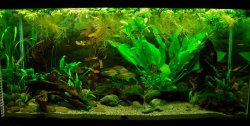
Great, you have the space, this will be spectacular.  I've attached a photo of my 90g with these beauties.
 
I'll just pick up on the barb aggression issue.  As we've been saying here, tank size and numbers in the group have a big impact on aggression.  Barbs are by nature very active (the cherry is perhaps a bit of an oddity here), good swimmers, and they have a strong interaction among each other.  This is something that is a trait of other cyprinids too, thinking here of the loaches which are highly social fish.  But the almost hyper-activity of barbs frequently turns nasty, due to numbers and environment.  As is usually the case, when any fish is provided with that which it "expects" naturally, it can be a very different resident.  These are not small tank fish, and no barb should ever be confined in less than 3 feet of length.  This causes stress, and fish have two ways to deal with this--accept it or fight it.  Neither is good, as accepting it invariably means the fish withdraws and this leads to health issues and a shorter lifespan; and fighting it for the fish means aggression, its only tool.
 
Byron.
 

Attachments

  • 90g Sep 15-15.JPG
    90g Sep 15-15.JPG
    107.9 KB · Views: 300
Beautiful Tank Byron, is it low tech? your plants seem to be doing great, even with the diffused light from what looks a bit like Water Lettuce.
 
Munroco said:
Beautiful Tank Byron, is it low tech? your plants seem to be doing great, even with the diffused light from what looks a bit like Water Lettuce.
 
Thank you very much.  Yes, it is low tech, I have no need for CO2 and I don't want brighter light for the sake of the fish.  It may limit plant options, but I stay with what has worked for more than two decades.  The floaters in this tank are Water Sprite (Ceratopteris cornuta), plus the floating leaves of the red tiger lotus.  I honestly toss out several water sprite plants every water change (weekly); I tend to toss the largest, and allow the daughter plants to develop.  If I miss one week doing this thinning, the next week you cannot even see the water surface, and the water sprite plants on all over top of each other.  I still haven't figured out why this plant grows so fast in this tank, but more slowly in any of the others.  Light and ferts are the same.  B.
 
I believe I am the one Akasha is speaking of, I have 11 black rubies in a four foot long 80 gallon tank, with other fish. They seem completely happy and healthy. Have spawned before. And they eat any stem plant I put in the tank, as well as new leaves on anubias species. The only thing they haven't touched is the sword plants, and they still sometimes nibble baby leaves.

I don't believe I am doing anything wrong by the fish, but they love eating plants.
 
thanks for reminding me jag. I speak to so many different members on this forum and I often get mixed up. My memory isn't good :(
 

Most reactions

Back
Top