Changing Substrate :/

guppiegirlie

Fish Fanatic
Joined
Jul 9, 2015
Messages
148
Reaction score
2
Location
GB
So I have pea gravel substrate at the moment, ranging in size from .5mm to 1.5mm all mixed up.

My platys loved the larger gravel while breeding as the fry tended to hide out in it!

But I would really love, at some point, to add some corys; specifically julii.

I know that my substrate at the moment is unsuitable for the corys soft noses, so what would be best to change over to?

And what is going to be the best way to change in a heavily planted 180 litre established tank!!

Please help me! :mad:
 
I've done this in six tanks over the past couple of years, and the best way is to remove the fish to a temporary tank and then tear down the tank.  The "temporary" can be a smaller tank, I use my 20g that is otherwise a spare used as a QT for new fish acquisitions.  The filter and heater from the main tank can be placed on the back wall (depending what sort of filter, but the point is it can sit in the temp tank so you have no cycling issues).  Some of the plants can be placed floating in the temp tank (a cover is essential and many fish will readily jump out in strange surroundings, I've seen this often with fish left in large buckets).  You want the fish to be at ease, and be able to leave them in this temp tank for more than a day or two just in case.  Use the water from the main tank to fill the temp before netting over the fish; take it from the top.
 
Once you have the fish moved, then remove all the plants (the debris this causes won't matter once the fish are out).  Some can be floated in the temp tank as I mentioned, the rest can go in another small tank or bucket, but must be submersed or they will quickly dry out; no need to "plant" them, just float them in water so they are covered.  Remove the decor (wood, rock, etc).  Some of this can go in the temp tank to provide refuge and hiding places to calm the fish.  Keep all of it wet, so the bacteria on the surface is preserved.  Then drain out all the remaining water, and remove the gravel.  I put this in a bucket to get it out of the way, and deal with it after the tank is re-set.  Wash your sand, place it in the tank, roughly evenly.
 
Add a few inches of tap water, scape the sand how you want it.  You can use some of the decor.  Plant the substrate-rooted plants.  Then drain the water out down to the sand, it will be very dirty with all this digging.  Then carefully fill the tank about 2/3; using a dish, bowl, etc in the tank to run the water into avoids disturbing the sand.  It will still be a bit dirty, but not bad.  Dechlorinate this water as you fill the tank.  I try to get the temp i the main tank as warm or just a tad warmer than the temp tank, as this is less stress than cooler water at this point.  When everything is as you want it, move the filter and heater back.  At this point, I do a 50-60% partial water change in the temp tank, as the parameters between the two tanks will be significant.  Leave the fish for 20-30 minutes, then net them over.
 
Byron.
 
Thank you Byron, I do have a spare, my old 90l but I must say it's been sat a while. I'm sure a good wipe out and it will be fine!

I have the fluval 305 extetnal filter, I did use it on my old tank but have since changed the pipework so an unsure if it will still fit my old set up.

I do have a spare internal filter for emergencies if that would suffice?

And lastly, is there a particular substrate you would recommend? I really like the colour the pea gravel gives my tank, but if I was to change I think black or a darker colour anyway, as it would show off my fishes colours best.

I'm not too keen on sand, I think the thought of repeatedly having to rinse it puts me off and it being so light, it being disrupted each and every water change!

I've been looking about and to be honest I'm slightly overwhelmed by the different types of substrate you can get, but also don't want to get something that looks pretty but is going to affect my water and fish :/
 
I was a large sized gravel user until recently. Sand is actually much easier to maintain. I went with pool filter sand and it required no rinsing. You don't have to vacuum it like you do gravel, either. The debris sits on top of it. With a well planned hardscape and good circulation, nothing will settle. I recently broke down a large tank and was absolutely amazed at how clean the sand was. I transferred some of it to a new set-up and it did not need any rinsing.
 
A temp tank can be a plastic container.  Walmart sells for about 10 bucks or less.  Lowes has some too.  I drilled a hole in mine for the cables.  The clear ones allow you to still see your fish.   Once done, you can put the equipment in the tub and store it away.  Makes a great quarantine or hospital tank later on.
 
I used play sand in my tank, but I wish I has used pool filter sand instead,  It's a more consistent size.  I would still rinse it, but you will not need to rinse it much.  
 
I have the fluval 305 extetnal filter, I did use it on my old tank but have since changed the pipework so an unsure if it will still fit my old set up.

I do have a spare internal filter for emergencies if that would suffice?
 
 
The idea behind using the existing filter in the temp tank is to keep it running, as it is well loaded with bacteria.  You don't need to fix the filter to the temp tank, just hang the intake and outlet tubes over the frame.
 
And lastly, is there a particular substrate you would recommend? I really like the colour the pea gravel gives my tank, but if I was to change I think black or a darker colour anyway, as it would show off my fishes colours best.

I'm not too keen on sand, I think the thought of repeatedly having to rinse it puts me off and it being so light, it being disrupted each and every water change!

I've been looking about and to be honest I'm slightly overwhelmed by the different types of substrate you can get, but also don't want to get something that looks pretty but is going to affect my water and fish
 
 
Substrate is an issue on which there will be many views, but not all of them consider the fish over personal preference of the aquarist.  My aim is always to replicate the natural habitat as best as I can.  The aquarium is not for our use, it is the permanent home of living creatures and denying them what they expect is not the way to go.  Now, we often have to make concessions; you wouldn't want mud substrates, which are certainly authentic for many fish.  But sand or fine gravel can work for most, with some species needing something more specific like sand for corys.
 
I really like pea gravel too, and this is absolutely ideal in a Central American habitat, to create a stream or river aquascape for livebearers, or medium cichlids.  It can also work for some Indian habitats for loaches, though not for the dwarf species which are best with sand.  When it comes to SE Asian and South American fish, sand is about the best substrate; some rivers and stream have sand, others mud for which sand is an acceptable substitute.  We can add dried leaves (oak, beech, maple, Indian almond, etc) which is certainly realistic, and lots of bogwood and branches.
 
When it comes to sand, a darker shade is preferable.  My main objection to pool filter sand is that it is white, and no tropical freshwater fish lives over a white substrate.  The fish expect dark substrates, so provide it; they will be less stressed, more colourful, and healthier as a result.  I tried black once, but it looked more dark grey under the tank lighting, which was fine, but every little speck of detritus stood out.  I've got play sand in six tanks now, and see no reason to ever change.  It took me a while to try sand, but I finally gave in to comments from others.  I liked the dark hue of Quikrete Play Sand, with its mix of black/grey/tan/white grains.  It always looks clean, the fish love digging in it, and plants grow fine.  And it is very inexpensive.  I can change the water and not disturb any of the sand.  I never dig into it, you want and need anaerobic areas anyway.  I do vacuum into the top in a couple tanks, not in others; depends upon the tank, fish, and conditions as each aquarium is different biologically.  It takes a lot of rinsing, but I don't do this; it is after all only dirt, and it will settle.
 
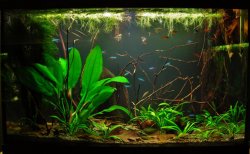
Here's a photo taken just a moment ago of my 29g that I re-set yesterday, so it is still a bit hazy.  But it is about as authentic for the fish species as one can reasonably get.  That's the play sand, with oak leaves, and branches.  A few Helanthium tenellum and one Echinodorus grisebachii [E. bleherae], and floating Water Sprite.
 
Byron.

 

Attachments

  • 29g Aug 2-15.JPG
    29g Aug 2-15.JPG
    103.8 KB · Views: 80
Wow that looks amazing! Ans I tend to agree with Byron on the pool filter sand being too pale for my liking.

But also I live in the UK and the play sand here is very similar in colour to the pool filter sand :(

That sand in your tank Byron is perfect, if only I could get my hands on it!!

I've been having a bit of a mooch about on eBay and have found some black sand, I thought of buying a few colours, black, white and brown and mixing it up see how it turns out.

I have found a darker play sand for dirt cheap (pardon the pun lol) but this is more of an orangey kind of colour.

I just reallt don't want to start shifting my babies about, ripping apart my tank just to hate the outcome! :(
 
I'd have to see it to be certain, but as long as the sand is not white, it can work.  There are ways of minimizing this, like using the dried leaves, lots of chunks of wood (or rock), and floating plants to shade the light so it doesn't reflect up from the substrate.
 
Be careful mixing different colours.  This may sound do-able, but I have never seen any mix that didn't look artificial and un-natural.  All black, all brown, this could be effective; once you mix them, separating them is near impossible.  I think it is CarribSea that make several freshwater sands.
 
And you're right...nothing is more involved that changing the substrate, and at the same time if it turns out that you don't like it, you will never really enjoy the aquarium.  So make sure you get what you want the first time.
 
Unipac make a wide range of sand for aquariums in the UK; the downside is the price. I have BD Trading sand in my tanks; this is fairly light in colour but it does have dark bits in it.
 
Ok so I've been looking about and have a few I kind of like the look of

http://imgur.com/a/gbfXu

The first is the very cheap store brand play sand, the second is a reasonably priced natural sand substrate from ebay, the third is a little more pricey but I think is my favourite and the fourth is just plain aquarium sand by unipac.

My tank is fairly heavily planted with wood and rocky hideaways and some floating plants. I also have a new bigger bit of wood to go in but will do that while changing substrate.

I didn't think changing/choosing substrate would be such a difficult and stressful thing to do! But as I said before, I really don't want to rip my tank up and be disappointed with the outcome :/

Any opinions will be greatly welcomed!!
essjay said:
Unipac make a wide range of sand for aquariums in the UK; the downside is the price.
Really? I've found a couple of sellers (on ebay) who are fairly reasonable between £15 and £30 for a 25kg bag. I thought that was fairly cheap considering I was quoted almost £70 for 20kg of some pretty brown and black sand! (They can keep it for that price lol)
 
The linked product calls itself "gravel," and from photos it is impossible to know the actual grain size, unless there is a photo that says it is actual.  So be careful, esp if buying online; in stores at least you can handle the sand.
 
So the unipac website says the grains are between .8-2mm depending on which type I go for.

My lfs sells the unipac and although it does say gravel on the pack it's actually sand.

The pictures of just the coloured grains are also unipac. But I'm not 100% sure on how to find out the grain size of the play sand, but I assume it will be pretty fine, I bought a bag a few years back fory sons sand tray and can't imagine its changed much
 
guppiegirlie said:
So the unipac website says the grains are between .8-2mm depending on which type I go for.

My lfs sells the unipac and although it does say gravel on the pack it's actually sand.

The pictures of just the coloured grains are also unipac. But I'm not 100% sure on how to find out the grain size of the play sand, but I assume it will be pretty fine, I bought a bag a few years back fory sons sand tray and can't imagine its changed much
 
Yes, any "play sand" is likely going to be much the same in grain size.  These sands are made in machines, and play sand is refined the most of any sand, to avoid roughness, which is why it is so good in aquaria.
 
I would not go with 2mm grain "sand," this is getting large, more what I would term "fine gravel."
 
Firstly I would just like to thank you and everyone else for all your help!

I think I'm going to go with the aquarium silica sand (roughly .8-1mm) it's slightly darker than the silver sand, which would probably be best but it's just too light for my liking.

I might get a bag of the play sand too just to see what it's like as it's so cheap. I'm sure my two year old will find plenty to do with it if I chose not to use it! :D
 

Most reactions

Back
Top